
Running in the dark, safely.
From the end of October, most runs before or after work in the UK start or finish in the dark. This guide covers that part only: being seen, seeing where you are going, and getting home safely.
Quick answer. Use pavements where there are any, and on roads without one keep to the right so you face oncoming traffic, as Rule 2 of the Highway Code says. Wear reflective kit, which Rule 3 says drivers can see "up to three times as far away as non-reflective materials", and carry a light: a head torch to see the ground, small lights to be seen. Choose lit routes you know, and tell someone where you are going and when you will be back.
When does it get dark for runners in the UK?
Earlier than most people expect, especially in the north. The clocks go back on Sunday 25 October, and from then until the turn of the year the light shrinks at both ends of the day. Our guide to the clocks going back covers what changes. For runners, the useful times are not only sunrise and sunset but civil twilight: the period when the sun is less than 6 degrees below the horizon and there is usually still enough natural light to see by.
| 21 December | First light | Sunrise | Sunset | Last light |
|---|---|---|---|---|
| London | 07:23 | 08:03 | 15:53 | 16:33 |
| Manchester | 07:39 | 08:22 | 15:51 | 16:34 |
| Edinburgh | 07:54 | 08:42 | 15:39 | 16:26 |
First and last light are the start and end of civil twilight. All times are calculated for each city centre and can differ by a minute or two from published tables. On the shortest day, a 7am run in Edinburgh starts almost an hour before first light, and a run after a 5pm finish is in full darkness in all three cities.
What does the Highway Code say about running in the dark?
Runners on roads and pavements are pedestrians, so the pedestrian rules apply. Three of them matter most after dark.
Rule 1: use the pavement and stay alert.
Pavements and footways "should be used if provided", and the rule adds: "Always remain aware of your environment and avoid unnecessary distractions."
Rule 2: no pavement, keep right.
"If there is no pavement, keep to the right-hand side of the road so that you can see oncoming traffic." The rule asks for extra care and single file "especially on narrow roads or in poor light", and notes that it may be safer to cross well before a sharp right-hand bend so oncoming traffic can see you, then cross back after it.
Rule 3: help other road users to see you.
In poor daylight, "wear or carry something light-coloured, bright or fluorescent." When it is dark, use reflective materials such as armbands, sashes, waistcoats, jackets and footwear, "which can be seen by drivers using headlights up to three times as far away as non-reflective materials."
One more is worth knowing if you run with a club. Rule 5, written for organised walks on the road, says: "At night, the look-out in front should show a white light and the one at the back a red light." It is a sensible pattern for a running group too.

What is the best light for running in the dark?
A light does two jobs, and most runners need both.
- A light to see by. A head torch or a chest-mounted light shows you kerbs, potholes, roots and puddles. It is essential on unlit paths and trails, and useful on any street where the lighting is patchy. Welsh Athletics suggests a running head torch and light "to ensure not only you can see the path ahead, but others can see you too."
- Lights to be seen by. Small clip-on lights, steady or flashing, make you visible from a distance on lit roads where a head torch adds little. Following the Highway Code's pattern for groups, white at the front and red at the back tells a driver which way you are facing.
A few practical points. Angle a head torch down at the ground a few strides ahead, so it lights your path without dazzling people coming towards you. Charge lights after every run. On long or rural runs, carry a small backup. And add reflective strips to the parts of you that move, such as ankles and wrists.
How do I choose a route for running in the dark?
Pick it before you leave, not on the way. The running safety guidelines published by UK Athletics and the home country federations advise running in daylight where possible, and otherwise staying on well-lit routes or using a head torch. Welsh Athletics says to "stick to well-lit routes to reduce your risk of tripping or stumbling."
- Lit and familiar. Save new routes and off-road paths for weekend daylight. In the dark you want ground you already know.
- Pavements over lanes. A country lane with no pavement is where Rule 2 matters most, and where drivers least expect a runner.
- Short loops. Laps of a lit park edge or a block near home keep you close to help and let you cut the run short.
- Not the same every day. The UKA guidelines suggest not keeping exactly the same routine, such as always running the same route at the same time, and Welsh Athletics gives the same advice.
For clothing, warming up and running on frost and ice, see our guide to running through a UK winter.
How do I stay safe running alone in the dark?
UK Athletics refreshed its safety guidance in 2021 after high-profile cases of runners being harassed while training. Announcing it on the England Athletics site, UKA's development director spoke of "harassment of runners, particularly female runners". The advice applies to everyone. Before you go:
- Tell someone where you are likely to be running and roughly when you will be back, and share the route if you can.
- Take a phone, but keep it out of sight. If anyone tries to take it, the guidance is clear: "a phone can always be replaced."
- Think about headphones. Consider whether they increase your risk on the route you have chosen. If you wear them, the guidelines suggest bone conduction headphones so you can still hear what is around you. Welsh Athletics advises a low volume.
- Consider the what3words app, which the guidelines note is used by emergency services to find your exact position, especially in rural areas.
- Run with others when you can. A running club or a local group is the simplest safety step there is.
If someone harasses you during a run, the UKA guidance says not to react or return the behaviour, to keep moving and stay calm, to find another member of the public and explain what is happening, and to change direction if you are being followed. Call 999 if you are in immediate danger, and report it to the police on 101 afterwards if not. As Welsh Athletics puts it: "Trust your instincts. They're probably right."
Where Immufix fits.
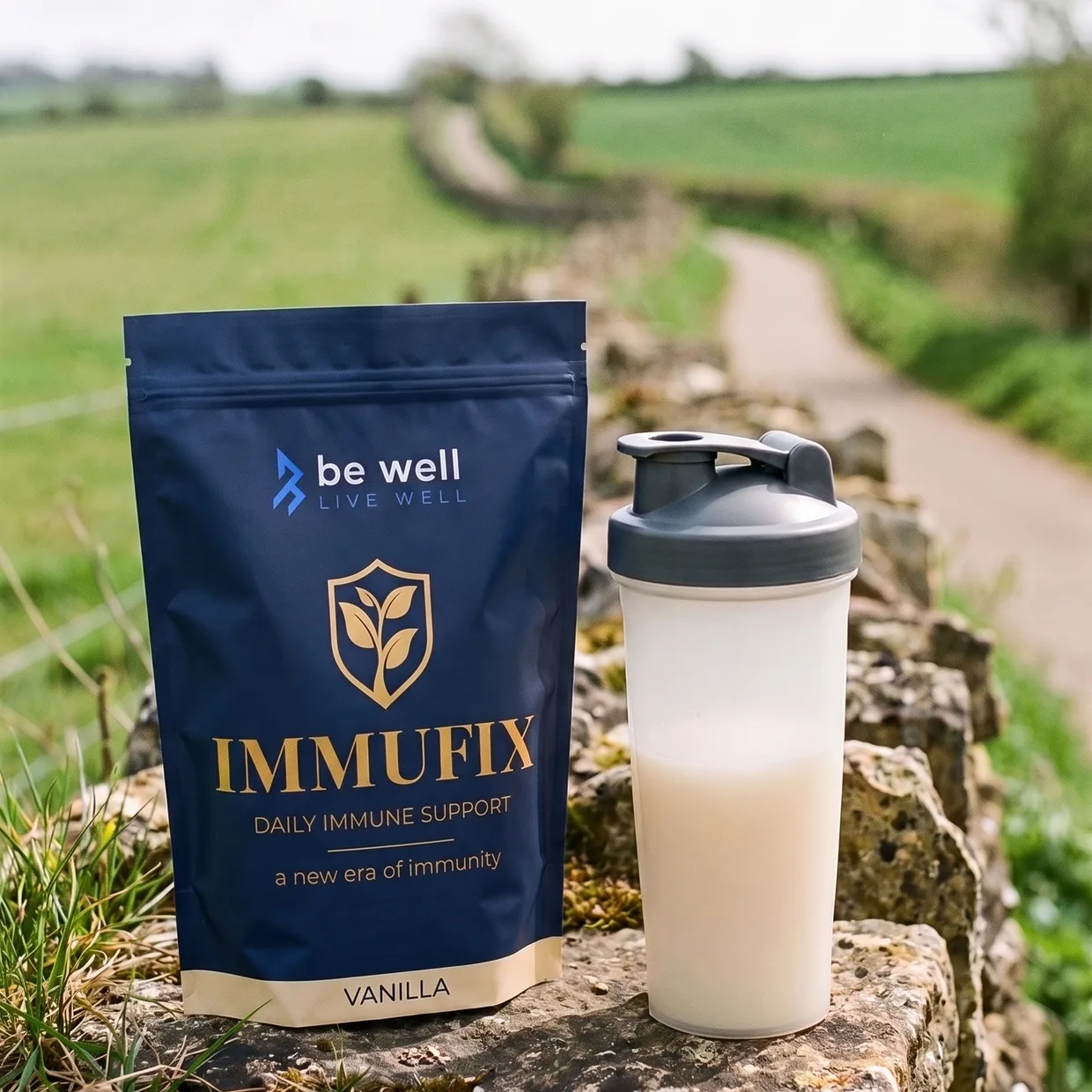
Dark mornings make routines harder to keep, which is why many runners put the small daily things on autopilot. Immufix is one 25g scoop in around 200ml of water, once a day, and fits with breakfast before or after a run (here is what to eat before a morning run). Riboflavin, niacin, pantothenic acid, vitamin B6 and magnesium contribute to normal energy-yielding metabolism and to the reduction of tiredness and fatigue, and magnesium also contributes to normal muscle function. Every amount is on the science page.
The short version.
- Use the pavement. With no pavement, keep right and face oncoming traffic (Highway Code Rule 2).
- Wear reflective kit after dark. Drivers can see it up to three times as far away (Rule 3).
- Carry a head torch to see and small lights to be seen: white at the front, red at the back.
- Stick to lit, familiar routes, and vary your routes and times.
- Tell someone your route and return time, take a phone, and keep your hearing free.
Food supplements should not be used as a substitute for a varied, balanced diet and a healthy lifestyle. If you have a medical condition, are pregnant, breastfeeding or taking medication, speak to your GP or pharmacist before taking any food supplement.

Daily Immune Support
Vitamins, minerals and plant nutrients in one daily scoop. The formula Paula Radcliffe has taken every day since 1998.
4.8 out of 5 · 89 reviewsDispatched the same day on weekday orders placed before 2pm.
Free standard UK delivery. Royal Mail 48 tracked, 2 to 3 working days. UK addresses only.
30‑day money-back guarantee. Try your first pouch of IMMUFIX for up to 30 days. If it’s not for you, we’ll refund your first qualifying pouch, less £10 shipping and handling. First purchase only. T&Cs apply.
Checkout completes securely on immufix.com
More from the journal.

Carb loading for a marathon, in grams.
How many carbs to eat before a marathon: 10 to 12g per kg a day for 36 to 48 hours, 1 to 4g per kg on race morning, with a calculated UK day of meals.
10 October 2026 · 6 min readCouch to 5K, started in winter.
Couch to 5K in winter: how the free NHS 9-week plan works, three runs a week, and how to fit it around dark mornings, short days, cold and rain.
10 October 2026 · 7 min readA half marathon nutrition plan, from the week before.
A half marathon nutrition plan for the week before, the night before, race morning, during the run and after, with sourced carbohydrate amounts.
10 October 2026 · 6 min read