
Running through a UK winter, properly.
The clocks go back on Sunday 25 October. From then until March, most weekday runs in the UK happen in the dark. None of that has to stop you. It just changes how you go about it.
Quick answer. From late October to March most weekday runs in the UK happen in the dark. Wear reflective kit and a light, choose lit routes with pavements, layer up so you are warm by the second mile, and shorten your stride on frost and wet leaves. A fixed routine does more than motivation.
The dark is the real change.
Temperature gets the attention, but daylight is what reshapes a winter running week. On 21 December London gets 7 hours 50 minutes of daylight, Manchester 7 hours 28 minutes and Edinburgh just under 7 hours. In June London gets more than twice that.
If you run before or after work, plan on doing it in the dark, and plan the route for it: lit streets, pavements, and loops you know well enough to spot a change in the surface.
Be seen.
The Highway Code is written for every pedestrian, and runners are pedestrians. Rule 3 asks you to "wear or carry something light-coloured, bright or fluorescent in poor daylight conditions", and in the dark to use reflective materials such as armbands, sashes, jackets and footwear, which "can be seen by drivers using headlights up to three times as far away as non-reflective materials."
Fluorescent colours work in daylight and dusk. Reflective strips only work when a light hits them. In the dark you want reflective kit, ideally on the parts of you that move, like ankles and wrists, plus a small light of your own.
On roads without a pavement, Rule 2 applies: "keep to the right-hand side of the road so that you can see oncoming traffic." The same rule asks for extra care in poor light and on narrow roads, and for single file if you are running with someone.
What to wear.
Dress for the second mile, not the first minute. If you feel comfortable standing at the door, you will be too warm ten minutes in. Most runners settle on a simple system:
- A base layer that moves sweat away from the skin. Cotton holds it and stays wet.
- A light windproof or waterproof layer on top for wet and windy days, which in a UK winter is most of them.
- Hat and gloves. They are the easiest layers to take off and carry once you warm up.
- Tights or long shorts, depending on how much you feel the chill in your legs.
- Shoes with grip. A trail shoe or a road shoe with a deeper tread copes better with wet leaves and mud.

Warm up before you head out.
On a dark morning it is tempting to go from the warm house straight into a hard effort. Five to ten minutes of easy movement indoors first, then a gentle opening mile, makes the rest of the run feel much better. Save any fast work for the middle of the session, when you are properly warm.
Frost, ice and wet leaves.
When the ground is slippery, shorten your stride and keep your feet under you. Pace matters less than footing on those days. Pavements under trees, painted road markings, metal drain covers and wooden bridges are the places to slow right down. If it is properly icy, move the session to a treadmill, a track, or a different day. One missed run costs you nothing.
Drink, even when it is chilly.
You notice thirst less in winter, but you still sweat under layers. Drink normally through the day and have water ready for when you get back, especially after a long run.
Make the routine do the work.
Motivation dips when it is dark at 4.30pm. Routine does not. A few things help:
- Fix the days. Decide on Monday which mornings or evenings you will run, the same way you would book a meeting.
- Lay the kit out the night before. Half the battle on a dark morning is the first five minutes.
- Run with someone. A running club or a friend makes it much harder to skip, and safer in the dark. A Saturday parkrun gives the week a fixed point.
- Have a spring goal. A race in March or April gives the winter miles a purpose.

What consistency looks like.
Paula Radcliffe set the women's marathon world record of 2:15:25 in London in April 2003, and it stood for 16 years. Records like that come from years of ordinary training weeks done well, through every season. She has also taken the same daily scoop, the formula that became Immufix, every morning since 1998. You can read more about that in Paula's own account and in our piece on Paula's Run Club podcast.
Where Immufix fits.
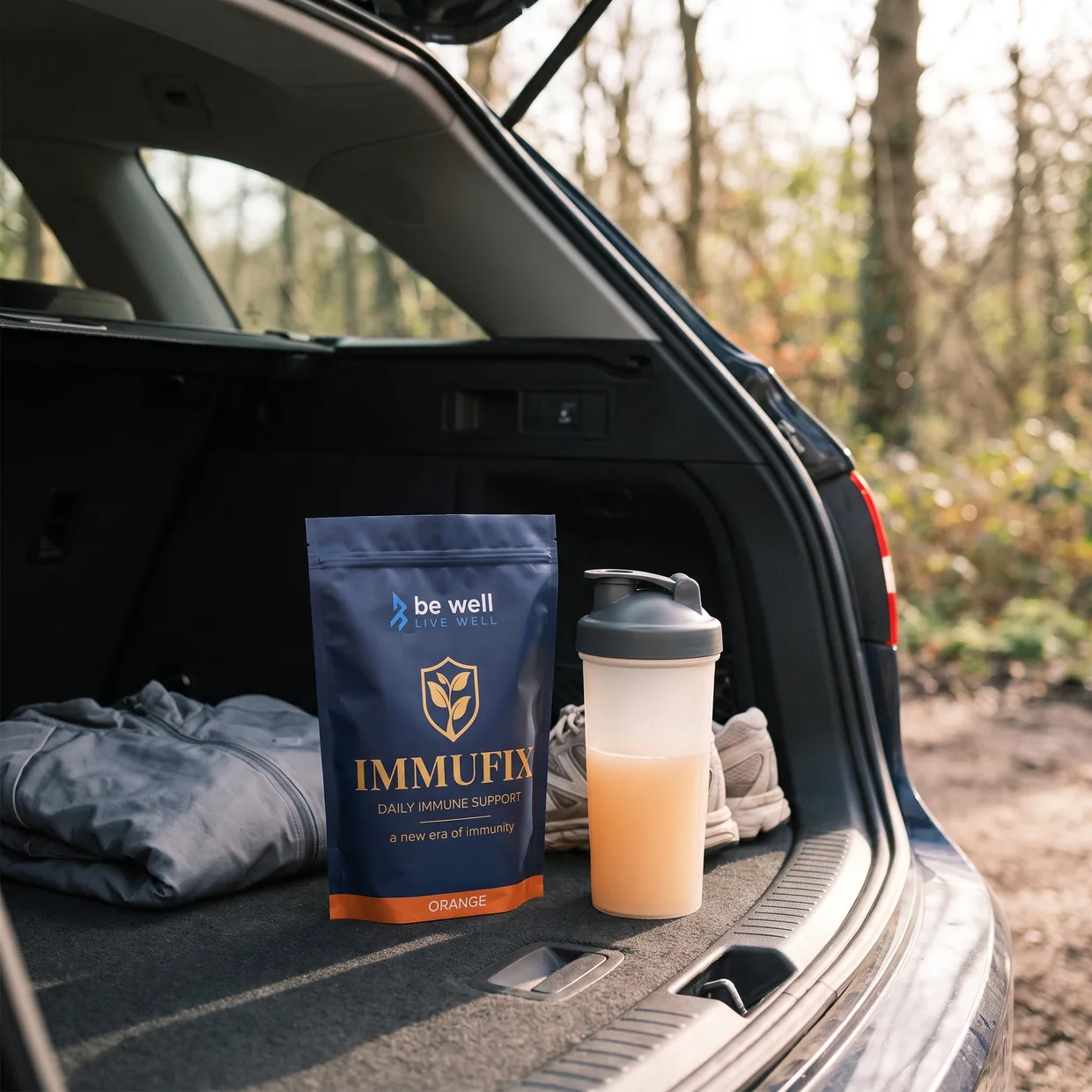
Immufix is one 25g scoop in water, once a day, and many runners take it in the morning so the habit sticks. B vitamins and magnesium contribute to normal energy-yielding metabolism and to the reduction of tiredness and fatigue. Magnesium also contributes to normal muscle function. Every ingredient and amount is on the science page, and you can see the product here.
Food supplements should not be used as a substitute for a varied, balanced diet and a healthy lifestyle. If you have a medical condition, are pregnant, breastfeeding or taking medication, speak to your GP or pharmacist before taking any food supplement.

Daily Immune Support
Vitamins, minerals and plant nutrients in one daily scoop. The formula Paula Radcliffe has taken every day since 1998.
4.8 out of 5 · 89 reviewsDispatched the same day on weekday orders placed before 2pm.
Free standard UK delivery. Royal Mail 48 tracked, 2 to 3 working days. UK addresses only.
30‑day money-back guarantee. Try your first pouch of IMMUFIX for up to 30 days. If it’s not for you, we’ll refund your first qualifying pouch, less £10 shipping and handling. First purchase only. T&Cs apply.
Checkout completes securely on immufix.com
More from the journal.

Carb loading for a marathon, in grams.
How many carbs to eat before a marathon: 10 to 12g per kg a day for 36 to 48 hours, 1 to 4g per kg on race morning, with a calculated UK day of meals.
10 October 2026 · 6 min read
Couch to 5K, started in winter.
Couch to 5K in winter: how the free NHS 9-week plan works, three runs a week, and how to fit it around dark mornings, short days, cold and rain.
10 October 2026 · 7 min readA half marathon nutrition plan, from the week before.
A half marathon nutrition plan for the week before, the night before, race morning, during the run and after, with sourced carbohydrate amounts.
10 October 2026 · 6 min read