
How much protein you need each day.
The UK reference is 0.75g of protein for every kilogram you weigh, which the government tables set at 55.5g a day for men and 45g for women. Most adults in the UK already eat more than that.

Quick answer. The UK Reference Nutrient Intake (RNI) for protein "is 0.75g of protein per kilogram body weight per day for adults", according to the British Nutrition Foundation. The UK Government Dietary Recommendations set that at 55.5g a day for men aged 19 to 64 and 45.0g for women. By our calculation, an adult who weighs 70kg needs 52.5g a day. The British Dietetic Association puts athletes in strength and endurance sports at about 1.4 to 2.0g per kg.
How much protein a day do adults need in the UK?
The British Nutrition Foundation gives the UK figure as a rate: "The Reference Nutrient Intake (RNI) is 0.75g of protein per kilogram body weight per day for adults". The UK Government Dietary Recommendations, published by Public Health England in August 2016, turn that rate into grams a day. In the document's own words, its "Protein figures were obtained from Dietary Reference Values for Food Energy and Nutrients for the United Kingdom (1991)."
- Men aged 19 to 64: 55.5g a day.
- Women aged 19 to 64: 45.0g a day.
- Men aged 65 and over: 53.3g a day.
- Women aged 65 and over: 46.5g a day.
How much protein do I need per kg of body weight?
Multiply your weight in kilograms by 0.75. The gram figures above were based on average body weights at the time, and the BNF adds "(note that this was in 1991 and that average body weights now are likely to be higher)". Working from your own weight gives a closer number. These amounts are calculated at 0.75g per kg:
| Body weight | Protein per day |
|---|---|
| 50kg | 37.5g |
| 60kg | 45g |
| 70kg | 52.5g |
| 80kg | 60g |
| 90kg | 67.5g |
| 100kg | 75g |
The BNF says the headline recommendations are based "on bodyweights of 75kg for men and 60kg for women". If you weigh more or less than that, the per kg figure is the one to use.
How much protein do children and older adults need?
The government tables set a figure for every age band. These are the daily amounts, in grams:
| Age | Males, per day | Females, per day |
|---|---|---|
| 1 to 3 years | 14.5g | 14.5g |
| 4 to 6 years | 19.7g | 19.7g |
| 7 to 10 years | 28.3g | 28.3g |
| 11 to 14 years | 42.1g | 41.2g |
| 15 to 18 years | 55.2g | 45.0g |
| 19 to 64 years | 55.5g | 45.0g |
| 65 to 74 years | 53.3g | 46.5g |
| 75 years and over | 53.3g | 46.5g |
Women over 65 have a slightly higher figure than younger women, and men over 65 a slightly lower one. The BNF table adds 6g a day in pregnancy, 11g a day while breastfeeding a baby up to 6 months old, and 8g a day after that. If you are pregnant or breastfeeding and have questions about your diet, ask your midwife, GP or a registered dietitian.
Do runners and gym-goers need more protein?
Regular exercise on its own does not change the figure much. The BNF says: "People who do some physical activity, like going for a run or to an exercise class are unlikely to need any extra protein."
Training hard is different. The British Dietetic Association's guide to sport and exercise nutrition says: "Athletes participating in strength and endurance sports have a higher requirement for protein (approximately 1.4-2.0 g/kg/day) than people who don’t exercise (0.75 g/kg/day)." By our calculation, that is 98g to 140g a day for a 70kg athlete, against 52.5g at the standard rate.
Timing comes into it too. The BNF notes that "People doing an intensive exercise programme may benefit from consuming protein after a workout, and spacing protein intakes throughout the day." Our guide to what to eat after a run turns that into meals.
Which UK foods are high in protein?
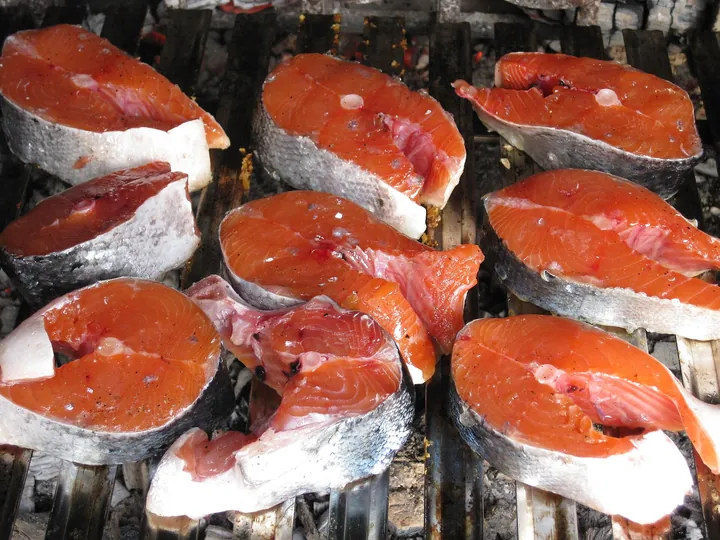
The BNF says: "The UK Government Eatwell Guide includes the following foods as examples of protein sources: beans, peas, lentils, meat, fish, nuts and eggs." The UK government's food composition data, CoFID 2021, gives these amounts per 100g:
- Chicken breast, grilled, without skin: 32g.
- English Cheddar: 25.4g.
- Tuna, canned in brine, drained: 24.9g.
- Salmon, farmed, grilled: 24.6g.
- Eggs, boiled: 14.1g.
- Red lentils, boiled: 8.1g.
- Tofu, steamed: 8.1g.
By our calculation, 150g of grilled chicken breast provides 48g of protein, and 200g of boiled red lentils provides 16.2g. Plant foods carry less per 100g, so portions and variety matter more on a vegetarian or vegan diet. According to the BNF, the foods that supply most of the protein eaten in the UK are "meat and meat products (34%), cereals and cereal products (24%) and milk and milk products (13%)." The longer list, with cheap and plant-based picks, is in our guide to high protein foods.
Can you eat too much protein?
Most adults in the UK already eat more than the RNI. The BNF says "men are eating about 85g and women about 67g of protein a day".
No UK upper limit has been set. The BNF explains that "in the absence of enough data to establish an upper limit, the Department of Health advised adults should avoid protein intakes which are more than twice the RNI." By our calculation, twice the RNI is 1.5g per kg, or 105g a day for a 70kg adult. If you train for a sport and aim higher than that, agree the target with a sports dietitian.
Food labels use their own yardstick. For labelling, "the reference intake for protein of an average adult (8400kJ/2000kcal) is 50g/day", the BNF says. Our guide to what NRV means explains how labels use reference values like this.
Where Immufix fits.
Food comes first, and protein comes from food. Immufix is one scoop (25g) in around 200ml of water, once a day. Each scoop has 2.1g of protein and 75 kcal, a small part of the daily figures above, so it is a vitamin and mineral powder rather than a protein product. Each scoop provides 3.75mg of zinc (38% of the NRV) and 50µg of chromium (125% of the NRV). Zinc and chromium contribute to normal macronutrient metabolism. Every amount in the formula is on the science page.
The short version.
- The UK RNI for adults is 0.75g of protein per kg of body weight a day.
- The government tables set that at 55.5g a day for men aged 19 to 64 and 45g for women.
- For your own figure, multiply your weight in kg by 0.75. At 70kg that is 52.5g.
- Athletes in strength and endurance sports need about 1.4 to 2.0g per kg, according to the BDA. Regular runs and classes alone are unlikely to need extra.
- Most UK adults already eat more than the RNI, and the Department of Health advised staying under twice the RNI.
Food supplements should not be used as a substitute for a varied, balanced diet and a healthy lifestyle. If you have a medical condition, are pregnant, breastfeeding or taking medication, speak to your GP or pharmacist before taking any food supplement.


Daily Immune Support
Vitamins, minerals and plant nutrients in one daily scoop. The formula Paula Radcliffe has taken every day since 1998.
4.8 out of 5 · 89 reviewsMonthly subscription. £52.00 is charged every month until you cancel. Minimum three payments, then cancel any time. Subscription terms
New here? 20% off your first order with code TRYIMMUFIX. Apply it
Dispatched the same day on weekday orders placed before 2pm.
Free standard UK delivery. Royal Mail 48 tracked, 2 to 3 working days. UK addresses only.
30‑day money-back guarantee. Try your first pouch of IMMUFIX for up to 30 days. If it’s not for you, we’ll refund your first qualifying pouch, less £10 shipping and handling. First purchase only. T&Cs apply.
Checkout completes securely on immufix.com
More from the journal.
How much selenium you need each day.
The NHS says men need 75µg of selenium a day and women 60µg. UK figures for every age, the 350µg supplement line and how to add up your products.
10 October 2026 · 6 min read
How much iron you need each day.
The NHS says men need 8.7mg of iron a day and women aged 19 to 49 need 14.8mg. UK figures for every age, iron-rich foods and the 17mg supplement line.
7 November 2026 · 6 min read
How much vitamin B12 you need each day.
The NHS says adults need about 1.5 micrograms of vitamin B12 a day. UK figures by age, the best foods, vegan sources and the 2mg supplement line.
7 November 2026 · 6 min read