
What to eat after a run.
After most easy runs, your next ordinary meal does the job. After a long run, a hard session or a race, or when you train again the next morning, what you eat and how soon starts to matter more.
Quick answer. Eat carbohydrate with some protein, and drink to replace what you sweated out. The British Dietetic Association advises that after exercise you "start replenishing glycogen stores immediately with a high carbohydrate snack or meal", and the IOC consensus statement on sports nutrition says foods or drinks providing "15-25 g" of high-quality protein after each training session maximise the body's protein building. Simple UK options include beans on toast, cereal with milk, eggs on a bagel, or Greek yoghurt with bananas.
What should I eat after a run?
A meal or snack with three things in it: carbohydrate, protein and fluid. Carbohydrate refills the glycogen your muscles burned. Protein supplies the building blocks your muscles use as they adapt to training. Fluid replaces sweat, which you lose even in winter under layers.
The BDA's sport and exercise fact sheet gives the everyday version: "Have protein and carbohydrate-rich foods on your plate at all meals." Muscles store carbohydrate as glycogen, and the fact sheet notes that "stores are limited and need to be topped up frequently, particularly if exercising daily or at high intensity."
How much effort this needs depends on how much you run. For someone on a general fitness programme, the BDA says carbohydrate needs "can be met by eating a normal healthy diet". If you run three or four times a week, a balanced breakfast, lunch or dinner after your run is usually enough. The more you train, the more the timing and amounts below start to count.
How soon after a run should I eat?
Soon, if you are training again within a day, and at your next meal if you are not. The BDA's advice is to "start refuelling with carbohydrate-rich foods and fluids as soon as possible after exercise" when quick recovery is required, and adds: "This is important if you are performing repeated bouts of training or competition within short time periods."
For protein, the International Society of Sports Nutrition's position stand on nutrient timing states that "post-exercise ingestion (immediately to 2-h post) of high-quality protein sources stimulates robust increases" in muscle protein synthesis. For carbohydrate, it says that when glycogen must be restored in less than four hours, one option is "aggressive carbohydrate refeeding (1.2 g/kg/h)". For a 70kg runner, that is about 84g of carbohydrate an hour, calculated. That level is meant for athletes with less than four hours before their next session, not for a Sunday long run followed by a rest day.
How much carbohydrate do I need after a run?
It depends on your whole week more than on one run. The BDA sets daily carbohydrate needs by training load:
| Training (BDA) | Carbohydrate a day | 70kg runner (calculated) |
|---|---|---|
| Light to moderate activity, 1 to 2 hours, 3 to 5 times a week | 3 to 5g per kg | 210 to 350g |
| 2 to 3 hours a day of intense activity, 5 to 6 times a week | 5 to 8g per kg | 350 to 560g |
| 3 to 6 hours a day, 1 to 2 daily workouts, 5 to 6 days a week | 8 to 10g per kg | 560 to 700g |
The BDA adds that these figures "should be fine-tuned" to the individual. The BDA also lists foods that each provide about 50g of carbohydrate, a handy unit for building a post-run meal. They include two slices of thick sliced bread, one bagel, a large bowl (60g) of breakfast cereal, one large potato, 150 to 160g of cooked pasta, rice or noodles, and two medium-large bananas.
How much protein should I eat after a run?
About 15 to 25g in the meal after your run is a good target, from food. That is the amount in the IOC consensus statement, which says "ingestion of foods or drinks providing 15-25 g of such protein after each training session will maximise the synthesis of proteins". The ISSN gives a similar range of 20 to 40g per serving, or 0.25 to 0.40g per kg of body weight.
The whole day matters more than the post-run snack. The BDA puts protein needs for people in endurance and strength sports at about 1.4 to 2.0g per kg a day, against 0.75g for people who do not exercise, and says that "in most cases, providing energy requirements are met, a healthy, balanced diet should provide enough protein". It advises spreading protein evenly through the day. Each of these, according to the BDA, provides about 20g of protein:
- Three medium eggs
- One small chicken breast (75g cooked)
- A small can (100g) of tuna or salmon
- Half a 450g pot of Greek yoghurt
- Half a 300g pot of low-fat cottage cheese
- A large (400g) can of baked beans
- A pint (600ml) of semi-skimmed milk

What is the best recovery food after running?
There is no single best food. The best post-run meal is one that gives you carbohydrate and protein together and that you will actually eat when you get in. Pairing one item from each of the BDA's lists gives roughly 50g of carbohydrate and 20g of protein:
| Post-run meal | About 50g carbohydrate | About 20g protein |
|---|---|---|
| Eggs on a bagel | One bagel | Three medium eggs |
| Jacket potato with tuna | One large potato | Small can (100g) of tuna |
| Chicken and rice | 150 to 160g cooked rice | One small chicken breast |
| Yoghurt and bananas | Two medium-large bananas | 225g Greek yoghurt |
| Cereal and milk | Large bowl (60g) of cereal | 600ml semi-skimmed milk |
Totals are approximate. Each food is listed by the BDA for its carbohydrate or its protein, and most also contain some of the other. Beans on toast works the same way: two thick slices of bread and a can of beans. If you are not hungry straight after a hard run, start with something small and easy, such as a glass of milk or a banana, and eat properly within the next couple of hours. For the other end of the run, see what to eat before a morning run.
What should I drink after a run?
Water, plus some salt from food. The IOC consensus statement says: "During recovery from exercise, rehydration should include replacement of both water and salts lost in sweat." The BDA advises restoring hydration "as soon as possible afterwards to replace water and salts lost in sweat", and gives a simple rule for the rest of the day: drink to "just stay ahead of thirst." A savoury meal provides some salt. Milk counts towards both your fluid and your protein.
Where Immufix fits.
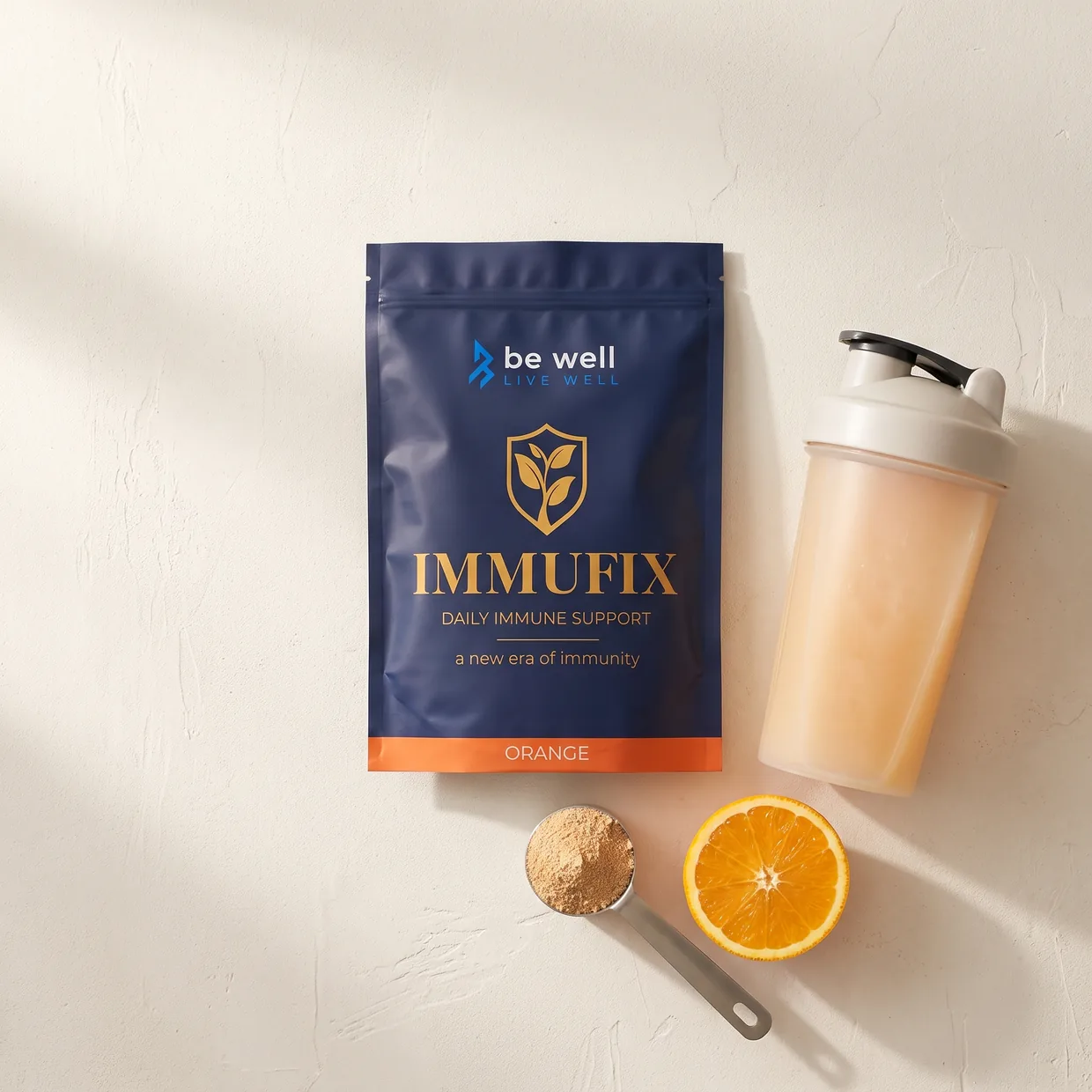
Immufix is not a recovery food. One 25g scoop has 2.1g of protein and 13.2g of carbohydrate, well short of the 15 to 25g of protein and roughly 50g of carbohydrate above, and as the BDA puts it, "supplements will not compensate for poor food choices". It is one scoop in around 200ml of water, once a day, alongside the meal. Magnesium contributes to normal muscle function and to electrolyte balance. Pantothenic acid, vitamin B6 and folic acid contribute to the reduction of tiredness and fatigue. For more on nutrients and training, see vitamins for runners. Every amount is on the science page.
The short version.
- After a run, eat carbohydrate and protein together, and drink to replace sweat.
- Aim for about 15 to 25g of protein in the next meal, as the IOC consensus suggests.
- Eat soon if you train again within a day. Otherwise your next normal meal is fine.
- Easy pairings: eggs on a bagel, tuna jacket potato, chicken and rice, yoghurt and bananas, cereal and milk.
- Your whole day of eating matters more than the first snack after the run.
Food supplements should not be used as a substitute for a varied, balanced diet and a healthy lifestyle. If you have a medical condition, are pregnant, breastfeeding or taking medication, speak to your GP or pharmacist before taking any food supplement.

Daily Immune Support
Vitamins, minerals and plant nutrients in one daily scoop. The formula Paula Radcliffe has taken every day since 1998.
4.8 out of 5 · 89 reviewsDispatched the same day on weekday orders placed before 2pm.
Free standard UK delivery. Royal Mail 48 tracked, 2 to 3 working days. UK addresses only.
30‑day money-back guarantee. Try your first pouch of IMMUFIX for up to 30 days. If it’s not for you, we’ll refund your first qualifying pouch, less £10 shipping and handling. First purchase only. T&Cs apply.
Checkout completes securely on immufix.com
More from the journal.
Carb loading for a marathon, in grams.
How many carbs to eat before a marathon: 10 to 12g per kg a day for 36 to 48 hours, 1 to 4g per kg on race morning, with a calculated UK day of meals.
10 October 2026 · 6 min read
Couch to 5K, started in winter.
Couch to 5K in winter: how the free NHS 9-week plan works, three runs a week, and how to fit it around dark mornings, short days, cold and rain.
10 October 2026 · 7 min read
A half marathon nutrition plan, from the week before.
A half marathon nutrition plan for the week before, the night before, race morning, during the run and after, with sourced carbohydrate amounts.
10 October 2026 · 6 min read