
Carb loading for a marathon, in grams.
Carb loading means eating far more carbohydrate than usual for a day or two before a long race. The amounts are larger than most people expect, so it helps to see them as real meals.

Quick answer. For a marathon, a 2019 review of endurance nutrition, drawing on the joint position of the American College of Sports Medicine and two dietetic bodies, gives 10 to 12g of carbohydrate per kg of body weight a day for the 36 to 48 hours before the race. For a 70kg runner that is 700 to 840g a day (calculated). On marathon morning the same review gives 1 to 4g per kg, 1 to 4 hours before the start, which is 70 to 280g for a 70kg runner.
How many carbs do you need for a marathon?
It depends on your body weight, because the guidance is set per kilogram. The review's figures for events lasting more than 90 minutes are:
- Carb loading: 10 to 12g per kg a day, over the 36 to 48 hours before the race.
- Race morning: 1 to 4g per kg, 1 to 4 hours before the start.
- During the race: 60 to 70g an hour for efforts over 2.5 hours, and up to 90g an hour if you can tolerate it.
Here is what the first two come to at common body weights.
| Body weight | Carb loading, per day | Race morning |
|---|---|---|
| 55kg | 550 to 660g | 55 to 220g |
| 60kg | 600 to 720g | 60 to 240g |
| 70kg | 700 to 840g | 70 to 280g |
| 80kg | 800 to 960g | 80 to 320g |
Calculated from the review's per-kg ranges. For comparison, the British Dietetic Association puts everyday needs at 3 to 5g per kg for keeping active and 5 to 8g per kg for 2 to 3 hours of intense training a day.
What is carb loading, and why does it work?
Your muscles and liver store carbohydrate as glycogen. The BDA notes that "Stores are limited and need to be topped up frequently". A marathon is long enough to run them low, which is one reason runners talk about hitting the wall late in the race.
Carb loading fills those stores beyond their usual level before you start. The 2019 review says that for events over 90 minutes, loading in the 36 to 48 hours before may improve performance by 2 to 3%. The old method of running yourself empty first is no longer needed. The review notes that a single day of high intake, at 10 to 12g per kg, after short hard exercise or even complete rest, achieves the same result, and that the higher stores hold for about three days.
That suits a taper. The official London Marathon beginner plan advises runners in week 14 of 16 to "increase the proportion of carbohydrate in your diet but not overall calories". Total intake climbs in the final 36 to 48 hours.
What does a carb loading day look like?
Bigger than a normal day, with most of it coming from white bread, pasta, cereal, fruit, juice and sweet foods. The review suggests fat can be limited while loading. A review of stomach complaints in athletes links fibre, fat, protein and fructose with a greater risk of gut symptoms, so lighter, lower-fibre choices make the volume easier to manage.
This sample day is for a 70kg runner. Every figure is calculated from CoFID 2021, the UK government's food composition dataset. Liquids are counted at 1g per ml.
| Meal | What | Carbohydrate (calculated) |
|---|---|---|
| Breakfast | 60g cornflakes with 250ml semi-skimmed milk, a plain bagel (85g) with 20g jam, 500ml orange juice | 172g |
| Mid-morning | Two toasted crumpets (100g) with 20g honey, one banana (120g flesh) | 85g |
| Lunch | Two white pittas (120g) with 100g grilled chicken breast, a 150g low-fat fruit yoghurt | 87g |
| Afternoon | 50g raisins, 50g fruit pastilles, 250ml apple juice | 98g |
| Dinner | 450g cooked white pasta, 200g canned tomatoes, 100g grilled chicken breast | 175g |
| Evening | Two slices of white toast (70g) with 30g honey, one banana (120g flesh), 250ml semi-skimmed milk | 98g |
| Total | About 3,550 kcal and 25g of fat | 715g (10.2g per kg) |
CoFID records carbohydrate as monosaccharide equivalents, so the figures on pack labels can read a little lower. For a 60kg runner, the same day comes to 11.9g per kg, still inside the range. If it looks like a lot of food, that is normal: juice, milk and sweets carry carbohydrate without much bulk. Try a loading day before a long training run first, not for the first time before the race.
How many carbs should I eat on marathon morning?
1 to 4g per kg, 1 to 4 hours before the start. The 2019 review explains why: races usually start in the morning, after an overnight fast that lowers liver glycogen. The more time you leave, the more you can comfortably eat.
An example for a 70kg runner, about three hours before the start: two plain bagels (170g) with 30g of jam, a banana (120g flesh) and 250ml of orange juice. That is about 165g of carbohydrate, or 2.4g per kg (calculated from CoFID 2021). For the 2027 London Marathon, the official FAQs give likely start times of 09:00 on Saturday and 09:30 on Sunday, which puts that breakfast at about 6am or 6.30am (calculated).
Paula Radcliffe kept it simple. Speaking to Run With Alice, as reported by Surrey Live, she said: "So my pre-run race fuel would be porridge made with water with some chopped-up bananas and some honey in there." Oats, water, banana and honey are all low in fat. Size the bowl to your own weight and start time.
How many carbs do you need during a marathon?
Unless you run close to elite pace, a marathon lasts more than 2.5 hours, so the review's figure is 60 to 70g an hour, and up to 90g if tolerable. A 2014 review by Asker Jeukendrup explains that a single type of carbohydrate can be used at up to about 60g an hour. Higher intakes need a mix of sugars, such as glucose with fructose. The BDA counts two gels or 800ml of isotonic sports drink as about 50g. Practise your race fuel on long runs, as the review recommends, to check that your stomach copes with it. Our London Marathon 2027 training and diet plan shows when to start practising.
Where Immufix fits.
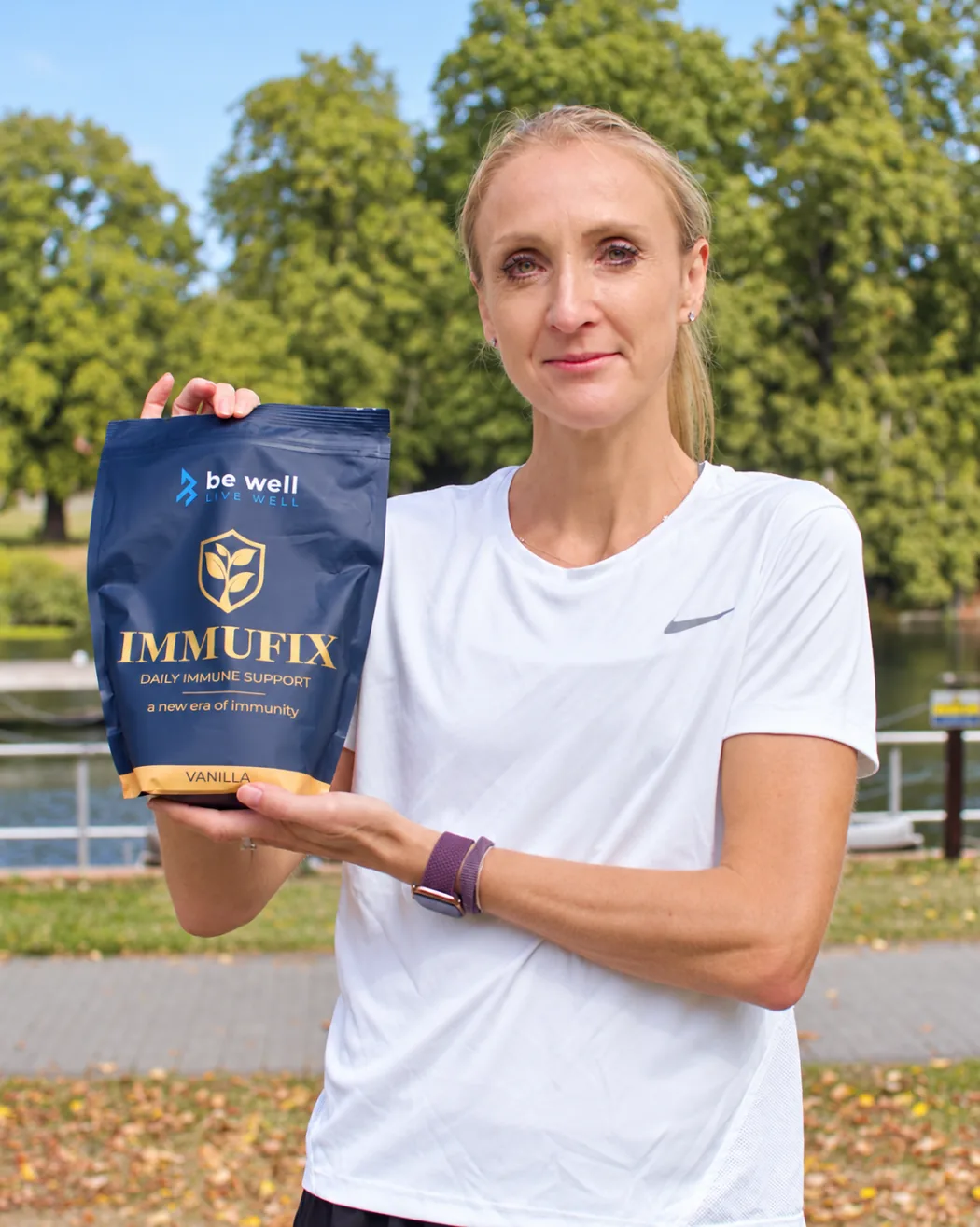
Immufix is not a carb loading food. One 25g scoop in around 200ml of water has 13.2g of carbohydrate, a small part of a 715g day, and 6.9g of prebiotic fibre (FOS). Keep it at your usual time in race week rather than adding anything new. Riboflavin, niacin, pantothenic acid, vitamin B6 and magnesium contribute to normal energy-yielding metabolism and to the reduction of tiredness and fatigue. Magnesium also contributes to normal muscle function. Paula Radcliffe has taken it every morning since 1998, as she describes on her journey page. Every amount is on the science page.
The short version.
- Carb load at 10 to 12g per kg a day for the 36 to 48 hours before a marathon: 700 to 840g a day at 70kg.
- A single high day after a taper is enough. You do not need to run yourself empty first.
- Choose white, low-fat, familiar foods, and use juice, milk and sweets to reach the total.
- On race morning, eat 1 to 4g per kg, 1 to 4 hours before the start.
- During the race, aim for 60 to 70g an hour, up to 90g if you can tolerate it.
Food supplements should not be used as a substitute for a varied, balanced diet and a healthy lifestyle. If you have a medical condition, are pregnant, breastfeeding or taking medication, speak to your GP or pharmacist before taking any food supplement.

Daily Immune Support
Vitamins, minerals and plant nutrients in one daily scoop. The formula Paula Radcliffe has taken every day since 1998.
4.8 out of 5 · 89 reviewsDispatched the same day on weekday orders placed before 2pm.
Free standard UK delivery. Royal Mail 48 tracked, 2 to 3 working days. UK addresses only.
30‑day money-back guarantee. Try your first pouch of IMMUFIX for up to 30 days. If it’s not for you, we’ll refund your first qualifying pouch, less £10 shipping and handling. First purchase only. T&Cs apply.
Checkout completes securely on immufix.com
More from the journal.

Couch to 5K, started in winter.
Couch to 5K in winter: how the free NHS 9-week plan works, three runs a week, and how to fit it around dark mornings, short days, cold and rain.
10 October 2026 · 7 min read
A half marathon nutrition plan, from the week before.
A half marathon nutrition plan for the week before, the night before, race morning, during the run and after, with sourced carbohydrate amounts.
10 October 2026 · 6 min read
How to breathe when you run in cold air.
How to breathe when running in cold air: nose breathing at easy pace, a buff over your mouth, a proper warm-up, and what cold air does to your lungs.
10 October 2026 · 7 min read