
What an authorised health claim is.
Every claim a UK supplement makes about what a nutrient does comes from one official list. The rules on wording are strict, and they explain why supplement copy reads the way it does.
Quick answer. An authorised health claim is a statement about what a nutrient or food does in the body that has been approved and listed on the Great Britain nutrition and health claims (NHC) register. Only those claims, or wording with the same meaning, may be used for food supplements in Great Britain. A vitamin or mineral generally has to supply at least 15% of its nutrient reference value (NRV) in the daily amount before a claim can be made. Words such as "normal" are part of the claim and cannot be dropped, general phrases like "good for you" need a specific authorised claim beside them, and no food may be presented as preventing, treating or curing a disease.
What food supplement claims are allowed in the UK?
Only the ones on the register. The government's GB NHC register page says it "sets out all authorised and rejected nutrition and health claims", and that "Only authorised claims in the Great Britain NHC register may be used in Great Britain."
The advertising code says the same. Rule 15.1.1 of the CAP Code reads: "Only health claims listed as authorised in the applicable register, or claims that would have the same meaning to the consumer, may be used in marketing communications." Rule 15.7 applies it to supplements by name.
The register is mostly a list of what is not allowed. In the 19 May 2026 spreadsheet, more than 2,000 health claim entries are marked non-authorised and fewer than 300 are marked authorised (our count). The register lists claims made for L-glutamine, taurine and fructooligosaccharides only as non-authorised, which is why Immufix makes no claim for its 1g of L-glutamine, 500mg of taurine or 6.9g of prebiotic FOS.
What is an authorised health claim?
Regulation (EC) No 1924/2006, which still applies in Great Britain, defines a health claim in Article 2 as "any claim that states, suggests or implies that a relationship exists between a food category, a food or one of its constituents and health." The words "suggests or implies" mean a picture or a hint can be a claim, not only a sentence.
The government's guidance on nutrition and health claims gives the clearest example of the difference between the two kinds of claim: "'contains calcium' only refers to the composition of the food and is a nutrition claim. In contrast 'calcium is needed for the maintenance of normal bones' refers to the function of calcium in the body and would be considered a health claim."
Each authorised claim comes with conditions of use. For most vitamin and mineral claims, the register says the claim "may be used only for food which is at least a source of" that nutrient. The ASA's advice on health claims adds a rule about who the claim belongs to: "replacing the nutrient referred to in the authorised claim with the product name is unacceptable." That is why every claim on this site starts with a nutrient's name, never the product's.
Why does the word "normal" matter?
Because it is part of the claim. An authorised claim reads, for example, "Vitamin C contributes to the normal function of the immune system". It describes a nutrient's role in keeping a body function working as it should. It does not promise more than that.
The ASA has ruled on this. Its advice says it "has ruled against a number of ads which made adapted health claims which it considered changed the meaning of the authorised health claim by removing the word 'normal'." It also says that "Taking an authorised health claim which refers to 'normal function' and rewording it to refer to 'improved' or 'increased' function is likely to be seen as exaggerating the claim."
Some flexibility is allowed, as long as the meaning stays the same. The ASA notes that swapping the authorised verb for "to support" has been accepted. Words like "boost" and "strengthen" go further than the authorised wording, so they are out.
What is the 15% NRV rule?
A nutrient has to be present in a meaningful amount before a claim can be made about it. Article 5 of the regulation requires it to be "contained in the final product in a significant quantity". For vitamins and minerals, Annex XIII of Regulation (EU) No 1169/2011 sets the benchmark. "As a rule", a significant amount is "15 % of the nutrient reference values" per 100g, or per portion if the package holds a single portion.
The government's claims guidance reads that as a guide, tied to what people actually eat: "the consumer should get 15% of the RDA for calcium, from the amount they could reasonably be expected to consume." For a supplement, that amount is the daily dose on the label. Our guide to what NRV means shows how each percentage is worked out.
Here is how the rule plays out on Immufix's own label, per 25g scoop:
| Nutrient | Per 25g scoop | Can it carry a claim? |
|---|---|---|
| Selenium | 75µg · 136% NRV | Yes, above 15% |
| Vitamin C | 100mg · 125% NRV | Yes, above 15% |
| Chromium | 50µg · 125% NRV | Yes, above 15% |
| Zinc | 3.75mg · 38% NRV | Yes, above 15% |
| Vitamin D | 1.25µg · 25% NRV | Yes, above 15% |
| Magnesium | 70mg · 19% NRV | Yes, above 15% |
| Vitamin K | 10µg · 13% NRV | No, below 15% |
| Copper | 0.12mg · 12% NRV | No, below 15% |
| Vitamin B12 | 0.25µg · 10% NRV | No, below 15% |
| Iron | 1.25mg · 9% NRV | No, below 15% |
The register does hold authorised claims for vitamin B12 and iron. Immufix supplies 10% and 9% of their NRVs, which is below 15%, so we make no claim for either.
Which claims are never allowed?
General health claims on their own.
Phrases like "healthy" or "good for you" are general references to health. Article 10(3) says these "may only be made if accompanied by a specific health claim" that is authorised. CAP rule 15.2 puts it the same way. The ASA's advice on general health claims adds that, on a website, "the specific health claim should be on the same page as the general health claim."
Our own product name is an example. "Daily Immune Support" is a general reference, so the specific claim sits beside it on our pages: vitamin C, vitamin D, zinc and selenium contribute to the normal function of the immune system.
Disease claims.
No food may claim the properties of a medicine. Article 7(3) of Regulation (EU) No 1169/2011 says food information "shall not attribute to any food the property of preventing, treating or curing a human disease, nor refer to such properties." CAP rule 15.6.2 carries the same ban into advertising. Its one exception is narrow: "Reduction-of disease-risk claims are acceptable if authorised on the applicable register." Those claims have their own strict conditions, and Immufix makes none.
Other banned approaches.
CAP rule 15.6 also rules out claims that "state or imply health could be affected by not consuming a food", and health claims "that refer to the recommendation of an individual health professional". Article 10(2) adds that a health claim must come with "a statement indicating the importance of a varied and balanced diet and a healthy lifestyle". You will find that statement at the end of this article.
Where Immufix fits.
Immufix is one 25g scoop in around 200ml of water, once a day. Its claims come from the GB register, use the authorised wording and belong to nutrients at 15% NRV or more. Vitamin C, riboflavin, niacin, pantothenic acid, vitamin B6, folic acid and magnesium contribute to the reduction of tiredness and fatigue. Zinc contributes to normal cognitive function. Every amount is on the science page, and the rules behind the label are in what a food supplement is.
The short version.
- Only health claims on the GB nutrition and health claims register, or wording with the same meaning, may be used.
- A claim belongs to the nutrient, never to the product's name.
- "Normal" is part of the authorised wording. Dropping it, or saying "improved", exaggerates the claim.
- A vitamin or mineral generally needs 15% of its NRV in the daily amount before it can carry a claim.
- General claims need a specific claim beside them, and no food may be presented as preventing, treating or curing a disease.
Food supplements should not be used as a substitute for a varied, balanced diet and a healthy lifestyle. If you have a medical condition, are pregnant, breastfeeding or taking medication, speak to your GP or pharmacist before taking any food supplement.

Daily Immune Support
Vitamins, minerals and plant nutrients in one daily scoop. The formula Paula Radcliffe has taken every day since 1998.
4.8 out of 5 · 89 reviewsDispatched the same day on weekday orders placed before 2pm.
Free standard UK delivery. Royal Mail 48 tracked, 2 to 3 working days. UK addresses only.
30‑day money-back guarantee. Try your first pouch of IMMUFIX for up to 30 days. If it’s not for you, we’ll refund your first qualifying pouch, less £10 shipping and handling. First purchase only. T&Cs apply.
Checkout completes securely on immufix.com
More from the journal.
Who regulates supplements in the UK.
Yes. UK supplements are regulated as food. Who does what: local councils and Trading Standards, the FSA, DHSC, the MHRA, the ASA and the claims register.
10 October 2026 · 7 min read
How to read a supplement label.
How to read a UK supplement label: the name, daily dose, warnings, % NRV, allergens and best before date, and why it differs from a US Supplement Facts panel.
10 October 2026 · 7 min read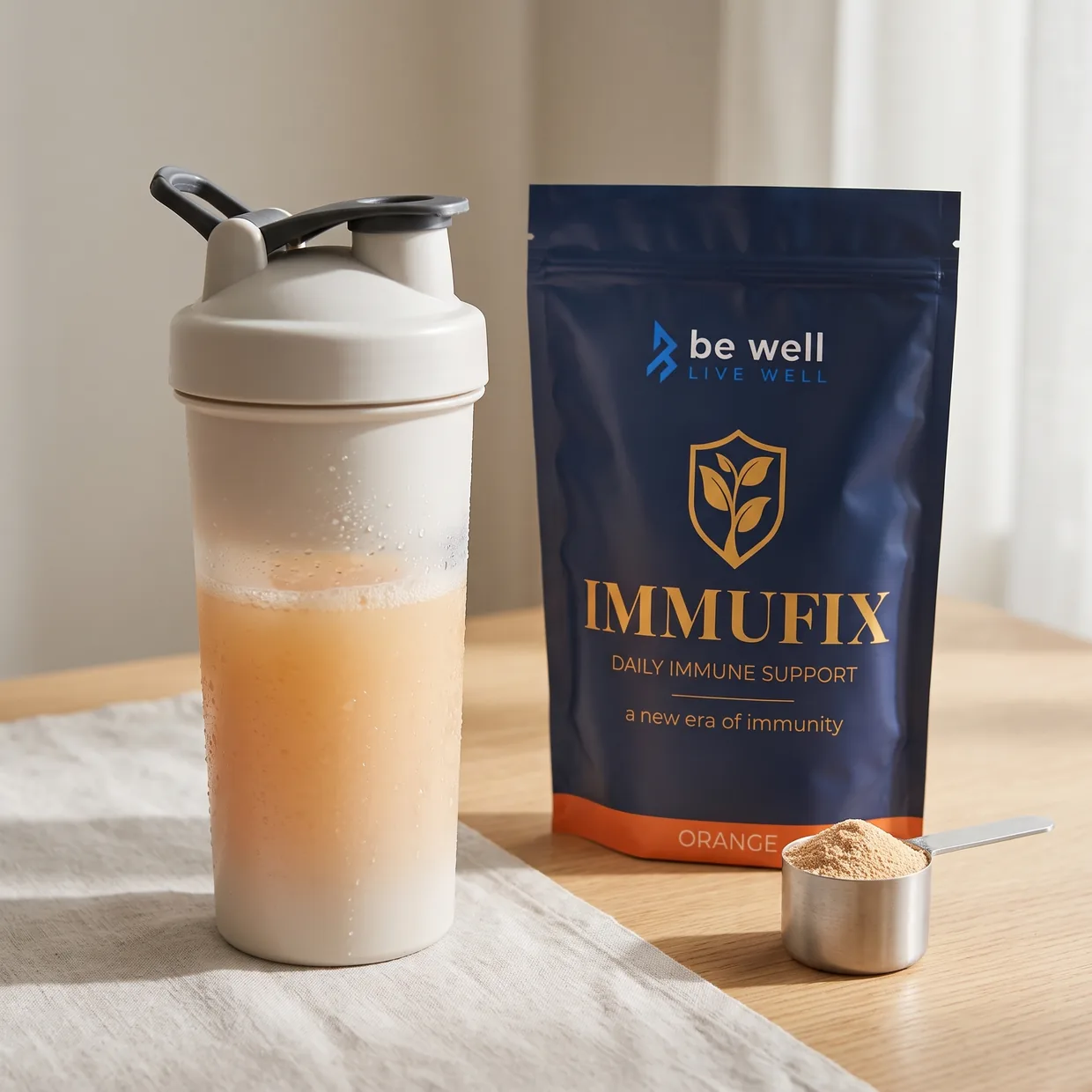
How much sugar a day, and what the label means.
The NHS says adults should have no more than 30g of free sugars a day. What "of which sugars" means on a label, and the 9.9g in Immufix in context.
10 October 2026 · 7 min read