
Do immune supplements work? What the label is allowed to say.
Every immune claim on a UK supplement has to use wording from an official register. Knowing what that wording says, and what it leaves out, is the clearest way to judge any product.

Quick answer. Immune supplements work in the sense UK law allows them to claim: vitamin C, vitamin D, vitamin A, vitamin B6, folic acid, zinc and selenium contribute to the normal function of the immune system, and a label may say so only in wording from the Great Britain nutrition and health claims register. The claim applies only when a serving contains a significant amount of the nutrient. The NHS says most people should get all the nutrients they need from a varied and balanced diet, although some people may need extra supplements.
Do immune support supplements work?
They work in a defined and limited way, and the label tells you exactly what that way is. We make Immufix, so we are not a neutral party. This guide explains what the rules say, so you can judge any product, ours included.
In Great Britain, a food supplement can only make a health claim that is on the nutrition and health claims register. GOV.UK says the register "sets out all authorised and rejected nutrition and health claims" and that "Only authorised claims in the Great Britain NHC register may be used in Great Britain." For the immune system, the authorised claims say that a named nutrient contributes to the normal function of the immune system.
That sentence describes a normal body function the nutrient takes part in. It is a statement about the vitamin or mineral, not about the brand, and it does not say that taking more of the nutrient will change anything for someone who already gets enough from food. Our guide to authorised health claims explains how the wording is set.
Are immune support supplements effective?
A product can only use a claim for a nutrient it contains in a significant amount. UK labelling law sets the guide figure. Annex XIII of the food information regulation says "As a rule, the following values should be taken into consideration in deciding what constitutes a significant amount", and gives "15 % of the nutrient reference values specified in point 1 supplied by 100 g or 100 ml in the case of products other than beverages".
On our own label, we use a claim only where a 25g serving gives at least 15% of the NRV. That is why vitamin C, vitamin D and zinc carry claims on Immufix, and vitamin K at 13% and vitamin B12 at 10% carry none.
Effective, in this sense, means the product gives enough of the nutrient for the claim to apply. It does not mean more is more. The NHS gives daily needs and upper limits for each nutrient.
The NHS vitamin C page says "You should be able to get all the vitamin C you need from your daily diet" and "Vitamin C cannot be stored in the body, so you need it in your diet every day." It says taking more than 1,000mg a day can cause stomach pain. On zinc, it says "Do not take more than 25mg of zinc supplements a day unless advised to by a doctor." On vitamin D, it says "If you choose to take vitamin D supplements, 10 micrograms a day will be enough for most people."
Do immune drinks work?
The same rules apply whatever the format. A juice shot, an effervescent tablet or a powder can carry the immune claim only for a nutrient it contains in a significant amount, and only in authorised wording. For drinks, Annex XIII sets the guide figure per 100ml: "7,5 % of the nutrient reference values specified in point 1 supplied by 100 ml in the case of beverages".
Read the claim on the label and check which nutrient it names. On MOJU's Ginger Shots page, checked on 17 November 2026, the claim reads "Vitamin C contributes to the reduction of tiredness and fatigue & the normal function of the immune system." MOJU gives the vitamin C as 31mg per 100ml, which it states is 39% of the reference intake. When a drink lists several ingredients, the claim sentence tells you which one the claim rests on.
Are immune support drinks good for you?
That depends on the drink and on the rest of your diet. Three things on the label are worth checking.
- Sugars. The NHS guide to sugar says "Adults should have no more than 30g of free sugars a day". It counts sugars in unsweetened fruit juices and smoothies as free sugars, so a juice-based drink adds to that total even with no added sugar. A serving of Immufix has 9.9g of sugars, which count too.
- Amounts. Add up the nutrients from every product you take. Two drinks with the same vitamins give you both amounts.
- Directions. The GOV.UK food supplements guidance says "Do not take more than the recommended dose" and "People should not take high dose supplements unless advised by their GP or healthcare specialist."
GOV.UK also says "Food supplements are not intended to replace a varied and balanced diet." Our guide to vitamin C foods shows how much of the 40mg a day ordinary meals can give.

How can I judge an immune supplement label?
Four checks cover most of it.
- A named nutrient. The claim should name a vitamin or mineral and use the words "normal function of the immune system".
- A significant amount. Look for at least 15% of the NRV per daily serving for that nutrient. Our guide to which vitamins support the immune system lists the nutrients that carry the claim.
- Amounts within the NHS limits. Compare the label with the NHS upper limits, counting every product you take.
- Your own diet. If you already eat a varied diet, the NHS says you should get most nutrients from food. If you are pregnant, breastfeeding, have a medical condition or take medication, ask a GP or pharmacist before you start any supplement.
Where Immufix fits.
Immufix is a vitamin-and-mineral powder with plant nutrients, made in the UK. Paula Radcliffe has taken it every morning since 1998. One 25g scoop goes into around 200ml of water once a day. Vitamin C, vitamin D, vitamin A, vitamin B6, folic acid, zinc and selenium contribute to the normal function of the immune system. Riboflavin, niacin, pantothenic acid and magnesium contribute to normal energy-yielding metabolism. Each serving has 9.9g of sugars. Every amount and % NRV is on the science page.
The short version.
- Immune supplements can claim that vitamin C, vitamin D, vitamin A, vitamin B6, folic acid, zinc or selenium contributes to the normal function of the immune system, in register wording.
- The claim applies only when a serving contains a significant amount of the nutrient: as a rule, 15% of the NRV, or 7.5% per 100ml for drinks.
- More does not mean more. The NHS gives upper limits, such as 25mg of zinc from supplements a day unless a doctor advises otherwise.
- The NHS says most people should get all the nutrients they need from a varied and balanced diet, although some people may need extra supplements.
- We make Immufix, so we are not neutral. Read any label, ours included, for the named nutrient, the amount and the sugars.
Food supplements should not be used as a substitute for a varied, balanced diet and a healthy lifestyle. If you have a medical condition, are pregnant, breastfeeding or taking medication, speak to your GP or pharmacist before taking any food supplement.
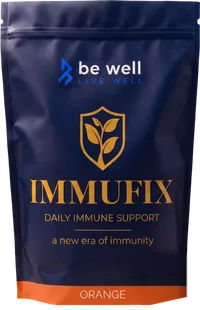

Daily Immune Support
Vitamins, minerals and plant nutrients in one daily scoop. The formula Paula Radcliffe has taken every day since 1998.
4.8 out of 5 · 89 reviewsMonthly subscription. £52.00 is charged every month until you cancel. Minimum three payments, then cancel any time. Subscription terms
New here? 20% off your first order with code TRYIMMUFIX. Apply it
Dispatched the same day on weekday orders placed before 2pm.
Free standard UK delivery. Royal Mail 48 tracked, 2 to 3 working days. UK addresses only.
30‑day money-back guarantee. Try your first pouch of IMMUFIX for up to 30 days. If it’s not for you, we’ll refund your first qualifying pouch, less £10 shipping and handling. First purchase only. T&Cs apply.
Checkout completes securely on immufix.com
More from the journal.

The vitamins and minerals behind a normal immune system.
The vitamins for immune system function under UK rules, how much adults need, and which foods supply them, with NHS amounts and CoFID figures per portion.
10 October 2026 · 8 min read
Best immune supplements in the UK: what to look for.
Best immune supplements in the UK: what to look for on the label, with claims, amounts and prices from each brand's own page, checked 17 November 2026.
17 November 2026 · 7 min read
Does Immufix work? What can honestly be said.
Does Immufix work? What GB law lets a food supplement say, what is in a 25g scoop, and what the 4.8 out of 5 rating from 89 reviews does and does not show.
17 November 2026 · 6 min read