
Who regulates supplements in the UK.
Supplements in the UK sit under food law, and several bodies share the work. Knowing who does what shows you what the rules check, and when.
Quick answer. Yes. In the UK, food supplements are regulated as food. The Food Supplements Regulations 2003 (one set for each nation) control what they may contain and what the label must say, and general food labelling law and the health claims rules apply on top. Local councils enforce the rules, with Trading Standards handling misleading labels in England and Wales. The MHRA steps in if a product is presented as a medicine, the ASA applies the advertising code, and only claims on the GB nutrition and health claims register may be used. The official guidance describes registering the business, not approving each product before sale.
Are supplements regulated in the UK?
They are, as food. GOV.UK's guidance for businesses says: "In the UK, food supplements are required to be regulated as food and are subject to the provisions of general food law." Food Standards Scotland's consumer advice says the same: "Food supplements are regulated as foods, not medicines."
Being regulated as food has two sides. Supplements must meet the same safety, labelling and claims rules as any packaged food, plus extra rules of their own. And they are kept out of the medicines system, which means they may not be sold as able to do what a medicine does. Our explainer on what a food supplement is covers the legal definition.
What are the food supplement regulations in the UK?
Several laws apply at once. The main ones:
- The Food Supplements Regulations 2003. One set for each nation: the Food Supplements (England) Regulations 2003 and matching regulations for Scotland, Wales and Northern Ireland. They define a supplement, list the vitamins and minerals that may be used, require the product to be prepacked and set the label wording.
- Regulation (EU) No 1169/2011 on food information. The general labelling law for every packaged food, which still applies in Great Britain. GOV.UK's guidance says any supplement placed on the market in Great Britain "must comply with the general food labelling requirements" it sets out.
- The Food Information Regulations 2014. GOV.UK lists these alongside the supplement regulations as the legal requirements in each nation.
- Regulation (EC) No 1924/2006 on nutrition and health claims. It decides what may be said about what a nutrient does. Only claims on the GB register may be used.
- The Human Medicines Regulations 2012. These mark the border. The supplement regulations "do not apply to medicinal products" as defined there.
Northern Ireland has an extra layer. GOV.UK notes that there, "food law relating to food supplements is covered by the Windsor Framework."
Who does what?
No single body owns supplements. The table sets out each one's part, from the sources linked in this article.
| Body | Area | What it does for supplements |
|---|---|---|
| Department of Health and Social Care | England | Policy and legislation for supplements in England. Receives the evidence for claims not yet on the register. |
| Food Standards Scotland | Scotland | Policy for food safety, composition and labelling in Scotland, including supplements. Works with local authorities on compliance. |
| Welsh Government | Wales | Policy and legislation for supplements in Wales. |
| Food Standards Agency | England, Wales, NI | Food safety and hygiene. Supplement policy in Northern Ireland. Oversees enforcement by local authorities. |
| Local councils | Their own area | Enforce the regulations. Trading Standards deal with misleading labels and claims; food safety teams with safety and hygiene. |
| MHRA | UK | Decides whether a product is really a medicine, from its ingredients and how it is presented. |
| ASA and CAP | UK | Write and apply the advertising code, including the rules on supplement claims. |
Policy: four nations, four leads.
GOV.UK's business guidance says "Food supplements policy and legislative responsibility across the UK sits with" the Department of Health and Social Care in England, Food Standards Scotland, the Welsh Government and the Food Standards Agency in Northern Ireland. The FSA describes its own remit on its about page: "We are responsible for food safety and food hygiene in England, Wales and Northern Ireland." It has powers to enforce food safety controls directly with some businesses and "to oversee the enforcement of them by local authorities".
Enforcement: your local council.
The England regulations say: "Each food authority shall enforce and execute these Regulations in its area." In practice that is the local council. GOV.UK's page on reporting misleading labelling tells people in England and Wales to "Contact Trading Standards" about a label that is misleading or missing information, with health claims first on its list. Safety and hygiene problems go to the council's food safety team.
The medicines border: the MHRA.
The MHRA's borderline products guidance names "food products, including, in particular, food supplements" among the products it may have to classify. It says supplements with "familiar substances like vitamins, amino acids or minerals are generally subject to food safety and food labelling legislation rather than medicines control unless presented for medicinal uses." To decide, it looks at the claims made, the ingredients, the product's purpose and how it is presented "through labelling, packaging, promotional literature, advertisements, websites, social media and customer reviews".
Advertising: the ASA.
Section 15 of the CAP Code covers food and supplement claims. Rule 15.7 says: "Nutrition and health claims for food supplements must be permitted or authorised". The ASA's advice on health claims adds that "From 1 January 2021, only health and nutrition claims authorised on the Great Britain nutrition and health claims register (the GB NHC Register) are permitted."
Are supplements approved before they go on sale?
Health claims are. Individual products are not described that way: none of the official guidance we read mentions a licence or approval for each supplement before sale. What it describes is the business registering and taking responsibility:
- GOV.UK: "To sell food supplements you must register as a Food Business Operator (FBO) with your local authority."
- GOV.UK: "It is your responsibility to ensure that food supplements you sell are safe for consumption."
- Food Standards Scotland: "Ultimately, food businesses are responsible for ensuring the food supplements they sell are safe."
Health claims work the other way round. They are authorised in advance and listed on the GB nutrition and health claims register, which says: "Only authorised claims in the Great Britain NHC register may be used in Great Britain." A business using a claim must be able to show its product meets that claim's conditions of use. Medicines are different again: the MHRA looks into complaints that a product "is being marketed as a medicine but does not have an appropriate marketing authorisation".
How do you report a supplement you are worried about?
GOV.UK's guidance for consumers says: "If you are concerned about the safety, labelling or claims made by a food supplement, you should report the issue to your Local Authority or District Council." In Scotland and Northern Ireland, GOV.UK points people to their local food safety team.
If you feel unwell after taking a supplement, the same guidance says to "Stop taking the supplement immediately and contact your healthcare professional for advice."
Where Immufix fits.
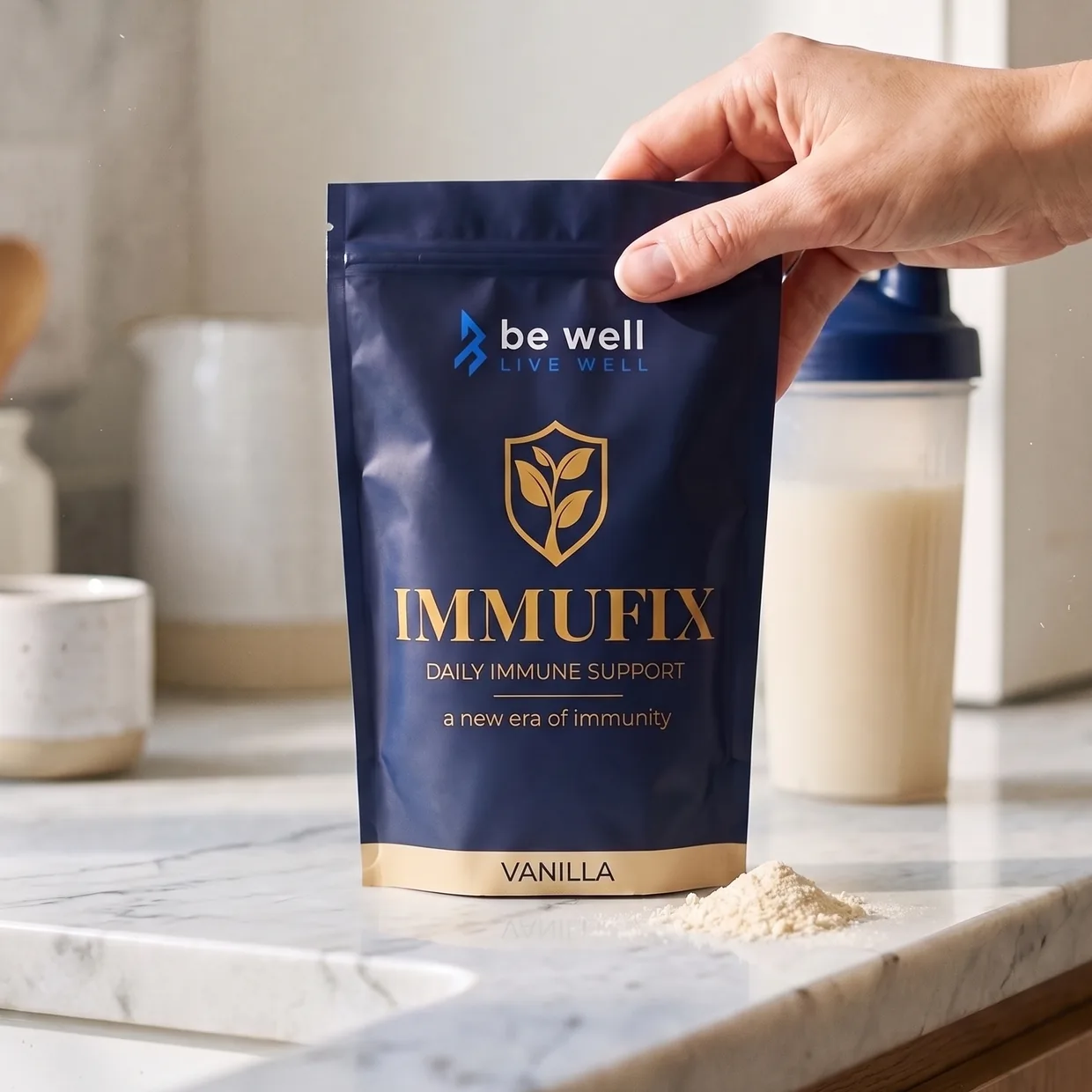
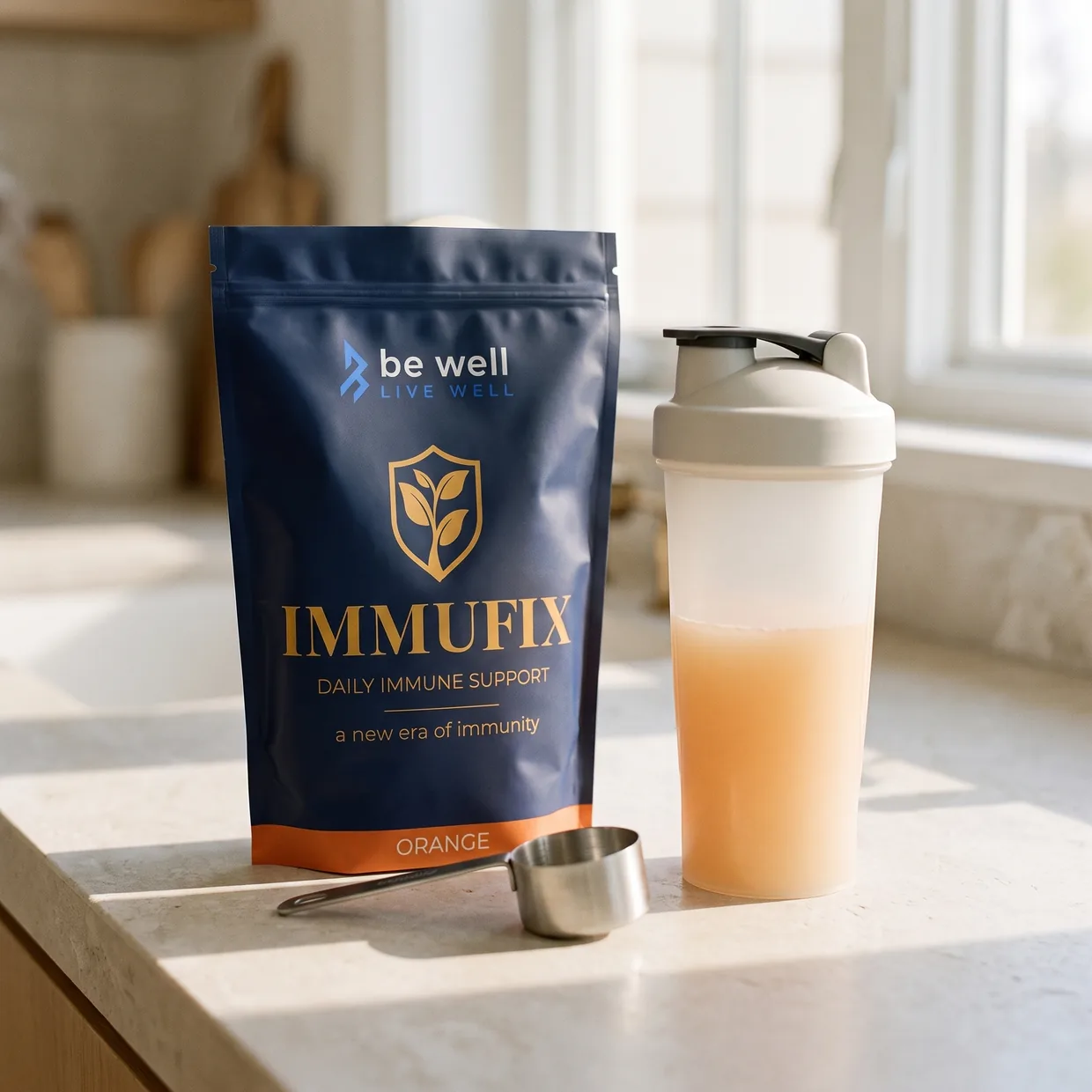
Immufix is made in the UK by Be Well Health and Nutrition Limited and sold as a food supplement: one 25g scoop in around 200ml of water, once a day. The claims we use are copied from the GB register and belong to named nutrients. For example, vitamin C, vitamin D, zinc and selenium contribute to the normal function of the immune system, and magnesium contributes to the reduction of tiredness and fatigue. Each nutrient's amount and % NRV is on the science page, and our guide to authorised health claims explains how the register works.
The short version.
- UK supplements are regulated as food, under the Food Supplements Regulations 2003 and general food law.
- Policy sits with DHSC in England, Food Standards Scotland, the Welsh Government and the FSA in Northern Ireland.
- Local councils enforce the rules. Trading Standards handle misleading labels and claims in England and Wales.
- The MHRA decides when a product is really a medicine. The ASA applies the advertising code.
- Health claims are authorised in advance on the GB register. The guidance describes registering the business, not licensing each product.
Food supplements should not be used as a substitute for a varied, balanced diet and a healthy lifestyle. If you have a medical condition, are pregnant, breastfeeding or taking medication, speak to your GP or pharmacist before taking any food supplement.

Daily Immune Support
Vitamins, minerals and plant nutrients in one daily scoop. The formula Paula Radcliffe has taken every day since 1998.
4.8 out of 5 · 89 reviewsDispatched the same day on weekday orders placed before 2pm.
Free standard UK delivery. Royal Mail 48 tracked, 2 to 3 working days. UK addresses only.
30‑day money-back guarantee. Try your first pouch of IMMUFIX for up to 30 days. If it’s not for you, we’ll refund your first qualifying pouch, less £10 shipping and handling. First purchase only. T&Cs apply.
Checkout completes securely on immufix.com
More from the journal.
How to read a supplement label.
How to read a UK supplement label: the name, daily dose, warnings, % NRV, allergens and best before date, and why it differs from a US Supplement Facts panel.
10 October 2026 · 7 min read
How much sugar a day, and what the label means.
The NHS says adults should have no more than 30g of free sugars a day. What "of which sugars" means on a label, and the 9.9g in Immufix in context.
10 October 2026 · 7 min readWhat NRV means on a label.
NRV means nutrient reference value, the daily amount used on UK food labels. How % NRV is worked out, why 15% matters, and how NRV differs from RNI.
10 October 2026 · 6 min read