
How much sugar a day, and what the label means.
The NHS sets a daily maximum for free sugars, and food labels show sugars on a line of their own. Here is how to read both, using the 9.9g on our own label.
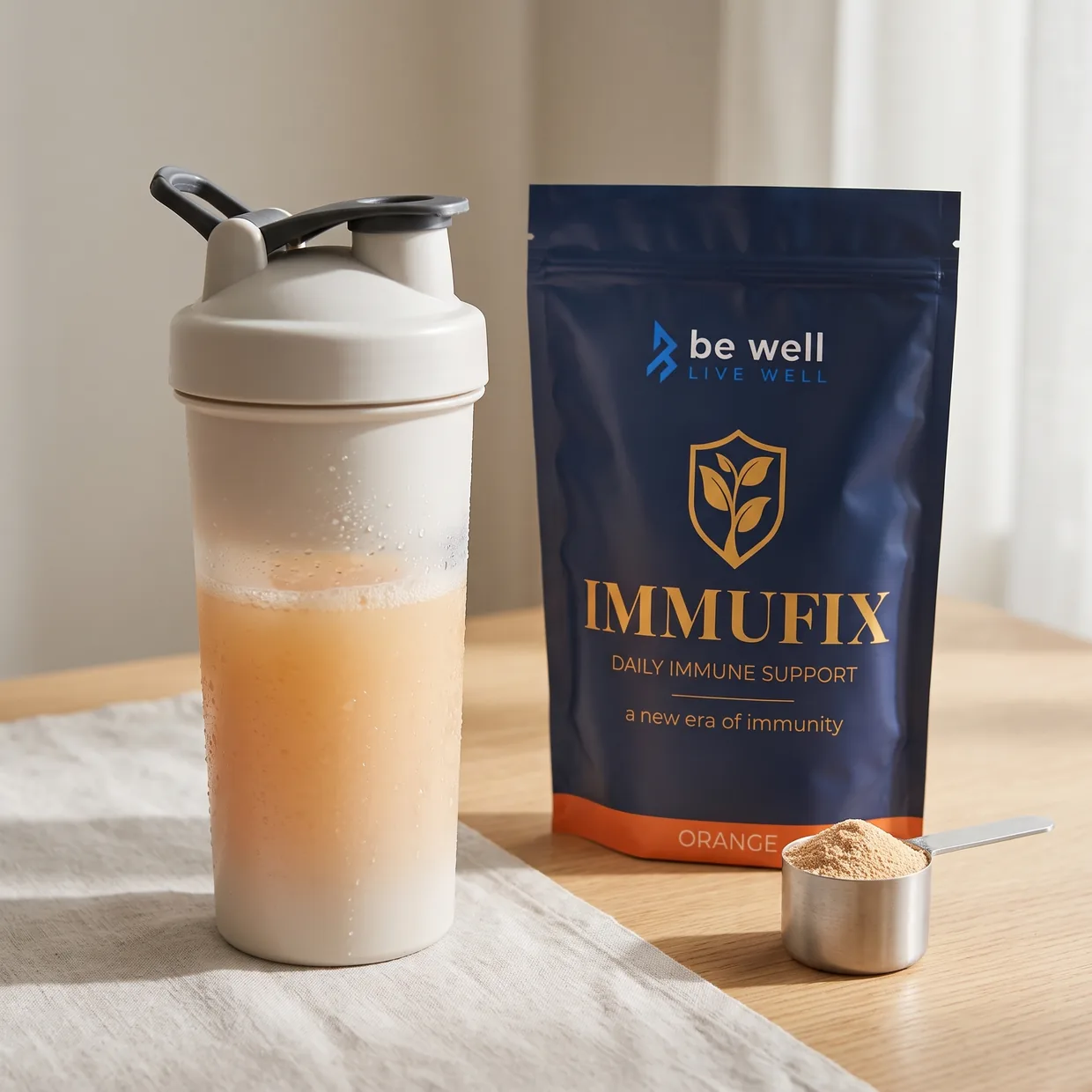
Quick answer. The NHS says adults should have no more than 30g of free sugars a day, roughly 7 sugar cubes, which is about 5% of daily energy. "Of which sugars" on a nutrition label is the part of the total carbohydrate that is sugars. It counts sugars from every source, including the free sugars the 30g limit applies to and the sugars naturally present in milk, fruit and vegetables. One 25g serving of Immufix has 9.9g of sugars, mainly added fructose and dextrose, which is about a third of the NHS's 30g daily maximum for adults (calculated).
How much sugar a day is recommended in the UK?
The UK guideline is about free sugars, not all sugars. The NHS page Sugar: the facts says: "The government recommends that free sugars ... should not make up more than 5% of the energy (calories) you get from food and drink each day." It turns that into grams by age:
- Adults: "no more than 30g of free sugars a day, (roughly equivalent to 7 sugar cubes)".
- Children aged 7 to 10: no more than 24g a day (6 sugar cubes).
- Children aged 4 to 6: no more than 19g a day (5 sugar cubes).
- Children aged 2 to 3: no more than 14g a day (3 and a half sugar cubes).
- Children aged 1: no more than 10g a day (2 and a half sugar cubes).
The NHS guide to cutting down on sugar says the 30g figure applies to "anyone aged 11 and older". It is a maximum, not a target.
What are free sugars?
The NHS defines free sugars as two groups:
- "Any sugars added to food or drinks", whether at home, by a chef or by a manufacturer.
- "Sugars in honey, syrups (such as maple, agave and golden), nectars (such as blossom), and unsweetened fruit juices, vegetable juices and smoothies."
What does not count is just as important. In the NHS's words, "Sugar found naturally in milk, fruit and vegetables does not count as free sugars." An apple or a glass of milk does not use up any of the 30g. A glass of juice does, which is why the NHS suggests no more than 150ml of fruit juice, vegetable juice and smoothies combined in a day.
What does "of which sugars" mean on a label?
A nutrition table lists carbohydrate first, then an indented line headed "of which sugars". The sugars figure is part of the carbohydrate figure, not extra to it. The carbohydrate figure also includes starchy carbohydrates, as the NHS points out.
The legal meaning of "sugars" is set in Annex I of Regulation (EU) No 1169/2011: "'sugars' means all monosaccharides and disaccharides present in food, but excludes polyols". So it counts every simple sugar, wherever it came from. The NHS explains that the figure "describes the total amount of sugars from all sources": free sugars, plus the sugars from milk, fruit and vegetables.
That has two consequences for reading a label:
- It does not show free sugars on its own. The NHS says it "does not tell you the amount of free sugars", but it is "a useful way of comparing labels". A plain yoghurt can show sugars on its label without any free sugars at all.
- The ingredients list fills the gap. According to the NHS, "Sugars added to foods and drinks must be included in the ingredients list, which always starts with the ingredient that there's the most of."
High, medium and low.
The NHS's guide to reading food labels gives per 100g thresholds for foods: high is "more than 22.5g of total sugars per 100g", and low is "5g of total sugars or less per 100g". Anything in between is medium. It notes that different criteria apply to drinks.
Why some labels say 90g.
Some packs show sugars as a percentage of a reference intake. That reference is set in Annex XIII at 90g of total sugars a day for an adult. It covers all sugars, including those from milk and fruit, so it is a different measure from the NHS's 30g of free sugars. Food supplements do not have to carry a full nutrition table at all, under Article 29 of the same regulation, so a sugars line is not always there.
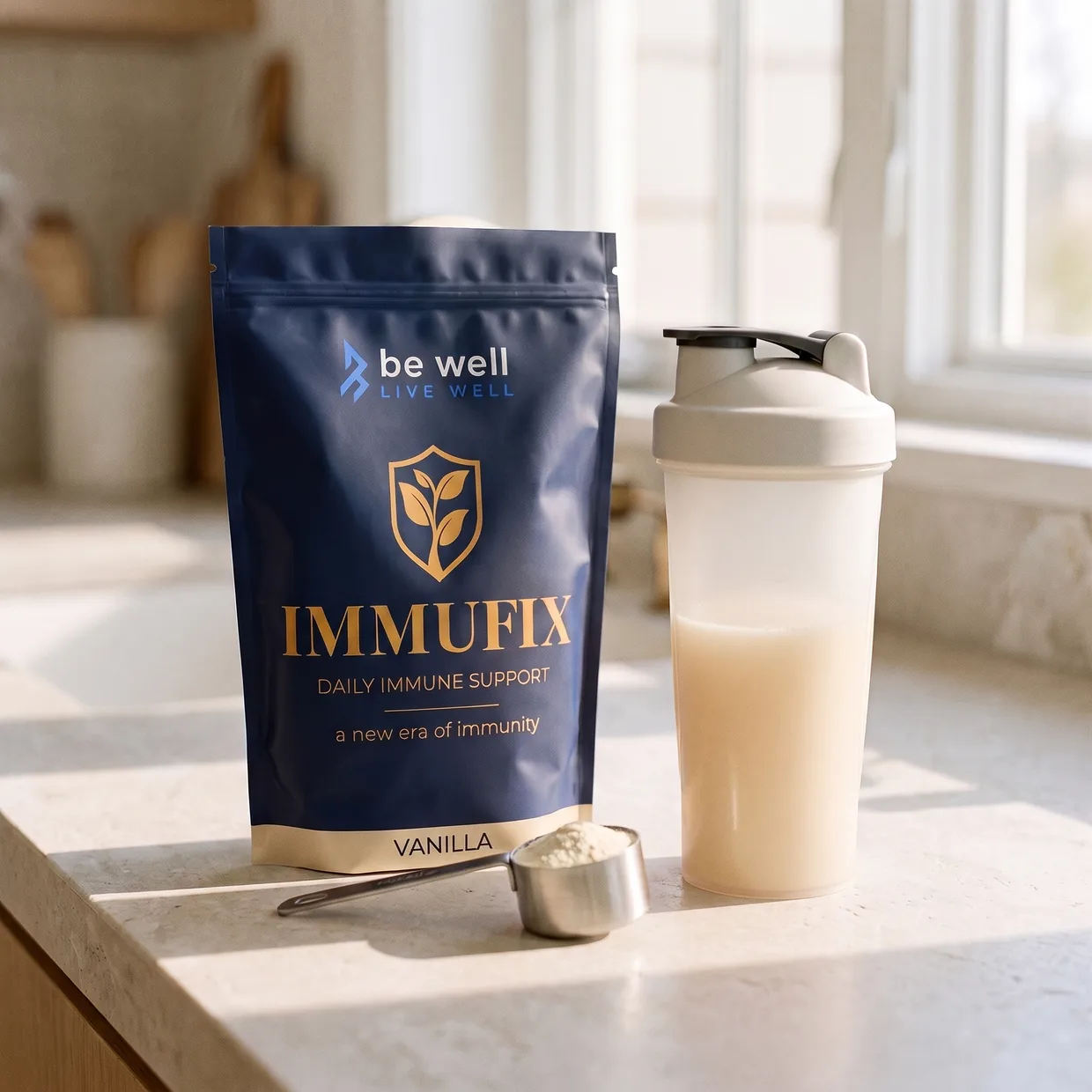
How much sugar is in Immufix?
Immufix's label gives the figures per 25g serving: 75 kcal, 13.2g of carbohydrate, of which 9.9g sugars, and 2.1g of protein. The other 3.3g of carbohydrate is not sugar (calculated). As our page on who Immufix suits explains, the sugars are principally fructose and dextrose, and maltodextrin counts towards carbohydrate but not the sugars line. Carbohydrate is a deliberate part of the recipe, used for taste and so the powder mixes.
Fructose and dextrose are added in the recipe, so under the NHS definition they count as free sugars. Here is how 9.9g compares, all calculated from the figures above:
- Against the NHS adult maximum of 30g of free sugars: 33%, about a third. That leaves 20.1g for the rest of the day.
- In NHS sugar cubes: a little over 2 of the 7 the NHS uses to picture 30g.
- Against the 90g reference intake for total sugars: 11%.
- Per 100g of powder: 39.6g. By the NHS per 100g guide for foods, that is high. You take 25g, not 100g, which is why the label gives the per serving figure.
- As you drink it: one 25g scoop in around 200ml of water makes roughly 225ml, so about 4.4g of sugars per 100ml (calculated). The government's front-of-pack labelling guidance classes drinks with more than 2.5g and up to 11.25g of sugars per 100ml as medium, and sets its per-portion high mark for drinks at more than 13.5g. The 9.9g in a serving is below that.
We think the honest way to read 9.9g is as a third of the adult daily maximum for free sugars. If you take Immufix every day and are keeping an eye on sugar, count it alongside everything else.
How can you keep within 30g a day?
The NHS's practical tips focus on where most free sugars come from. A few of them:
- Drinks first. The NHS says "Nearly a quarter of the added sugar in our diets comes from sugary drinks", and that "A can of regular cola contains 7 teaspoons of sugar (35g)".
- Breakfast. It suggests unsweetened wholegrain cereals rather than ones "frosted, or coated with chocolate or honey".
- Juice. Keep fruit juice, vegetable juice and smoothies to 150ml a day in total.
- Labels. Compare the "of which sugars" line and check how high up the ingredients list sugars appear.
If you have been advised to watch your sugar intake for a medical reason, follow that advice and speak to your GP or a dietitian before adding any food or supplement.
Where Immufix fits.
Immufix is one 25g scoop in around 200ml of water, once a day, with 9.9g of sugars per serving. We show that figure on the label and on the science page so you can count it. The vitamins and minerals carry the claims, each in its own name: vitamin C, vitamin D, zinc and selenium contribute to the normal function of the immune system. Our guide to reading a supplement label covers the rest of the pack.
The short version.
- The NHS says adults should have no more than 30g of free sugars a day, about 7 sugar cubes. Children's limits are lower.
- Free sugars are sugars added to food and drink, plus those in honey, syrups and juices. Sugars in whole fruit, vegetables and milk do not count.
- "Of which sugars" is the sugars part of total carbohydrate, from every source. The ingredients list shows which sugars were added.
- One 25g serving of Immufix has 9.9g of sugars, mainly added fructose and dextrose: about a third of the adult 30g maximum (calculated).
- Per 100g of powder that is 39.6g, high by the NHS guide for foods. Made up as a drink it is about 4.4g per 100ml, medium by the government guidance for drinks. The per serving figure, 9.9g, is the one to count.
Food supplements should not be used as a substitute for a varied, balanced diet and a healthy lifestyle. If you have a medical condition, are pregnant, breastfeeding or taking medication, speak to your GP or pharmacist before taking any food supplement.

Daily Immune Support
Vitamins, minerals and plant nutrients in one daily scoop. The formula Paula Radcliffe has taken every day since 1998.
4.8 out of 5 · 89 reviewsDispatched the same day on weekday orders placed before 2pm.
Free standard UK delivery. Royal Mail 48 tracked, 2 to 3 working days. UK addresses only.
30‑day money-back guarantee. Try your first pouch of IMMUFIX for up to 30 days. If it’s not for you, we’ll refund your first qualifying pouch, less £10 shipping and handling. First purchase only. T&Cs apply.
Checkout completes securely on immufix.com
More from the journal.
Who regulates supplements in the UK.
Yes. UK supplements are regulated as food. Who does what: local councils and Trading Standards, the FSA, DHSC, the MHRA, the ASA and the claims register.
10 October 2026 · 7 min read
How to read a supplement label.
How to read a UK supplement label: the name, daily dose, warnings, % NRV, allergens and best before date, and why it differs from a US Supplement Facts panel.
10 October 2026 · 7 min readWhat NRV means on a label.
NRV means nutrient reference value, the daily amount used on UK food labels. How % NRV is worked out, why 15% matters, and how NRV differs from RNI.
10 October 2026 · 6 min read