
How much water runners should drink.
There is no single right amount of water for a runner, because sweat rates vary several times over from one person to the next. This guide covers the daily baseline, drinking to thirst, a simple sweat test, salt, and what to do on half marathon day.
Quick answer. There is no single amount. Day to day, the British Dietetic Association gives an adequate intake from drinks of 2,000ml for men and 1,600ml for women, with more needed when you exercise and sweat. On a run, most people can drink to thirst: a National Athletic Trainers' Association position statement says "Most individuals can avoid fluid-balance problems by drinking when thirsty during and after exercise and eating a healthy diet." To fine-tune it, weigh yourself before and after a run, aim to lose no more than about 2% of your body weight, and never finish heavier than you started.
How much water should runners drink?
Start with the everyday baseline, then add what you lose in sweat. The BDA's fluid fact sheet, which uses European Food Safety Authority figures, puts the adequate intake of water from drinks at 2,000ml a day for men and 1,600ml for women. It adds that drinks provide "around 70-80% of our water needs", with the rest coming from food. The NHS gives the same idea in glasses: the Eatwell Guide recommends 6 to 8 cups or glasses of fluid a day, and the NHS page on water and drinks lists being "physically active for long periods" as a reason to drink more.
How much more depends on how much you sweat, and that varies enormously. The NATA position statement, published in the Journal of Athletic Training in 2017, reports that "Sweat rates for adults (>18 years old) during exercise can range from 0.5 to 4.0 L/h". Body size, pace, temperature and clothing all move the figure. That is why the American College of Sports Medicine's position stand on exercise and fluid replacement says "customized fluid replacement programs are recommended" instead of one number for everyone.
For the everyday side of fluid, including tea, coffee and how to tell if you are drinking enough, see our guide to how much water to drink in a day.
Should runners drink to thirst?
For most runs, yes. The BDA's sport and exercise fact sheet puts it simply: "A simple, practical recommendation is to drink to 'just stay ahead of thirst.'" It says this "will help you avoid drinking too much or too little." The NATA statement agrees that thirst works for most people, and adds that if runners "do not know their individual sweat rates, drinking to thirst during activity most likely represents a safe strategy".
Thirst is not perfect. The BDA's fluid sheet points out that "you stop feeling thirsty before your body is completely rehydrated", so after a long or warm run keep sipping through the next few hours. Urine colour is the other check the BDA recommends: "Your urine should be a pale straw colour which shows you are well hydrated."
Drinking more is not always better. The safety line from the NATA statement is short: "Individuals should not gain body mass (or body weight) during exercise". If you weigh more after a run than before it, you drank more than you sweated, and you should drink less next time. If anything about how you feel during or after a run worries you, speak to your GP.
How do I work out my sweat rate?
With bathroom scales and a stopwatch. The ACSM position stand says "Individual sweat rates can be estimated by measuring body weight before and after exercise." The NATA statement gives the sum: sweat loss equals your weight before, minus your weight after, plus anything you drank, minus any toilet stop. One kilogram lost is roughly one litre of sweat.
- Weigh yourself in minimal clothing just before a run, after going to the toilet.
- Run for about an hour at your usual pace, and note how much you drink.
- Towel off and weigh yourself again in the same minimal clothing.
- Do the sum, and repeat it on a warm day and a chilly day, because the answer changes with the weather.
| Worked example (calculated) | Figure |
|---|---|
| Weight before a 60 minute run | 70.0kg |
| Weight after | 69.2kg |
| Drunk during the run | 0.4 litres |
| Sweat loss (0.8kg + 0.4 litres) | 1.2 litres |
| Sweat rate | 1.2 litres an hour |
| 2% of starting weight | 1.4kg |
In this example the runner lost 0.8kg, about 1.1% of body weight, which is inside the 2% line. The ACSM position stand describes the goal of drinking during exercise in terms of avoiding a loss of more than 2% of body weight from a water deficit. The NATA statement adds that for recreational athletes, the 2% threshold "has little effect on overall exercise performance".
Do runners need electrolytes or salt?
For most everyday runs, no. The NATA statement says: "As a general rule, those participating in physical activity lasting less than 1 hour should require no substances other than water." For sessions longer than an hour, or with hard intervals, it says runners "may benefit from adding carbohydrates or electrolytes (or both) to rehydration fluids, especially in extreme environments."
Sweat also carries sodium, and the amount varies as much as the sweat itself. The NATA statement reports that "measured sodium losses during exercise range between 0.2 and 7.3 g/h." The BDA's sport sheet says to restore hydration after exercise "to replace water and salts lost in sweat", which for most people happens through ordinary meals and drinks. Everyday salt intake still has an upper limit: the NHS says "Adults should have no more than 6g of salt a day (around 1 level teaspoon)."
Salt tablets are a common habit among distance runners. The NATA statement says of using them to hold on to fluid that "Little evidence supports this practice", and recommends individual testing of sweat electrolytes before anyone considers supplementing.

What about half marathon nutrition and hydration?
A half marathon is 13.1 miles (21.1km), which for most runners is well over an hour of running, long enough for a drinking plan to matter. Keep it simple and practise it in training first.
- The days before: drink normally and check that your urine is pale straw coloured. There is no need to drink large extra amounts.
- Race morning: have a drink with breakfast, a few hours before the start. The ACSM position stand says drinking before exercise should start "at least several hours before the activity to enable fluid absorption and allow urine output to return to normal levels."
- During the race: drink to thirst at the water stations. Using the worked example above, a runner sweating 1.2 litres an hour would lose about 2.4 litres over two hours; drinking about a litre in total would keep the loss near the 2% line (calculated). Smaller or slower runners usually need less.
- Sports drinks: the ACSM says drinks "containing electrolytes and carbohydrates can provide benefits over water alone under certain circumstances", and a long race is one of them. Only use one on race day if you have tried it in training.
- Afterwards: keep drinking with your recovery meal. If you need to recover quickly, the NATA statement suggests replacing 100% to 150% of what you lost; with more than 12 hours to recover, normal eating and drinking is enough.
The food side, from carbohydrate in the week before to gels on the course, is in our half marathon nutrition plan, and what to eat when you get home is in what to eat after a run.
Where Immufix fits.
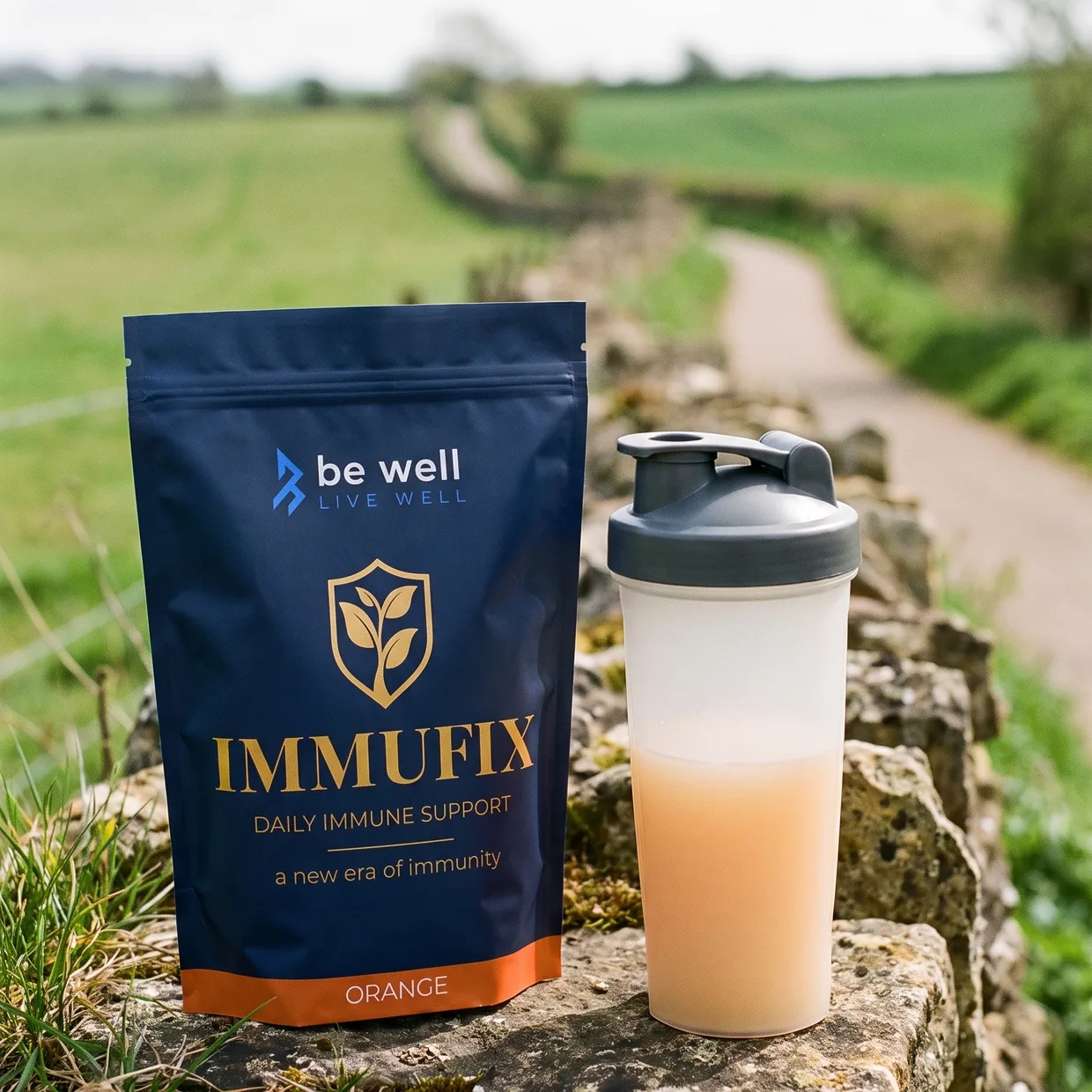
Immufix is a daily food supplement, not a drink for during a run. It is one 25g scoop in around 200ml of water, once a day, so it also adds a glass of fluid to your day. Magnesium contributes to electrolyte balance and to normal muscle function. Riboflavin, niacin and vitamin B6 contribute to the reduction of tiredness and fatigue. Every amount is on the science page.
The short version.
- Daily baseline from drinks: about 2,000ml for men and 1,600ml for women (BDA), plus what you sweat.
- Sweat rates range from 0.5 to 4.0 litres an hour, so there is no single right amount for runners.
- Drink to thirst on most runs, check for pale straw urine, and never finish a run heavier than you started.
- Runs under an hour need only water. Longer runs and races may suit a drink with carbohydrate and electrolytes.
- For a half marathon, drink with breakfast, sip to thirst on the course, and only use drinks you have tried in training.
Food supplements should not be used as a substitute for a varied, balanced diet and a healthy lifestyle. If you have a medical condition, are pregnant, breastfeeding or taking medication, speak to your GP or pharmacist before taking any food supplement.

Daily Immune Support
Vitamins, minerals and plant nutrients in one daily scoop. The formula Paula Radcliffe has taken every day since 1998.
4.8 out of 5 · 89 reviewsDispatched the same day on weekday orders placed before 2pm.
Free standard UK delivery. Royal Mail 48 tracked, 2 to 3 working days. UK addresses only.
30‑day money-back guarantee. Try your first pouch of IMMUFIX for up to 30 days. If it’s not for you, we’ll refund your first qualifying pouch, less £10 shipping and handling. First purchase only. T&Cs apply.
Checkout completes securely on immufix.com
More from the journal.
Carb loading for a marathon, in grams.
How many carbs to eat before a marathon: 10 to 12g per kg a day for 36 to 48 hours, 1 to 4g per kg on race morning, with a calculated UK day of meals.
10 October 2026 · 6 min read
Couch to 5K, started in winter.
Couch to 5K in winter: how the free NHS 9-week plan works, three runs a week, and how to fit it around dark mornings, short days, cold and rain.
10 October 2026 · 7 min read
A half marathon nutrition plan, from the week before.
A half marathon nutrition plan for the week before, the night before, race morning, during the run and after, with sourced carbohydrate amounts.
10 October 2026 · 6 min read