
How much vitamin C you need each day.
The NHS figure for adults is 40mg a day, and most people can get it from food. Supplement labels use a different number, 80mg, and the NHS draws its line for too much at 1,000mg.

Quick answer. The NHS says "Adults aged 19 to 64 need 40mg of vitamin C a day", and UK government tables give the same 40mg for adults over 65. You should be able to get it all from food, and because the body cannot store vitamin C, you need some every day. The NHS says taking more than 1,000mg a day can cause stomach pain, diarrhoea and flatulence, and that less than 1,000mg a day from supplements is unlikely to cause any harm.
How much vitamin C do adults need per day in the UK?
The NHS page on vitamin C gives one figure: "Adults aged 19 to 64 need 40mg of vitamin C a day."
The same 40mg applies to older adults. The UK's Government Dietary Recommendations, published by Public Health England, list 40mg a day for men and women aged 19 to 64, 65 to 74 and 75 and over. There is no separate figure for men and women.
How much do children need?
The same government tables give lower figures for children:
- Ages 1 to 10: 30mg a day.
- Ages 11 to 14: 35mg a day.
- Ages 15 to 18: 40mg a day.
Why do supplement labels say 80mg?
Because labels use a different measure. The 40mg is a dietary recommendation, the daily amount the UK government sets for the general population. The 80mg is the nutrient reference value, or NRV, the single figure set in food labelling law so that every pack in the country uses the same yardstick.
So a product with 40mg of vitamin C shows 50% NRV on the label, even though 40mg is the whole NHS daily amount. Both numbers are correct. They answer different questions. The NRV also decides when a health claim can be made: a nutrient has to be present at 15% of its NRV or more.
Can you get enough vitamin C from food?
Yes, for most people. The NHS is direct about it: "You should be able to get all the vitamin C you need from your daily diet." The Department of Health and Social Care advice on the same page repeats the point: "You should be able to get all the vitamin C you need by eating a varied and balanced diet."
The figures bear it out. In the UK government's food composition data (CoFID 2021), each of these 100g amounts provides 40mg or more on its own:
- Raw red pepper: 126mg per 100g.
- Kiwi fruit: 71mg per 100g.
- Strawberries: 57mg per 100g.
- Oranges: 52mg per 100g of flesh.
- Boiled broccoli: 44mg per 100g.
- Chilled orange juice: 40mg per 100g.
Our guide to the highest vitamin C foods in the UK has the full table, including what boiling does to the figures.
Do you need vitamin C every day?
Yes. In the NHS's words, "Vitamin C cannot be stored in the body, so you need it in your diet every day." A big serving of fruit on Sunday does not carry over to Wednesday. Fruit or vegetables at each meal is the simplest way to make sure the daily amount turns up.
How much vitamin C is too much?
The NHS sets the line at 1,000mg a day. This is its guidance, quoted in full:
"Taking large amounts (more than 1,000mg per day) of vitamin C can cause:"
- "stomach pain"
- "diarrhoea"
- "flatulence"
"These symptoms should disappear once you stop taking vitamin C supplements."
The Department of Health and Social Care advice adds: "If you take vitamin C supplements, do not take too much as this could be harmful." And: "Taking less than 1,000mg of vitamin C supplements a day is unlikely to cause any harm."
If you take more than one supplement, add up the vitamin C across all of them, including drinks and effervescent tablets, and keep the total under 1,000mg a day. If you are unsure, a pharmacist can check your supplements for you.
What does vitamin C do?
These are the authorised health claims for vitamin C in Great Britain, in their set wording:
- Vitamin C contributes to the normal function of the immune system.
- Vitamin C contributes to the reduction of tiredness and fatigue.
- Vitamin C contributes to normal energy-yielding metabolism.
- Vitamin C contributes to normal psychological function.
- Vitamin C contributes to the protection of cells from oxidative stress.
- Vitamin C contributes to normal collagen formation for the normal function of skin.
Where Immufix fits.
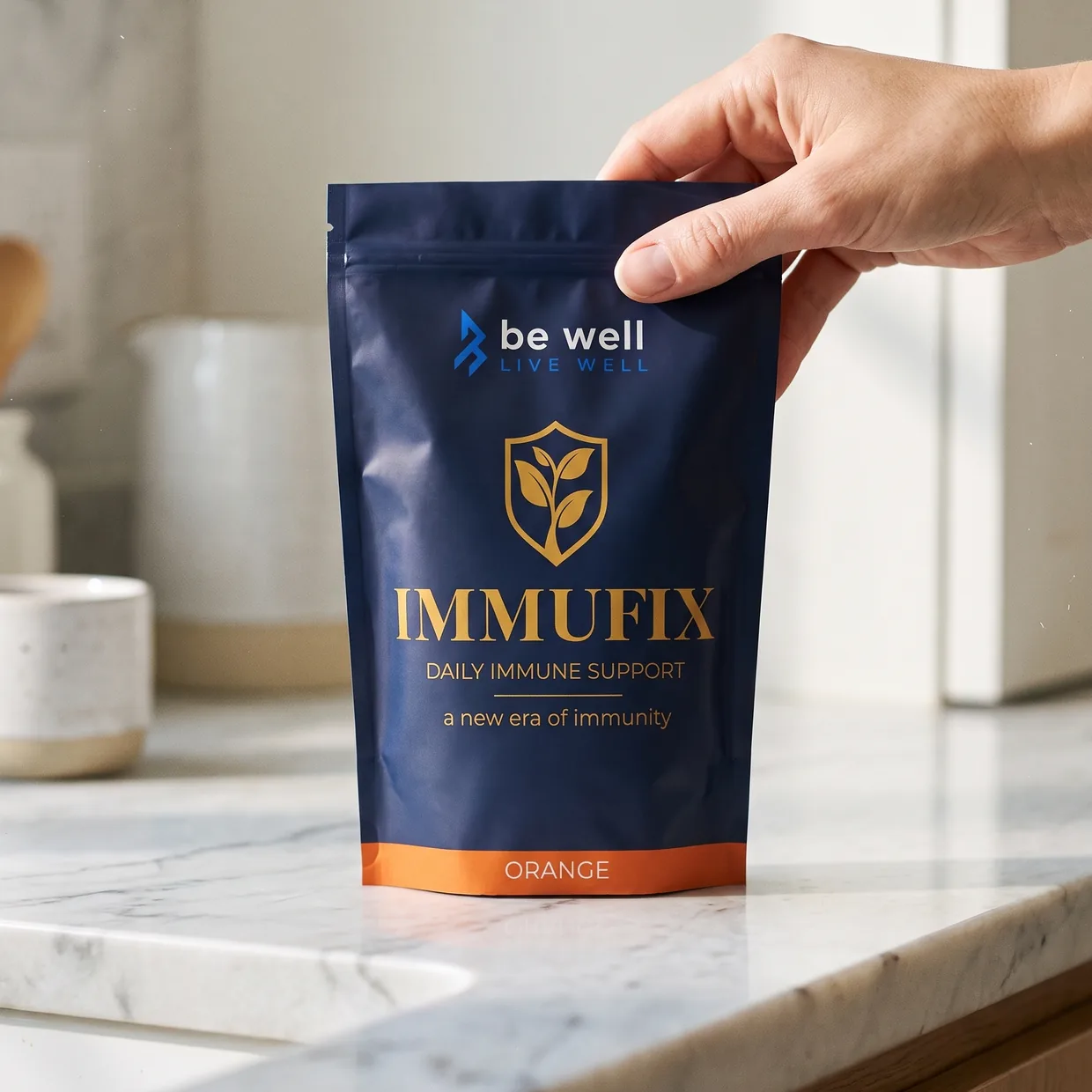
Immufix is one scoop (25g) in around 200ml of water, once a day. Each scoop provides 100mg of vitamin C, which is 125% of the NRV and, by our calculation, two and a half times the NHS figure of 40mg. That is a tenth of the NHS's 1,000mg line. Vitamin C contributes to the normal function of the immune system and to the reduction of tiredness and fatigue. Every amount in the formula is listed on the science page.
The short version.
- The NHS says adults need 40mg of vitamin C a day. Government tables give the same figure over 65.
- Labels use the NRV of 80mg, a labelling yardstick rather than a daily target.
- A varied diet with fruit and vegetables covers it for most people.
- The body cannot store vitamin C, so it is needed every day.
- The NHS says more than 1,000mg a day can cause side effects. Under 1,000mg from supplements is unlikely to cause any harm.
Food supplements should not be used as a substitute for a varied, balanced diet and a healthy lifestyle. If you have a medical condition, are pregnant, breastfeeding or taking medication, speak to your GP or pharmacist before taking any food supplement.

Daily Immune Support
Vitamins, minerals and plant nutrients in one daily scoop. The formula Paula Radcliffe has taken every day since 1998.
4.8 out of 5 · 89 reviewsDispatched the same day on weekday orders placed before 2pm.
Free standard UK delivery. Royal Mail 48 tracked, 2 to 3 working days. UK addresses only.
30‑day money-back guarantee. Try your first pouch of IMMUFIX for up to 30 days. If it’s not for you, we’ll refund your first qualifying pouch, less £10 shipping and handling. First purchase only. T&Cs apply.
Checkout completes securely on immufix.com
More from the journal.

What antioxidants are, in plain English.
What antioxidants are, what oxidative stress means in plain English, which nutrients hold the authorised claim, and the UK foods that provide them.
10 October 2026 · 7 min read
Biotin, what it does and where it is.
Biotin (vitamin B7) foods per 100g from UK government data, what the NHS says about biotin, its authorised claims and the NHS 0.9mg supplement guide.
10 October 2026 · 5 min read
What chromium is, and where you find it.
What chromium is, which foods contain it, how much the NHS says adults need, and the one authorised health claim chromium holds in Great Britain.
10 October 2026 · 6 min read