
How much fibre you need a day, and what most of us eat.
The UK recommendation is 30g of fibre a day for adults. The latest national survey puts the average adult at 16.4g, and only 4% of adults reach the target.
Quick answer. In the UK, adults are advised to eat 30g of fibre a day. The figure was set by the Scientific Advisory Committee on Nutrition (SACN) in 2015 and is used by the NHS and the British Nutrition Foundation. The average UK intake is far lower: the National Diet and Nutrition Survey 2019 to 2023 found adults aged 19 to 64 eat 16.4g a day, and only 4% of adults meet the 30g recommendation.
How much fibre a day in the UK?
Adults should aim for 30g a day. The number comes from SACN's Carbohydrates and Health report, published in July 2015, which recommends "that the dietary reference value for the average population intake of dietary fibre for adults should be 30g/day". The NHS puts it plainly: "Government guidelines say our dietary fibre intake should increase to 30g a day".
That 30g was a real increase. SACN explains that the previous reference value of 18g a day was measured with an older method, and "equates to about 23-24 g/day of dietary fibre" when analysed the way fibre is measured today.
How much fibre do children need?
SACN set lower amounts for children, rising with age:
- 2 to 5 years: about 15g a day.
- 5 to 11 years: about 20g a day.
- 11 to 16 years: about 25g a day.
- 16 to 18 years: about 30g a day, the same as adults.
What is the average fibre intake in the UK?
The most recent official figures come from the National Diet and Nutrition Survey (NDNS) report for 2019 to 2023, published on GOV.UK in June 2025. Average daily fibre intake was "16.4g for those aged 19 to 64 years". The report adds: "For adults, 4% met the fibre recommendation."
| Age group | Average intake a day | SACN recommendation |
|---|---|---|
| Children, 4 to 10 years | 14.5g | 15g to 20g |
| Children, 11 to 18 years | 15.4g | 25g to 30g |
| Adults, 19 to 64 years | 16.4g | 30g |
| Adults, 65 to 74 years | 16.9g | 30g |
| Adults, 75 years and over | 16.4g | 30g |
Averages from the NDNS 2019 to 2023 report. Recommendations from SACN (2015); the children's bands overlap the survey's age groups, so a range is shown.
You will see other averages quoted. The NHS fibre page says most adults eat "about 20g" a day, and the British Dietetic Association gives 18g. The NDNS report notes that a change in its dietary method in 2019 means the latest results cannot be compared directly with earlier survey years. Whichever figure you use, the typical adult eats around half to two thirds of the 30g.
Where does most of our fibre come from?
Bread, cereals and other grain foods. The NDNS report says "'Cereals and cereal products' were the main source of fibre for all age groups", providing 43% to 50% of average daily intake. Vegetables came second, at 19% to 25%. That makes the grain foods you already eat the easiest place to start: swapping white for wholemeal changes the number more than any single new food.
What counts as fibre?
SACN defines dietary fibre as carbohydrates that are not digested or absorbed in the small intestine and have chains of three or more sugar units, plus lignin. It also recommends that fibre is measured using AOAC methods, which is how the UK's food composition data reports it today. The British Nutrition Foundation's fibre page uses the same 30g target for adults and puts average UK intake at "about 16g per day".
On packs, two phrases have legal thresholds under the nutrition claims rules. "Source of fibre" needs at least 3g per 100g. "High fibre" needs at least 6g per 100g. Those two lines are a quick way to read a cereal box.
How can I get 30g of fibre a day?
SACN recommends "that fibre intakes should be achieved through a variety of food sources." Here is one ordinary day that reaches 30g, using standard portion sizes from the BDA and the NHS:
| Meal | What it is | Fibre |
|---|---|---|
| Breakfast | 40g porridge oats with 80g raspberries | 6.1g |
| Lunch | Baked potato with skin (180g) and 150g baked beans | 12.0g |
| Snack | One pear (80g) | 2.2g |
| Dinner | 150g cooked wholewheat spaghetti with 80g peas | 10.7g |
| Total | 31.0g |
Calculated from the government's Composition of Foods Integrated Dataset (CoFID) 2021, AOAC fibre, using porridge oats (dry), raw raspberries, baked old potato with skin, baked beans in tomato sauce, raw pear with skin, boiled wholewheat spaghetti and boiled frozen peas. Brands vary a little.

Five swaps that add up
Each figure below is calculated from CoFID 2021 for one standard portion:
- Two slices of white bread to wholemeal: from 2.0g to 4.9g.
- 30g of cornflakes to bran flakes: from 0.8g to 4.0g.
- 150g of cooked white rice to brown: from 0.8g to 2.3g.
- Add 150g of canned chickpeas to a curry or salad: plus 10.7g.
- Add 80g of raspberries to breakfast: plus 3.0g.
The BDA advises increasing fibre gradually rather than all at once, and drinking plenty of fluid as you do. For a longer list of foods with their numbers, read our guide to high fibre foods in the UK, and for the first meal of the day, our high fibre breakfast ideas.
Where Immufix fits.
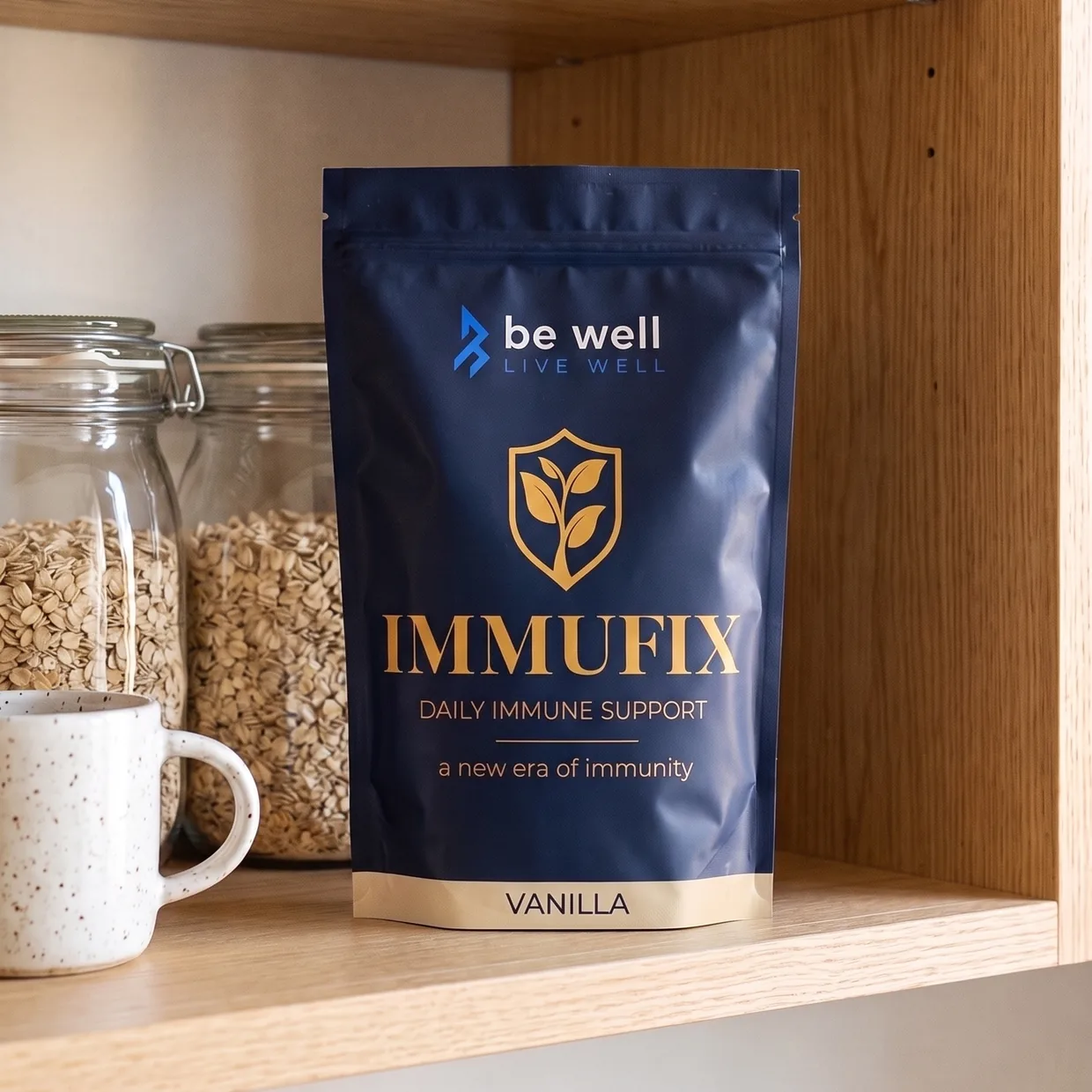
Fibre comes from food first, and the day above shows that 30g is reachable with ordinary meals. Immufix is a daily food supplement: one 25g scoop in around 200ml of water, once a day. Each scoop contains 6.9g of prebiotic FOS (fructo-oligosaccharides), a carbohydrate found naturally in foods such as onions and chicory. No authorised health claim applies to the FOS in Immufix, so we tell you the amount and nothing more; our explainer on what FOS is covers the rest. The scoop also provides vitamins and minerals: riboflavin, niacin and magnesium contribute to normal energy-yielding metabolism and to the reduction of tiredness and fatigue. Every amount is on the science page.
The short version.
- UK adults are advised to eat 30g of fibre a day (SACN, 2015). Children need 15g to 30g depending on age.
- The average adult aged 19 to 64 eats 16.4g a day, and only 4% of adults reach 30g (NDNS 2019 to 2023).
- Cereals and cereal products supply 43% to 50% of the fibre we eat, so wholemeal swaps matter most.
- Porridge, a baked potato with beans, a pear and wholewheat pasta with peas reach about 31g (calculated).
- Increase gradually and drink plenty of fluid, as the BDA advises.
Food supplements should not be used as a substitute for a varied, balanced diet and a healthy lifestyle. If you have a medical condition, are pregnant, breastfeeding or taking medication, speak to your GP or pharmacist before taking any food supplement.

Daily Immune Support
Vitamins, minerals and plant nutrients in one daily scoop. The formula Paula Radcliffe has taken every day since 1998.
4.8 out of 5 · 89 reviewsDispatched the same day on weekday orders placed before 2pm.
Free standard UK delivery. Royal Mail 48 tracked, 2 to 3 working days. UK addresses only.
30‑day money-back guarantee. Try your first pouch of IMMUFIX for up to 30 days. If it’s not for you, we’ll refund your first qualifying pouch, less £10 shipping and handling. First purchase only. T&Cs apply.
Checkout completes securely on immufix.com
More from the journal.

High fibre breakfasts, counted in grams.
The highest fibre breakfast cereals in the UK ranked per 100g and per bowl, plus seven easy high fibre breakfasts with fibre calculated from CoFID data.
10 October 2026 · 5 min read
The UK's high fibre foods, by the gram.
The UK foods with the most fibre, with AOAC fibre per 100g from the government's CoFID data and per standard portion, from bran and beans to fruit.
10 October 2026 · 6 min read
Looking for an AG1 alternative? The facts side by side.
Looking for an AG1 alternative in the UK? Serving size, pack price, sugars and format from each brand's own page, checked 10 October 2026.
10 October 2026 · 5 min read