
Where to find zinc in everyday food.
Meat, shellfish, cheese, bread and wheatgerm are the NHS's main sources of zinc. Here is how much each one carries, from the UK's own food composition data, and how to get more without changing much.
Quick answer. The NHS lists meat, shellfish, dairy foods such as cheese, bread and cereal products such as wheatgerm as good sources of zinc. In UK government food data (CoFID 2021), oysters lead at 59.2mg per 100g, followed by wheatgerm (14.0mg), lean stewed beef (8.6mg), crab (7.2mg), pumpkin seeds (6.6mg) and cashews (5.9mg). The NHS says men need about 9.5mg a day and women about 7mg, and that you should be able to get it all from your diet.
What foods have zinc?
The NHS page on other vitamins and minerals names five groups as good sources of zinc:
- Meat.
- Shellfish.
- Dairy foods, such as cheese.
- Bread.
- Cereal products, such as wheatgerm.
For the amounts, the reference is the Composition of Foods Integrated Dataset (CoFID), the UK government's food composition tables. All figures below are from its 2021 release, per 100g of food as described.
Which foods are highest in zinc?
| Food (as eaten) | Zinc per 100g | Group |
|---|---|---|
| Oysters, raw | 59.2mg | Shellfish |
| Wheatgerm | 14.0mg | Cereal product |
| Beef stewing steak, stewed, lean | 8.6mg | Meat |
| Crab, white meat, cooked | 7.2mg | Shellfish |
| Pumpkin seeds | 6.6mg | Seeds |
| Cashew nuts, plain | 5.9mg | Nuts |
| Rump steak, grilled, lean | 5.6mg | Meat |
| Sesame seeds | 5.3mg | Seeds |
| Beef mince, stewed | 5.0mg | Meat |
| Lamb leg, roasted, lean | 4.6mg | Meat |
| Cheddar cheese | 4.1mg | Dairy |
| Pork mince, stewed | 3.5mg | Meat |
| Mussels, cooked | 3.4mg | Shellfish |
| Porridge oats, dry | 2.3mg | Cereal product |
| Chicken thigh, casseroled | 2.1mg | Meat |
| Wholemeal bread | 1.6mg | Bread |
| Eggs, boiled | 1.3mg | Eggs |
| Red kidney beans, boiled | 0.88mg | Pulses |
| White bread, average | 0.7mg | Bread |
Two things stand out. Red meat and shellfish are the densest everyday sources. And per 100g, seeds and nuts compete with meat, although they are usually eaten in much smaller amounts.
Why cooked meat shows more zinc than raw.
CoFID lists lean stewing steak at 5.7mg per 100g raw and 8.6mg per 100g stewed. The zinc has not grown. Meat loses water as it cooks, so the same zinc sits in fewer grams. Compare like with like: raw with raw, cooked with cooked.
What about milk and yoghurt?
They are lower per 100g than cheese. CoFID gives 0.4mg for semi-skimmed milk and 0.7mg for whole plain yoghurt. They still count, because they are eaten in bigger servings and often every day.
How much zinc do you need a day?
The NHS gives two figures. It says the amount you need is about:
- "9.5mg a day for men (aged 19 to 64 years)"
- "7mg a day for women"
The UK Government Dietary Recommendations keep the same 9.5mg for men and 7.0mg for women at 65 to 74 and at 75 and over.
Food labels use a third number, the nutrient reference value (NRV), which for zinc is 10mg. It is a labelling yardstick that lets every pack use the same scale, not a personal target.
How can I increase zinc naturally?
The NHS view is that "You should be able to get all the zinc you need from your daily diet." Most of the gains come from small swaps rather than new foods:
- Choose wholemeal bread. CoFID gives 1.6mg per 100g for wholemeal against 0.7mg for average white bread, more than twice as much, by our calculation.
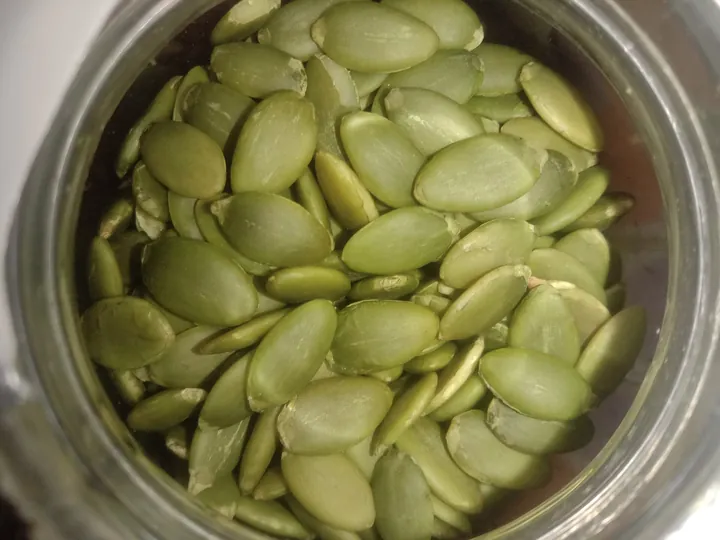
- Add seeds. Pumpkin seeds (6.6mg per 100g) and sesame seeds (5.3mg) go on porridge, salads or soup.
- Keep some cheese in the week. English Cheddar has 4.1mg per 100g.
- Eat oats. Dry porridge oats carry 2.3mg per 100g, and wheatgerm, at 14.0mg, can be stirred into them.
- Use red meat or shellfish when you eat them. A beef stew or a crab sandwich is one of the richest meals on the table.
- Pick chicken thighs over breast. CoFID lists casseroled thigh meat at 2.1mg per 100g and grilled breast at 0.8mg.
Zinc on a vegetarian or vegan diet.
Without meat and shellfish, the work falls to the other groups: cheese and other dairy, wholemeal bread, oats and wheatgerm, seeds, nuts and pulses. All of them are in the table above. Building one of them into each meal is a simple rule to follow. If you have questions about your own diet, a GP or a registered dietitian can help.
Can you have too much zinc?
Yes, from supplements. The NHS says: "Taking high doses of zinc reduces the amount of copper the body can absorb." Its advice is plain: "Do not take more than 25mg of zinc supplements a day unless advised to by a doctor."
If you take more than one supplement, add the zinc up across all of them.
What does zinc do?
Zinc holds these authorised health claims in Great Britain:
- Zinc contributes to the normal function of the immune system.
- Zinc contributes to normal cognitive function.
- Zinc contributes to the maintenance of normal hair, nails and skin.
- Zinc contributes to the protection of cells from oxidative stress.
- Zinc contributes to normal macronutrient metabolism.
Vitamin C shares the immune claim. Our guide to the highest vitamin C foods covers that side of the plate.
Where Immufix fits.
Food comes first. Immufix is one scoop (25g) in around 200ml of water, once a day, and each scoop provides 3.75mg of zinc, 38% of the NRV. By our calculation that is just over half the NHS figure for women and around two fifths of the figure for men, well under the NHS's 25mg ceiling. Zinc contributes to the normal function of the immune system and to the maintenance of normal hair, nails and skin. The full formula is on the science page.
The short version.
- The NHS's sources of zinc are meat, shellfish, cheese and other dairy, bread and cereal products such as wheatgerm.
- Per 100g, oysters (59.2mg), wheatgerm (14.0mg), lean stewed beef (8.6mg) and crab (7.2mg) lead the UK data.
- The NHS says men need about 9.5mg a day and women about 7mg.
- Wholemeal bread, seeds, oats and cheese are easy ways to add more.
- Do not take more than 25mg of zinc from supplements a day unless a doctor advises it.
Food supplements should not be used as a substitute for a varied, balanced diet and a healthy lifestyle. If you have a medical condition, are pregnant, breastfeeding or taking medication, speak to your GP or pharmacist before taking any food supplement.

Daily Immune Support
Vitamins, minerals and plant nutrients in one daily scoop. The formula Paula Radcliffe has taken every day since 1998.
4.8 out of 5 · 89 reviewsDispatched the same day on weekday orders placed before 2pm.
Free standard UK delivery. Royal Mail 48 tracked, 2 to 3 working days. UK addresses only.
30‑day money-back guarantee. Try your first pouch of IMMUFIX for up to 30 days. If it’s not for you, we’ll refund your first qualifying pouch, less £10 shipping and handling. First purchase only. T&Cs apply.
Checkout completes securely on immufix.com
More from the journal.
What antioxidants are, in plain English.
What antioxidants are, what oxidative stress means in plain English, which nutrients hold the authorised claim, and the UK foods that provide them.
10 October 2026 · 7 min read
Biotin, what it does and where it is.
Biotin (vitamin B7) foods per 100g from UK government data, what the NHS says about biotin, its authorised claims and the NHS 0.9mg supplement guide.
10 October 2026 · 5 min readWhat chromium is, and where you find it.
What chromium is, which foods contain it, how much the NHS says adults need, and the one authorised health claim chromium holds in Great Britain.
10 October 2026 · 6 min read