
High fibre breakfasts, counted in grams.
Bran cereals, shredded wheat and beans on wholemeal toast lead the numbers. Here are the UK's breakfast cereals ranked by fibre, and seven breakfasts with their fibre calculated from government data.

Quick answer. In the UK government's food composition data (CoFID 2021, AOAC fibre), the highest fibre breakfast cereals are bran-type cereals (24.6g per 100g), bran flakes (13.4g), shredded wheat (12.2g) and wheat biscuits (9.7g), against 2.6g for cornflakes. For a high fibre breakfast, pair one of them, or porridge, with fruit: 40g of shredded wheat with 80g of raspberries gives about 7.8g of fibre (calculated), roughly a quarter of the 30g a day UK adults are advised to eat. Baked beans on two slices of wholemeal toast give about 12.3g.
What are the highest fibre cereals in the UK?
A cereal can only be labelled "high fibre" if it contains at least 6g of fibre per 100g, under the nutrition claims rules. Here is how the main types of UK breakfast cereal compare, per 100g and per standard bowl. Bowl sizes are the British Dietetic Association's portion sizes: 30g for flaked and puffed cereals and wheat biscuits, 40g for porridge oats and shredded cereals, 45g for muesli and granola.
| Cereal type | Fibre per 100g | Bowl | Fibre per bowl |
|---|---|---|---|
| Bran-type cereal | 24.6g | Not given | n/a |
| Bran flakes | 13.4g | 30g | 4.0g |
| Shredded wheat | 12.2g | 40g | 4.9g |
| Wheat biscuits (Weetabix type) | 9.7g | 30g | 2.9g |
| Fruit and fibre type | 8.6g | 30g | 2.6g |
| Swiss style muesli, no added sugar | 8.5g | 45g | 3.8g |
| Porridge oats | 7.8g | 40g | 3.1g |
| Crunchy clusters, without nuts | 7.2g | 45g | 3.2g |
| Multigrain hoops | 5.7g | 30g | 1.7g |
| Cornflakes | 2.6g | 30g | 0.8g |
| Toasted rice cereal | 0.7g | 30g | 0.2g |
CoFID 2021, AOAC fibre, dry cereal. Fibre per bowl is calculated. Milk adds no fibre. Brands vary, so check the pack: the per 100g column on the label is the one to compare.
The top four all clear the 6g mark comfortably. The NHS names the same family, suggesting "plain wholewheat biscuits (like Weetabix)", "plain shredded whole grain (like Shredded Wheat)" and porridge, because "oats are also a good source of fibre."
What is a good high fibre breakfast?
A high fibre cereal or bread plus fruit, nuts or beans. Each breakfast below is calculated from CoFID 2021 using the BDA's portion sizes and the NHS adult portion of fruit, 80g.
| Breakfast | Fibre |
|---|---|
| Two slices of wholemeal toast (70g) with 150g baked beans | 12.3g |
| 40g porridge oats made with milk, 80g blackberries and 30g almonds | 9.6g |
| 40g shredded wheat with milk and 80g raspberries | 7.8g |
| 30g bran flakes with milk and 80g strawberries | 7.1g |
| 40g overnight oats with Greek style yoghurt and 80g raspberries | 6.1g |
| 45g no-added-sugar muesli with milk and 80g chopped pear | 6.0g |
| 30g wheat biscuits with milk and 80g banana | 4.0g |
| For comparison: 30g cornflakes with milk | 0.8g |
| For comparison: two slices of white toast | 2.0g |
Calculated from CoFID 2021, AOAC fibre: wholemeal bread, baked beans in tomato sauce, porridge oats (dry weight), raw blackberries, raspberries, strawberries and pear with skin, whole almonds, shredded wheat type cereal, bran flakes, Swiss style muesli with no added sugar, wheat biscuits, banana flesh, cornflakes and white bread. Milk and plain Greek style yoghurt add no fibre (0g in CoFID).
The NHS gives its own example: "2 slices of wholemeal toast with peanut butter followed by a medium-size orange should give you around 8.3g of fibre."
Is porridge a high fibre breakfast?
Porridge oats are high fibre by the label definition, at 7.8g per 100g dry. A standard 40g bowl gives 3.1g (calculated), so the bowl itself is a good start rather than a big total. The toppings make the difference. Add 80g of raspberries or blackberries and you gain about 3g. A 30g handful of almonds adds 3.8g. Ready-to-eat dried figs add 3.0g per 30g.
If you run in the morning, our guide to porridge before running covers timing and portion sizes.
Is wholemeal toast high in fibre?
Yes. Wholemeal bread has 7.0g of fibre per 100g in CoFID, against 5.0g for brown and 2.9g for white. Two medium slices (the BDA gives 34g to 36g a slice) come to about 4.9g of fibre for wholemeal and 2.0g for white (calculated). Topped with 150g of baked beans, which add 7.4g, wholemeal toast is the highest fibre breakfast in the table above.
How can I add fibre to breakfast without changing cereal?
Keep the cereal you like and build around it. Each figure is calculated from CoFID 2021 for a standard portion:
- Berries: 80g of strawberries or raspberries adds 3.0g, blackberries 2.7g. Frozen berries work just as well.
- Pear or kiwi: 80g adds 2.2g. A banana adds 1.1g.
- Nuts: a 30g handful of almonds adds 3.8g, dry roasted peanuts 2.3g.
- Dried fruit: 30g of ready-to-eat figs adds 3.0g, dates 2.3g, prunes 1.6g.
- Half and half: mix a low fibre cereal with bran flakes or shredded wheat.
For the daily target and how the UK average compares, read how much fibre you need a day, and for the rest of the day, our table of high fibre foods.
Where Immufix fits.
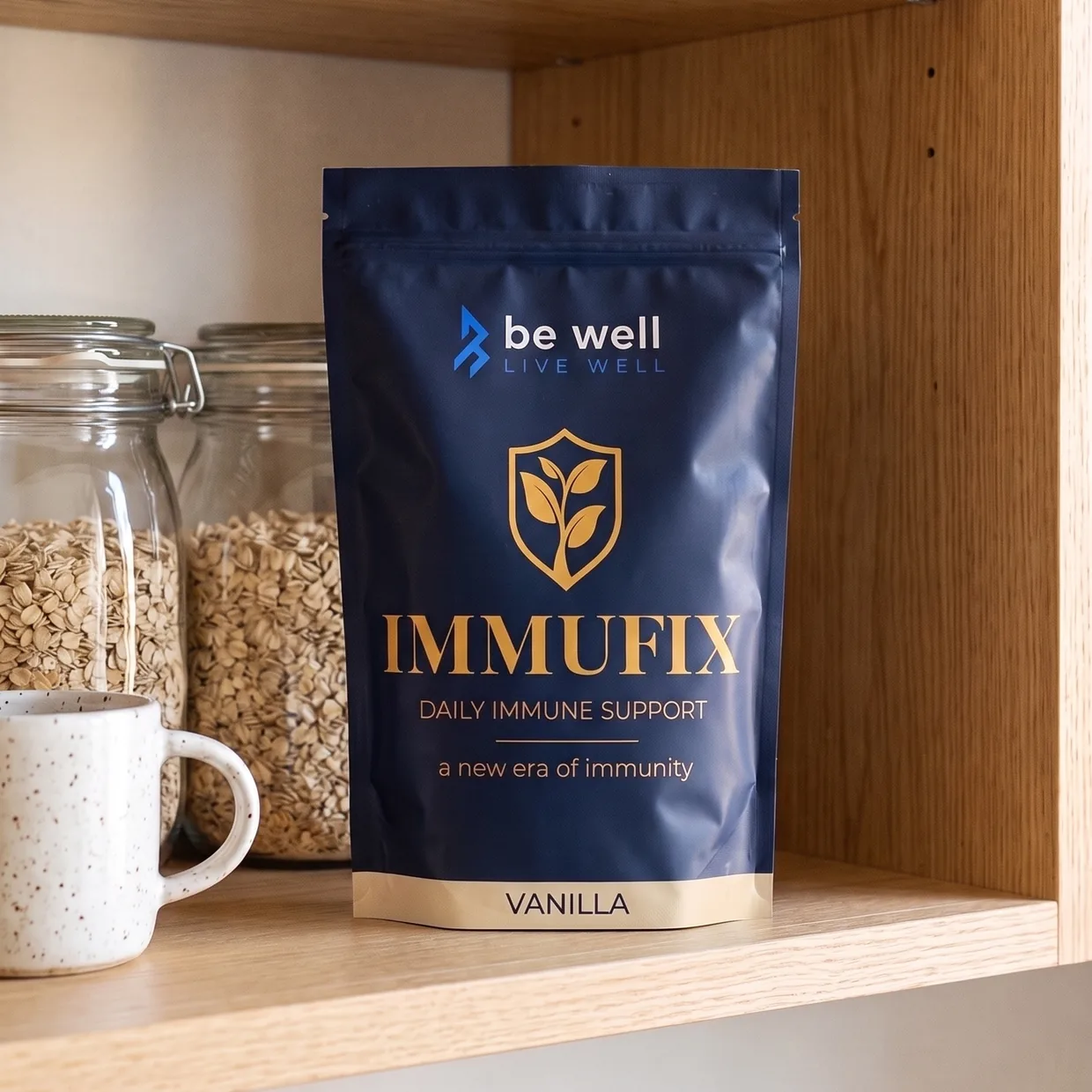
Many people take Immufix with breakfast, so the habit sits next to one they already have. It is a drink, not a cereal topping: one 25g scoop in around 200ml of water, once a day. Each scoop has 75 kcal and contains 6.9g of prebiotic FOS. No authorised health claim applies to the FOS in Immufix, so we state the amount only; read what FOS is for the detail. The scoop also provides vitamins and minerals. Vitamin C, riboflavin, niacin, pantothenic acid, vitamin B6, folic acid and magnesium contribute to the reduction of tiredness and fatigue. Paula Radcliffe has taken it every morning since 1998. Every amount is on the science page.
The short version.
- The highest fibre UK cereals per 100g are bran-type (24.6g), bran flakes (13.4g), shredded wheat (12.2g) and wheat biscuits (9.7g). Cornflakes have 2.6g.
- "High fibre" on a label means at least 6g per 100g.
- Beans on two slices of wholemeal toast give about 12.3g; shredded wheat with raspberries about 7.8g (calculated).
- Porridge is high fibre per 100g, but a 40g bowl gives 3.1g. Berries and nuts lift it to nearly 10g.
- Fruit, nuts and dried fruit add 1g to 4g each to any breakfast.
Food supplements should not be used as a substitute for a varied, balanced diet and a healthy lifestyle. If you have a medical condition, are pregnant, breastfeeding or taking medication, speak to your GP or pharmacist before taking any food supplement.

Daily Immune Support
Vitamins, minerals and plant nutrients in one daily scoop. The formula Paula Radcliffe has taken every day since 1998.
4.8 out of 5 · 89 reviewsDispatched the same day on weekday orders placed before 2pm.
Free standard UK delivery. Royal Mail 48 tracked, 2 to 3 working days. UK addresses only.
30‑day money-back guarantee. Try your first pouch of IMMUFIX for up to 30 days. If it’s not for you, we’ll refund your first qualifying pouch, less £10 shipping and handling. First purchase only. T&Cs apply.
Checkout completes securely on immufix.com
More from the journal.
The UK's high fibre foods, by the gram.
The UK foods with the most fibre, with AOAC fibre per 100g from the government's CoFID data and per standard portion, from bran and beans to fruit.
10 October 2026 · 6 min readHow much fibre you need a day, and what most of us eat.
UK adults are advised to eat 30g of fibre a day. The average adult eats 16.4g. The official figures, children's targets and simple ways to reach 30g.
10 October 2026 · 6 min read
Looking for an AG1 alternative? The facts side by side.
Looking for an AG1 alternative in the UK? Serving size, pack price, sugars and format from each brand's own page, checked 10 October 2026.
10 October 2026 · 5 min read