
What FOS is, and where it is found.
FOS, short for fructo-oligosaccharides, is a family of short carbohydrate chains found naturally in onions, chicory, garlic, asparagus, bananas and artichokes. Here is what it is made of and how it differs from inulin.
Quick answer. Yes, FOS (fructo-oligosaccharides) is classed as a prebiotic in the scientific literature. It is made of short chains of fructose units, and a 2009 review lists foods that contain it naturally: "onion, chicory, garlic, asparagus, banana, artichoke, among many others." FOS and inulin belong to the same family of carbohydrates, called fructans. The difference is chain length: FOS (also called oligofructose) has short chains of up to about 10 units, while inulin chains run up to about 60.
What is FOS?
FOS stands for fructo-oligosaccharides. The name describes the chemistry. "Fructo" means the chain is built from fructose, the sugar found in fruit. "Oligosaccharide" means a carbohydrate made of a few sugar units joined together, rather than one or two (like table sugar) or hundreds (like starch).
The review by Sabater-Molina and colleagues, published in the Journal of Physiology and Biochemistry, describes FOS as "composed of linear chains of fructose units, linked by beta (2-1) bonds", which "often terminate in a glucose unit." In plain English: a short, straight string of fructose units, usually with one glucose unit at the end.
The UK's Scientific Advisory Committee on Nutrition (SACN), in its Carbohydrates and Health report, groups FOS with the "non-digestible oligosaccharides", alongside raffinose, stachyose and verbascose, which are found in peas, beans and lentils.
FOS also has a taste. A 1999 paper in the Journal of Nutrition notes that "Oligofructose has a sweet, pleasant flavor and is highly soluble", and the same paper describes its use to improve the flavour and sweetness of lower calorie foods.
Is FOS a prebiotic?
Yes. Reviews in the Journal of Nutrition describe both oligofructose (FOS) and inulin as prebiotics, and "prebiotic FOS" is the usual name for the ingredient on food and supplement labels. The scientific definition of a prebiotic was last updated in 2017 by an expert panel of the International Scientific Association for Probiotics and Prebiotics, published as a consensus statement.
Being called a prebiotic is not the same as having an authorised health claim. In Great Britain, what a food or supplement may say a nutrient does is set by law. No authorised health claim applies to the FOS in Immufix, so on this site we describe what FOS is, where it is found and how much there is, and nothing more. Our guide to how to read a supplement label explains how claims work.
Which foods contain FOS naturally?
FOS and inulin are storage carbohydrates in plants: the plant's way of keeping energy in reserve. SACN's report says fructans "are the storage carbohydrates in artichokes and chicory", with "small amounts of low molecular weight forms found in wheat, rye, asparagus and members of the onion, leek and garlic family."
Putting the two sources together, the foods named are:
- Onions and garlic: named by both SACN and the 2009 review. SACN adds leeks, from the same family.
- Chicory and artichokes: named by both sources. SACN calls fructans their storage carbohydrate.
- Asparagus: named by both sources.
- Bananas: named in the 2009 review.
- Wheat and rye: small amounts, according to SACN.
Wheat and onions matter most in practice, because people eat them so often. SACN states: "The main source of inulin-type fructans in a typical Western diet are wheat and onions."
How much FOS do people eat?
Estimates vary. SACN notes that intake of these carbohydrates in the UK "is not available from the National Diet and Nutrition Survey." It cites an estimate that intake of inulin-type fructans "ranges between 1 and 4 g/day", and a study of 66 people in the UK that estimated mean intakes of about 4.0g a day of inulin and 3.8g a day of oligofructose.
Why is FOS missing from food tables?
Because the standard fibre tests were not designed to measure it. A 1995 review by van Loo and colleagues found that "Inulin and oligofructose are not measured by classic methods of dietary fiber analysis and consequently are often not mentioned in food tables." The UK's own food composition dataset (CoFID) has no FOS column. Its user guide explains that where oligosaccharides are present, "they are not always measured separately and may be included in the starch, sugar or fibre fractions".
So you will not find an FOS figure for an onion in the government tables. Published amounts come from specialist studies; van Loo's review, for example, also measured how much is lost during storage and preparation.
FOS vs inulin: what is the difference?
They are the same kind of molecule at different lengths. Inulin is the long-chain form and FOS (oligofructose) the short-chain form. The 1999 Journal of Nutrition paper puts it simply: "Oligofructose is a subgroup of inulin, consisting of polymers with a degree of polymerization (DP) ≤10." Degree of polymerisation just means the number of sugar units in the chain.
A 2007 review by Roberfroid gives the typical ranges for the different forms:
| Form | Chain length (units) | Average chain length |
|---|---|---|
| Oligofructose (FOS) | 2 to 8 | 4 |
| Native inulin (as found in plants) | 2 to 60 | 12 |
| Inulin HP (long-chain inulin) | 10 to 60 | 25 |
Source: Roberfroid (2007), Journal of Nutrition. Different papers draw the line between FOS and inulin at slightly different points, but 10 units is the usual cut-off.
Chain length changes how they behave in food. The shorter chains of FOS taste sweet and dissolve easily. The 1999 paper describes commercial inulin as having "a neutral, clean flavor", and it is used to change the texture of foods. In plants the two come as one mixture. SACN notes that the chain length of inulin "varies from 2-60 sugar units", so a native inulin contains short FOS-length chains as well as long ones.
Where Immufix fits.
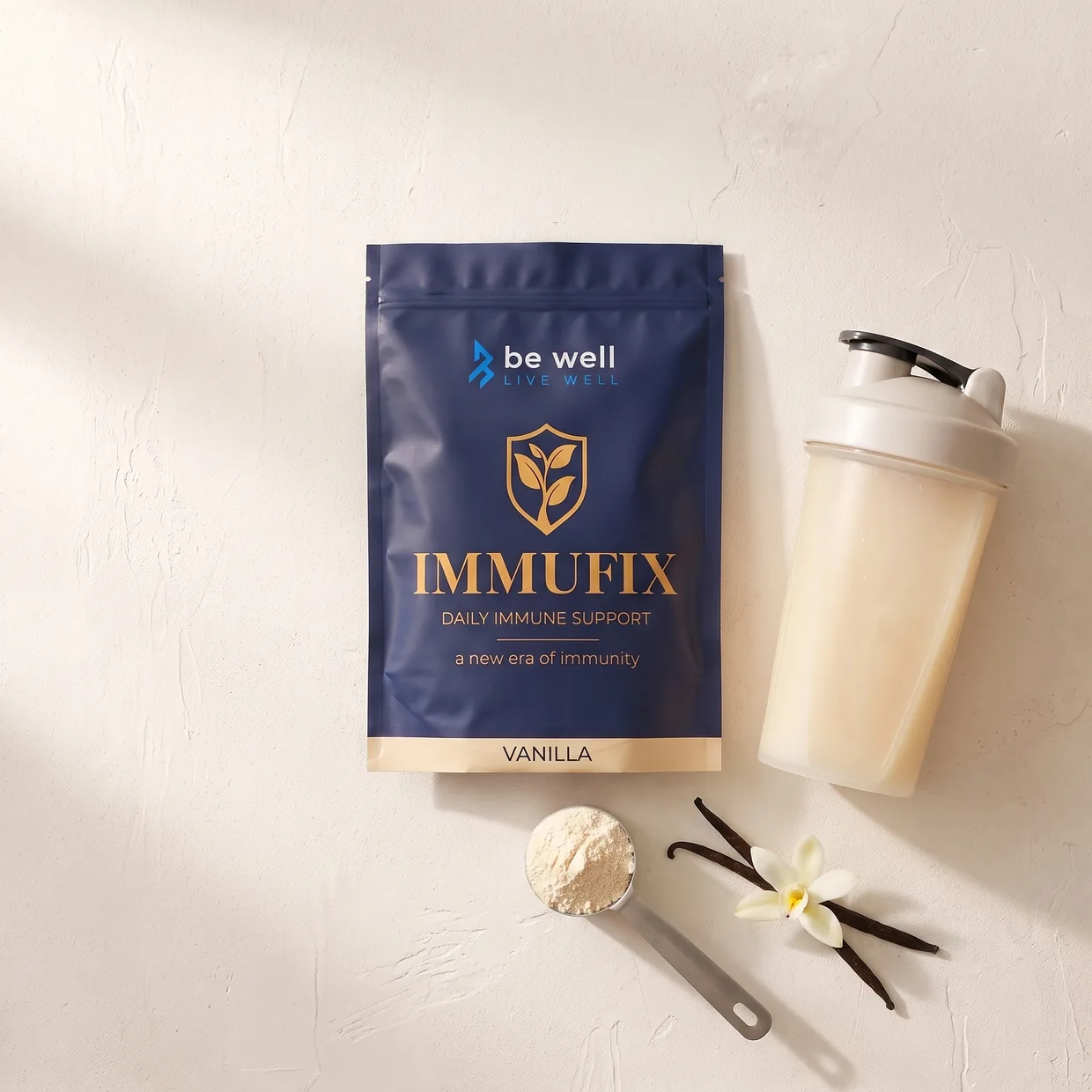
Immufix is a daily food supplement: one 25g scoop in around 200ml of water, once a day. Each scoop contains 6.9g of prebiotic FOS. No authorised health claim applies to it, so the amount is all we state. The scoop also provides vitamins and minerals that do carry authorised claims. Thiamin, riboflavin, niacin, vitamin B6 and biotin contribute to normal energy-yielding metabolism. Paula Radcliffe has taken it every morning since 1998. Every amount is on the science page, and our guide to high fibre foods lists the everyday foods with the most fibre.
The short version.
- FOS (fructo-oligosaccharides) are short chains of fructose units, usually ending in one glucose unit.
- FOS is classed as a prebiotic in the scientific literature. In Great Britain, no authorised health claim applies to the FOS in Immufix.
- Foods that contain it naturally include onions, leeks, garlic, chicory, artichokes, asparagus and bananas. In a typical Western diet, wheat and onions supply the most.
- FOS and inulin are both fructans. FOS has up to about 10 units per chain, inulin up to about 60.
- FOS is not listed in the UK's food composition tables because standard fibre tests do not measure it.
Food supplements should not be used as a substitute for a varied, balanced diet and a healthy lifestyle. If you have a medical condition, are pregnant, breastfeeding or taking medication, speak to your GP or pharmacist before taking any food supplement.

Daily Immune Support
Vitamins, minerals and plant nutrients in one daily scoop. The formula Paula Radcliffe has taken every day since 1998.
4.8 out of 5 · 89 reviewsDispatched the same day on weekday orders placed before 2pm.
Free standard UK delivery. Royal Mail 48 tracked, 2 to 3 working days. UK addresses only.
30‑day money-back guarantee. Try your first pouch of IMMUFIX for up to 30 days. If it’s not for you, we’ll refund your first qualifying pouch, less £10 shipping and handling. First purchase only. T&Cs apply.
Checkout completes securely on immufix.com
More from the journal.
Choline and inositol, side by side.
Choline is an essential nutrient found mainly in eggs, liver, meat and fish. Inositol is a ring-shaped compound found in grains, beans, nuts and fruit.
10 October 2026 · 6 min read
Citrus bioflavonoids, explained.
Citrus bioflavonoids are the flavonoids in citrus fruit, such as hesperidin and naringin. Where they are found, how much fruit holds, and the 28mg in Immufix.
10 October 2026 · 5 min readFood state vitamins, what the words mean.
Food state and food grown describe vitamins and minerals cultivated within a food-like matrix such as yeast. What the terms mean, and what UK law says.
10 October 2026 · 6 min read