
Choline and inositol, side by side.
Choline and inositol sit next to each other on the Immufix label, at 1.25mg each. They are often mentioned together, but they are quite different compounds, found in different foods.
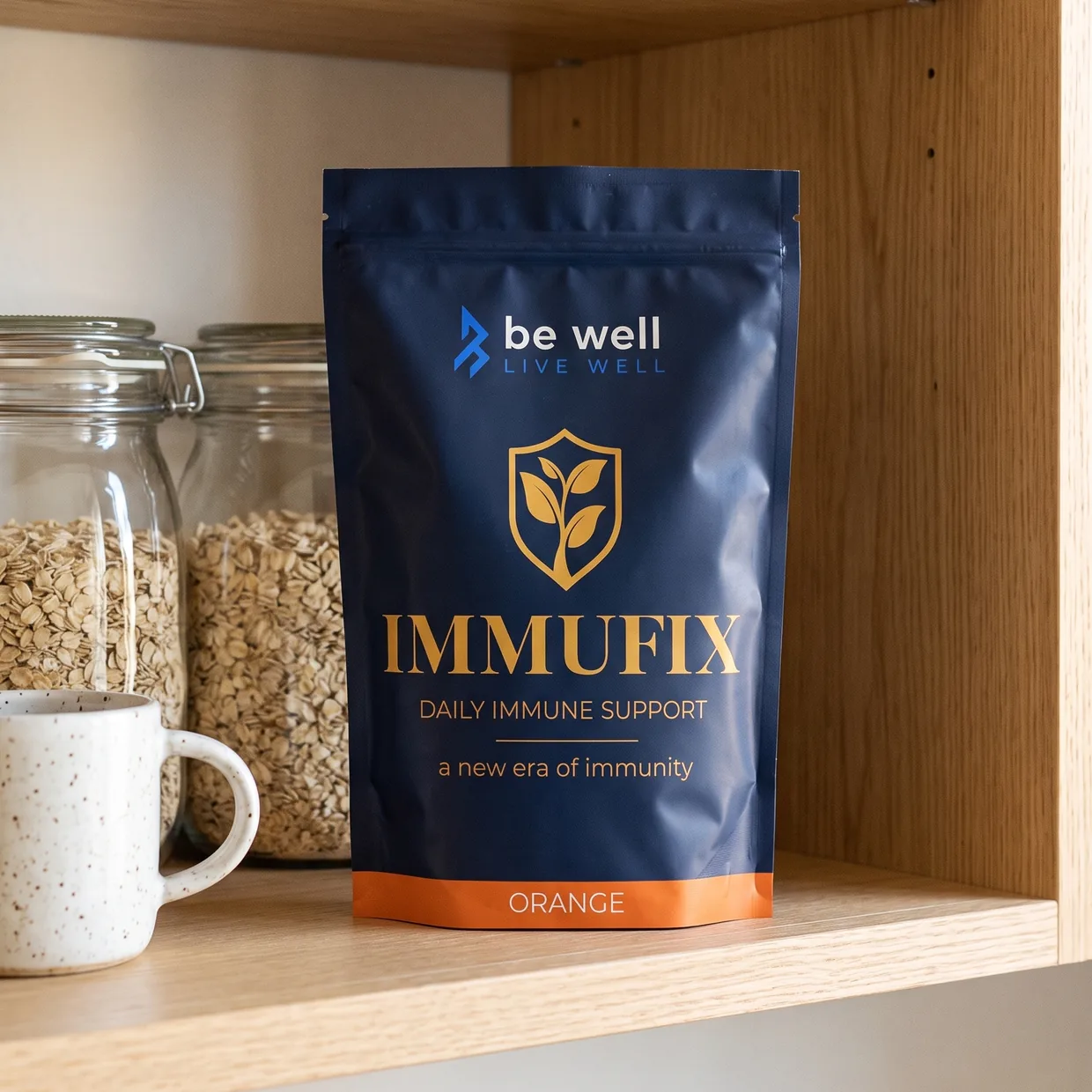
Quick answer. Choline is a nutrient that the body makes only in part, so most has to come from food. The European Food Safety Authority (EFSA) set an adequate intake of 400mg a day for adults in 2016, and the richest sources are liver, eggs, meat and fish. Inositol is a ring-shaped compound related to sugars, mostly found as myo-inositol. The body makes several grams a day, and food adds more from grains, beans, nuts and fruit. Immufix contains 1.25mg of each per scoop, far below any amount that could carry a claim, and we make no claim for either.
What is choline?
Choline is a small nitrogen-containing compound. A 2018 review in Nutrients describes it as "an essential nutrient for humans", and explains why: the body can make some choline itself, but this is not normally enough, so the rest has to come from the diet.
Its status is fairly recent. The same review records that "In 1998, the Institute of Medicine recognized choline as an essential nutrient and established dietary intake recommendations", and that "the European Food Safety Authority set dietary recommendations for choline in 2016".
Choline comes in several forms in food. The review lists them: "In foods, choline is found as both water-soluble (free choline, phosphocholine, and glycerophosphocholine) and lipid-soluble forms (phosphatidylcholine and sphingomyelin)". Food tables add these together and report "total choline".
How much choline do adults need?
EFSA did not find enough evidence to set an average requirement, so it set an adequate intake instead. For adults, the Nutrients review reports, "the AI was set at 400 mg/day based on the mean choline intake from healthy populations observed in the European Union". The same 400mg applies to men and women.
Which foods contain choline?
Animal foods contain the most. The review states that "Foods that contain the highest content of choline include liver, eggs, beef, fish, pork, and chicken", and that "Milk is also a good food source for total choline, as it is usually consumed on a daily basis." Soya beans, wheat germ, peanuts and some green vegetables also contain choline.
These are total choline figures per 100g from the USDA Database for the Choline Content of Common Foods (Release Two, 2008):
| Food | Total choline | Per |
|---|---|---|
| Beef liver, pan-fried | 420mg | 100g |
| Egg, whole, hard-boiled | 230mg | 100g |
| Wheat germ, toasted | 180mg | 100g |
| Soya beans, mature, raw | 120mg | 100g |
| Salmon, Atlantic, farmed, cooked | 91mg | 100g |
| Cod, Atlantic, cooked | 84mg | 100g |
| Beef mince (85% lean), cooked | 82mg | 100g |
| Chicken breast, rotisserie | 62mg | 100g |
| Peanuts, raw | 53mg | 100g |
| Brussels sprouts, boiled | 41mg | 100g |
| Broccoli, boiled | 40mg | 100g |
| Whole milk | 14mg | 100g |
Most of the choline in eggs sits in the yolk: the database lists 680mg per 100g of raw yolk and 1.1mg per 100g of raw white.
What is inositol?
Inositol is a ring of six carbon atoms, each carrying an alcohol group. Chemists call it a hexahydroxycyclohexane. It is related to the sugars and tastes slightly sweet, which is part of how it got its name.
A 2021 review in the International Journal of Molecular Sciences traces it back to 1850, when the German physician and chemist Johann Joseph Scherer "isolated a hexahydroxycyclohexane from muscle cells and named this molecule 'Inositol'". The review explains that the structure "allows the formation of nine different isomers", and that "Myo-inositol and D-chiro-inositol are the most common isomers of inositol."
Unlike choline, inositol is made in quantity by the body. The review estimates that "about 1 g/day" comes from the diet, while about 4g a day is made in the body, mostly by the kidneys. The body makes it from glucose.
Which foods contain inositol?
Plant foods, mainly. A 1980 paper in the American Journal of Clinical Nutrition, which measured 487 foods. It found that "the greatest amounts of myo-inositol were present in fruits, beans, grains, and nuts", and that "Fresh vegetables and fruits were found to contain more myo-inositol than did frozen, canned, or salt-free products."
The 2021 review names "cereals, legumes, oil seeds and nuts" as the main dietary sources. Put together, the two sources point to four food groups:
- Grains and cereal foods.
- Beans and other legumes.
- Nuts and oil seeds.
- Fruit, fresh rather than canned or frozen.
The 1980 study used its figures to design diets providing between 225mg and 1,500mg of myo-inositol a day, for every 1,800kcal eaten.
How much choline and inositol is in Immufix?
A little of each: 1.25mg of choline and 1.25mg of inositol per 25g scoop. These are small amounts, and we would rather say so plainly.
To put the choline in context: 1.25mg is about what you would get from half a gram of hard-boiled egg, or 9g of whole milk, using the USDA figures above (calculated). The 1.25mg of inositol is about 0.1% of the 1g a day the 2021 review estimates comes from food (calculated).
Can Immufix make a claim for choline or inositol?
No. For inositol the answer is simple: every inositol entry on the GB nutrition and health claims register is "Non-authorised".
Choline is different. The register does include authorised claims for choline, but each comes with a condition: "The claim may be used only for food which contains at least 82,5 mg of choline per 100 g or 100 ml or per single portion of food." A scoop of Immufix contains 1.25mg, which is about 1.5% of that minimum (calculated). Per 100g of powder it would be 5mg (calculated). Either way, Immufix is nowhere near the threshold, so no choline claim can be made for it, and we make none. Our guide to authorised health claims explains how these conditions work, and what NRV means covers the related 15% rule for vitamins and minerals.
Where Immufix fits.
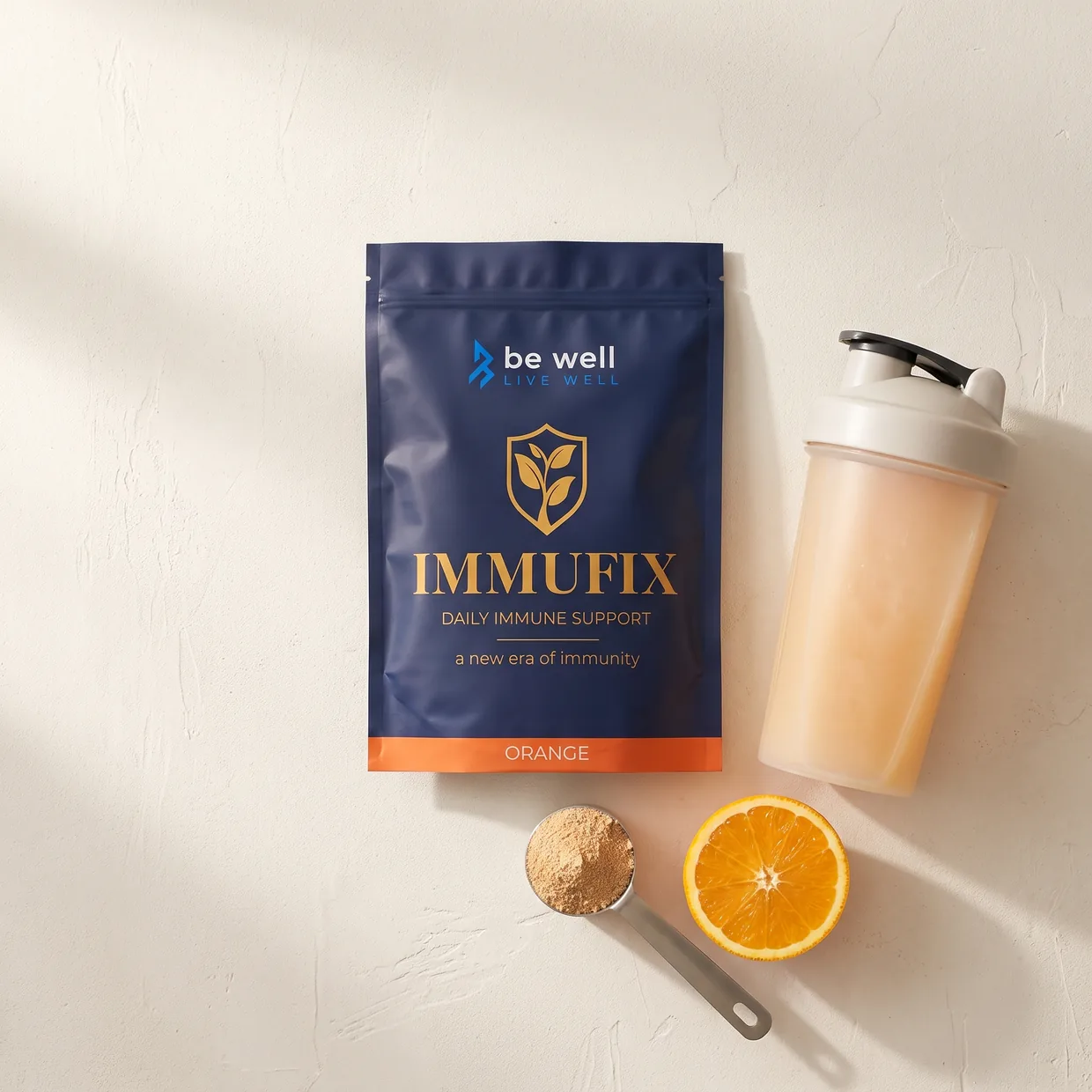
Immufix is one scoop (25g) in around 200ml of water, once a day. Choline and inositol are on the label at 1.25mg each, declared so that you know exactly what is in the scoop. The claims on our pack belong to the vitamins and minerals present at 15% of the NRV or more. Niacin and pantothenic acid contribute to normal energy-yielding metabolism. Iodine contributes to normal cognitive function. The full label is on the science page.
The short version.
- Choline is an essential nutrient: the body makes some, but not normally enough. EFSA's adequate intake for adults is 400mg a day.
- Liver, eggs, beef, fish, pork and chicken are the richest sources of choline. A hard-boiled egg has about 230mg per 100g.
- Inositol is a six-carbon ring compound, mostly myo-inositol. The body makes about 4g a day, and food adds about 1g from grains, beans, nuts and fruit.
- Immufix contains 1.25mg of each, far below the 82.5mg per portion needed for any choline claim. Inositol has no authorised claim.
- We make no claim for choline or inositol.
Food supplements should not be used as a substitute for a varied, balanced diet and a healthy lifestyle. If you have a medical condition, are pregnant, breastfeeding or taking medication, speak to your GP or pharmacist before taking any food supplement.

Daily Immune Support
Vitamins, minerals and plant nutrients in one daily scoop. The formula Paula Radcliffe has taken every day since 1998.
4.8 out of 5 · 89 reviewsDispatched the same day on weekday orders placed before 2pm.
Free standard UK delivery. Royal Mail 48 tracked, 2 to 3 working days. UK addresses only.
30‑day money-back guarantee. Try your first pouch of IMMUFIX for up to 30 days. If it’s not for you, we’ll refund your first qualifying pouch, less £10 shipping and handling. First purchase only. T&Cs apply.
Checkout completes securely on immufix.com
More from the journal.
Citrus bioflavonoids, explained.
Citrus bioflavonoids are the flavonoids in citrus fruit, such as hesperidin and naringin. Where they are found, how much fruit holds, and the 28mg in Immufix.
10 October 2026 · 5 min readFood state vitamins, what the words mean.
Food state and food grown describe vitamins and minerals cultivated within a food-like matrix such as yeast. What the terms mean, and what UK law says.
10 October 2026 · 6 min read
Soya isoflavones, food by food.
Soya isoflavones are plant compounds found mainly in soya beans. What they are, which soy foods contain the most, and the 45mg in a scoop of Immufix.
10 October 2026 · 5 min read