
Citrus bioflavonoids, explained.
Citrus bioflavonoids appear on plenty of supplement labels, often without a word of explanation. They are a family of plant compounds found in oranges, lemons, grapefruit and mandarins, and most of them sit in the peel rather than the juice.
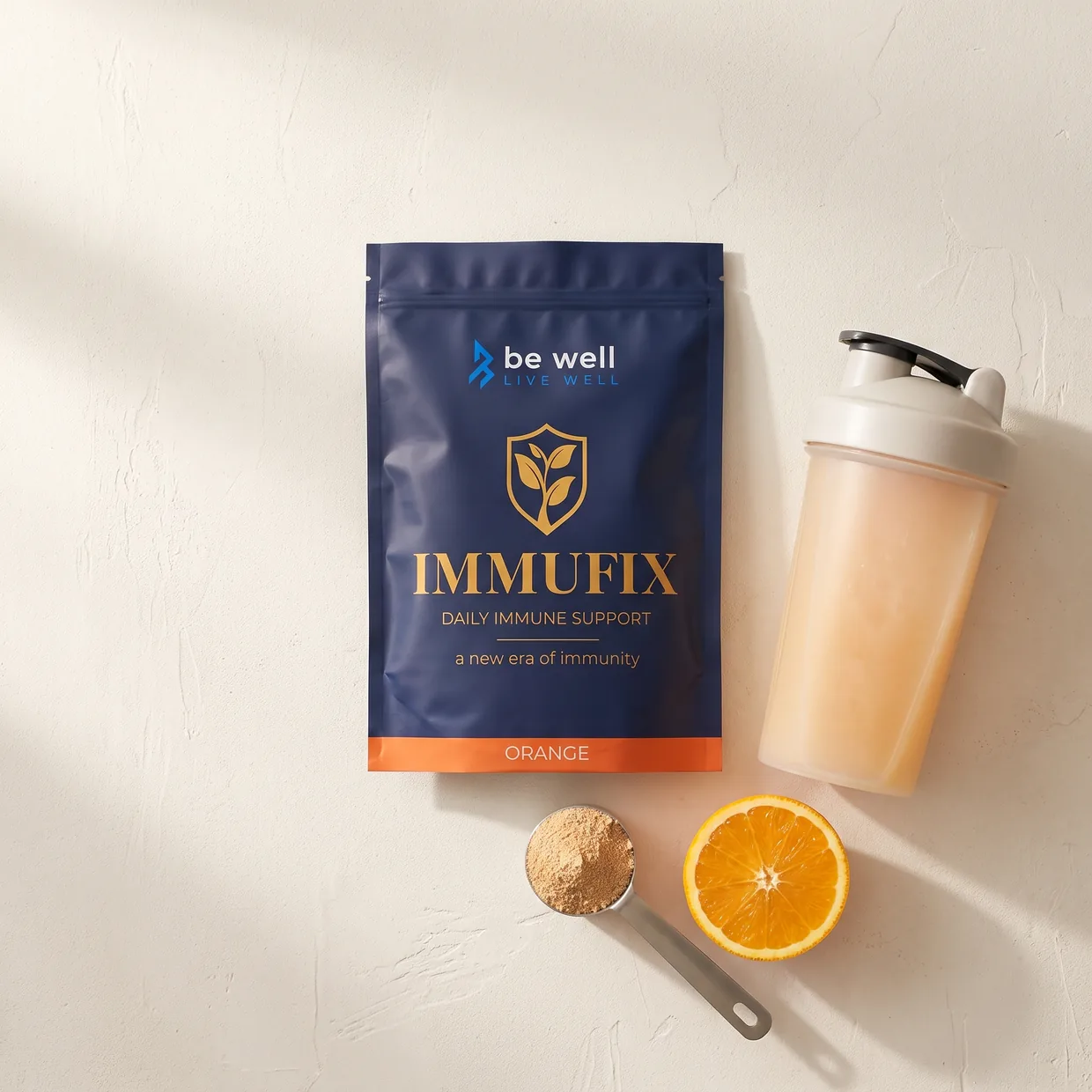
Quick answer. Citrus bioflavonoids are the flavonoids found in citrus fruit. The main ones are flavanones such as hesperidin and naringin, along with flavones such as nobiletin and tangeretin. Oranges and lemons are richest in the hesperidin family, grapefruit in the naringin family, and the peel and pith hold more flavonoids than the juice. Immufix contains 28mg per 25g scoop. No health claim for bioflavonoids is authorised in Great Britain, so we make none.
What are citrus bioflavonoids?
Flavonoids are a large family of compounds made by plants. A 2022 review of citrus fruit composition in the journal Antioxidants describes their shared shape: "Chemically, flavonoids are composed of a 15-carbon skeleton (C6-C3-C6) with two six-carbon phenyl rings joined by a heterocyclic ring containing the embedded oxygen."
On a label, "citrus bioflavonoids" means flavonoids from citrus fruit. The GB claims register uses the same wording, with entries for "Bioflavonoids from citrus" and "Citrus bioflavonoids". The review lists what citrus fruits contain:
- Flavanones. Naringin, eriocitrin, hesperidin and narirutin, which the review says citrus fruits contain in "a substantial amount".
- Flavones. Rhoifolin, vitexin and diosmin.
- Polymethoxylated flavones. Nobiletin, tangeretin and 5-demethyl nobiletin. The review notes these are "a unique class" that "abundantly occur in citrus fruits".
- Flavonols. Quercetin, rutin and kaempferol.
- Anthocyanins. Cyanidin and peonidin glucosides.
The polymethoxylated flavones are concentrated in particular fruits: of 116 citrus types screened in one study cited by the review, the highest amounts of nobiletin and tangeretin "were recorded in loose-skin mandarins (including mandarins and tangerines) and their hybrids".
What is hesperidin?
Hesperidin is the main flavanone in oranges, lemons and limes. Chemically it is hesperetin with a sugar attached. The US Department of Agriculture's flavonoid database gives its full name as "Hesperetin 7-rutinoside". The sugar-free part, hesperetin, is called the aglycone.
Naringin is its counterpart. The GB nutrition and health claims register describes naringin as "a component of citrus peel extract and precursor of naringenin", and describes hesperidin as a component of citrus peel extract too.
This matters when you read figures. Food databases often report the aglycone weight rather than the whole molecule. The USDA converts every value this way, which is why its table below lists hesperetin and naringenin rather than hesperidin and naringin.
Which citrus fruits contain the most?
The USDA's Database for the Flavonoid Content of Selected Foods (Release 3.3, 2018) gives these averages, as aglycone values in mg per 100g of fresh fruit or juice:
| Fruit (per 100g) | Hesperetin | Naringenin |
|---|---|---|
| Limes, raw | 43.0mg | 3.4mg |
| Lemons, raw, without peel | 27.9mg | 0.6mg |
| Oranges, raw | 27.3mg | 15.3mg |
| Orange juice, raw | 12.0mg | 2.1mg |
| Tangerines (mandarins), raw | 7.9mg | 10.0mg |
| Grapefruit, pink and red, raw | 0.4mg | 32.6mg |
Source: USDA Database for the Flavonoid Content of Selected Foods, Release 3.3. The lime figure comes from a single study; the others are averages of several.
Two things stand out. Oranges, lemons and limes are dominated by hesperetin, while grapefruit is almost all naringenin. And raw orange has more than twice the hesperetin of the same weight of raw orange juice: 27.3mg against 12.0mg per 100g. Lemons also contain eriodictyol, 21.4mg per 100g in the same database.
Where in the fruit are they found?
Mostly in the peel. A citrus peel has two layers: the coloured outer zest, called the flavedo, and the white pith beneath it, called the albedo. The Antioxidants review reports that "the citrus fruit peel flavedo (outer layer) and the albedo contain more flavonoids than the juice sacs".
The pith can be especially rich. In the albedo of one group of Mediterranean citrus fruits, the review records that flavonoids made up 89.34% of the polyphenols, "dominated by flavanones eriocitrin and hesperidin".
That helps explain why the figures for fruit run higher than for juice, and why the claims register describes hesperidin and naringin as components of citrus peel extract. For the vitamin C side of citrus fruit, see our guide to vitamin C foods.
Do citrus bioflavonoids have a health claim?
No. Every claim submitted for bioflavonoids, citrus bioflavonoids, hesperidin or naringin on the GB nutrition and health claims register is listed as "Non-authorised".
For the general "bioflavonoids" and "bioflavonoids from citrus" entries, the register cites a 2011 opinion of the European Food Safety Authority (EFSA Journal 2011;9(4):2082) and gives this reason: "on the basis of the scientific evidence assessed, this food is not sufficiently characterised for a scientific assessment of this claimed effect and the claim could not therefore be substantiated." In other words, EFSA did not consider the ingredient defined precisely enough to assess.
Citrus bioflavonoids also have no nutrient reference value, so the label gives the amount without a % NRV.
Where Immufix fits.
Immufix is one scoop (25g) in around 200ml of water, once a day. Each scoop contains 28mg of citrus bioflavonoids, and we make no claim for them. The claims on our pack belong to the vitamins and minerals. Vitamin C, at 100mg per scoop (125% of the NRV), contributes to the reduction of tiredness and fatigue, and vitamin C increases iron absorption. Our guide to how much vitamin C you need a day covers UK advice, and every amount is on the science page.
The short version.
- Citrus bioflavonoids are the flavonoids in citrus fruit, mainly flavanones such as hesperidin and naringin, plus flavones such as nobiletin and tangeretin.
- Oranges, lemons and limes are richest in hesperetin. Grapefruit is richest in naringenin.
- The peel and pith hold more flavonoids than the juice. 100g of raw orange has 27.3mg of hesperetin; 100g of orange juice has 12.0mg (USDA).
- No health claim for bioflavonoids is authorised in Great Britain. EFSA found them not sufficiently characterised to assess.
- Immufix contains 28mg of citrus bioflavonoids per scoop and makes no claim for them.
Food supplements should not be used as a substitute for a varied, balanced diet and a healthy lifestyle. If you have a medical condition, are pregnant, breastfeeding or taking medication, speak to your GP or pharmacist before taking any food supplement.

Daily Immune Support
Vitamins, minerals and plant nutrients in one daily scoop. The formula Paula Radcliffe has taken every day since 1998.
4.8 out of 5 · 89 reviewsDispatched the same day on weekday orders placed before 2pm.
Free standard UK delivery. Royal Mail 48 tracked, 2 to 3 working days. UK addresses only.
30‑day money-back guarantee. Try your first pouch of IMMUFIX for up to 30 days. If it’s not for you, we’ll refund your first qualifying pouch, less £10 shipping and handling. First purchase only. T&Cs apply.
Checkout completes securely on immufix.com
More from the journal.
Choline and inositol, side by side.
Choline is an essential nutrient found mainly in eggs, liver, meat and fish. Inositol is a ring-shaped compound found in grains, beans, nuts and fruit.
10 October 2026 · 6 min readFood state vitamins, what the words mean.
Food state and food grown describe vitamins and minerals cultivated within a food-like matrix such as yeast. What the terms mean, and what UK law says.
10 October 2026 · 6 min read
Soya isoflavones, food by food.
Soya isoflavones are plant compounds found mainly in soya beans. What they are, which soy foods contain the most, and the 45mg in a scoop of Immufix.
10 October 2026 · 5 min read