
Taurine, without the myths.
Taurine is best known as an energy drink ingredient, which has earned it some strange rumours. It is a compound your body makes, found in meat and seafood, and it has been assessed in detail by Europe's food safety regulator.
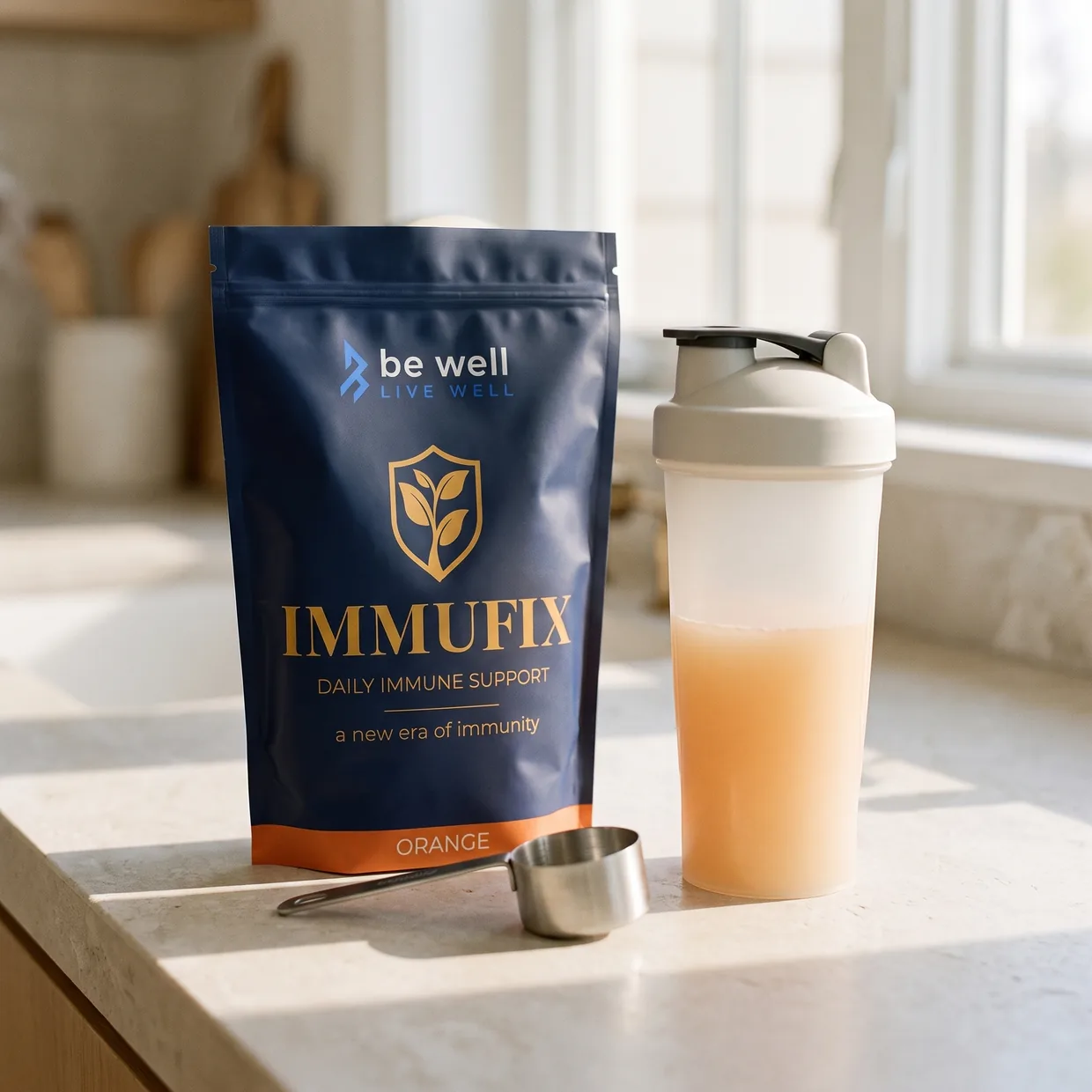
Quick answer. Not at the amounts used in food and drink. In 2009 the European Food Safety Authority (EFSA) concluded that taurine at the levels used in energy drinks "is not of safety concern". Taurine does not come from bull sperm: it is named after the ox, Bos taurus, because it was first isolated from ox bile, and the taurine added to drinks and supplements is generally made by chemical synthesis. It is not caffeine and contains none. Immufix has 500mg per 25g scoop and makes no claim for it.
Is taurine bad for you?
Taurine is a normal part of the body. EFSA's scientific panel described it in its 2009 opinion as a compound that "occurs naturally in food, especially in seafood and meat, and it is a normal metabolite in humans", made mainly from the amino acid cysteine in the liver.
The panel was asked whether taurine was safe at the levels used in energy drinks. It looked at new animal studies and found no adverse effects in rats at 1,000mg of taurine per kg of body weight per day. That amount is 120 times the average daily intake from energy drinks, and 43 times the intake of high consumers, for a 60kg person. Its conclusion: "Given that taurine is a natural body constituent, the Panel concludes that these margins of safety are sufficiently large to conclude that exposure to taurine at the levels mentioned above is not of safety concern."
Two limits are worth knowing. The panel said plainly that it "does not evaluate the safety of 'energy' drinks as such", only taurine and one other ingredient. And on the case reports of people who became unwell after drinking large amounts of energy drinks, it considered that the effects "could be due to the well known side effects of high caffeine intake, while the assumption of a causal relationship with taurine intake is lacking scientific evidence."
Does taurine come from bull sperm?
No. The rumour comes from the name. A review in the journal Molecular Vision explains: "It was first identified and isolated from the bile of the ox (Bos taurus), from which it derives its name." The original work, by Tiedemann and Gmelin, was published in 1827. Bile is a digestive fluid. It has nothing to do with reproduction.
The taurine added to energy drinks is not taken from animals either. EFSA's opinion describes how it is made: "Taurine can be made from monoethanolamine and sulphuric acid as the starting materials or from ethylene oxide and sodium hydrogen sulphate as the starting materials. The crude production is followed by purification steps." The applicant told EFSA that the taurine used in energy drinks complies with US Pharmacopeia specifications, with a purity of "not less than 98.5 %".
A 2023 review in Nutrients adds that "More than 20 methods have been developed for the chemical synthetic production of taurine", and that extracting it from natural sources "is not suitable for industrial production of taurine because of its high cost and low efficiency." Both Immufix flavours are vegetarian, and Orange is also vegan.
Does taurine have caffeine?
No. Taurine and caffeine are two different molecules. The US National Library of Medicine's PubChem database lists taurine as 2-aminoethanesulfonic acid, formula C2H7NO3S, and caffeine as 1,3,7-trimethylpurine-2,6-dione, formula C8H10N4O2. Taurine contains sulphur and no caffeine.
The confusion is understandable, because energy drinks usually contain both. EFSA noted that taurine was "to be used as constituents of so-called 'energy' drinks together with caffeine". In other words, caffeine is a separate ingredient. On the question of the two together, the panel concluded that "additive interactions between taurine and caffeine on diuretic effects are unlikely" and noted that other interactions had not been studied.
If caffeine is what you want to keep track of, our guide to how much caffeine is too much sets out the UK guidance. Caffeine is not among the ingredients declared on the Immufix label.
Is taurine an amino acid?
Broadly, yes, though it is an unusual one. The Molecular Vision review notes that its structure "lacks the carboxyl group typical of other amino acids, but does contain a sulfonate group", and that it is "one of the few amino acids not incorporated into proteins". The World Health Organization's report on protein and amino acid requirements lists it among the amino acids that are "conditionally indispensable".
The body makes taurine from the sulphur-containing amino acids methionine and cysteine. Methionine has to come from food, which our guide to what methionine is explains.
Which foods contain taurine?
Animal foods. EFSA lists seafood and meat as the main natural sources, and the Nutrients review adds that seaweeds and a few plants contain some. EFSA summarised three estimates of how much people get from food:
- About 58mg a day on average from omnivore diets in one study, with a range of 9 to 372mg.
- Generally under 200mg a day in another, "even in individuals eating a high meat diet".
- 40 to 400mg a day in a third.
From a strict vegetarian diet, EFSA described intake as "low or negligible". The 500mg in a scoop of Immufix is more than these dietary estimates, and half of the 1,000mg in one 250ml energy drink made at the 4,000mg per litre level EFSA used in its calculations (calculated).
Where Immufix fits.
Immufix is one scoop (25g) in around 200ml of water, once a day. Each scoop contains 500mg of taurine. Taurine has no nutrient reference value, so the label shows the amount without a percentage. Every taurine claim on the GB nutrition and health claims register is listed as "Non-authorised", so we make none. The claims on our pack belong to the vitamins and minerals. Vitamin D contributes to the maintenance of normal bones and teeth. Zinc contributes to the maintenance of normal hair, nails and skin. The full list is on the science page.
The short version.
- EFSA concluded in 2009 that taurine at the levels used in energy drinks "is not of safety concern".
- Taurine is named after the ox, Bos taurus, because it was first isolated from ox bile in 1827. It does not come from bull sperm.
- Taurine added to foods and drinks is made by chemical synthesis, from starting materials such as monoethanolamine and sulphuric acid.
- Taurine and caffeine are different molecules. Taurine contains no caffeine.
- A scoop of Immufix contains 500mg of taurine, and we make no claim for it.
Food supplements should not be used as a substitute for a varied, balanced diet and a healthy lifestyle. If you have a medical condition, are pregnant, breastfeeding or taking medication, speak to your GP or pharmacist before taking any food supplement.

Daily Immune Support
Vitamins, minerals and plant nutrients in one daily scoop. The formula Paula Radcliffe has taken every day since 1998.
4.8 out of 5 · 89 reviewsDispatched the same day on weekday orders placed before 2pm.
Free standard UK delivery. Royal Mail 48 tracked, 2 to 3 working days. UK addresses only.
30‑day money-back guarantee. Try your first pouch of IMMUFIX for up to 30 days. If it’s not for you, we’ll refund your first qualifying pouch, less £10 shipping and handling. First purchase only. T&Cs apply.
Checkout completes securely on immufix.com
More from the journal.
Choline and inositol, side by side.
Choline is an essential nutrient found mainly in eggs, liver, meat and fish. Inositol is a ring-shaped compound found in grains, beans, nuts and fruit.
10 October 2026 · 6 min read
Citrus bioflavonoids, explained.
Citrus bioflavonoids are the flavonoids in citrus fruit, such as hesperidin and naringin. Where they are found, how much fruit holds, and the 28mg in Immufix.
10 October 2026 · 5 min readFood state vitamins, what the words mean.
Food state and food grown describe vitamins and minerals cultivated within a food-like matrix such as yeast. What the terms mean, and what UK law says.
10 October 2026 · 6 min read