
How much caffeine is too much in a day.
For most adults, UK food safety guidance puts the line at 400mg of caffeine a day, from every source added together. That is roughly three to four mugs of coffee, depending on how it is made.
Quick answer. The Food Standards Agency's guidance, based on the European Food Safety Authority's 2015 opinion, says that "caffeine intakes of up to 400mg per day are unlikely to cause adverse effects" for most people, with single doses of up to 200mg also considered safe for healthy adults. The 400mg covers every source in the day: by the FSA's figures, a mug of coffee has about 100 to 140mg and a mug of tea about 75mg. In pregnancy, the NHS limit is 200mg a day.
How much caffeine a day is safe in the UK?
For most adults, up to 400mg a day. The Food Standards Agency set this out in its 2024 guidance on food supplements containing caffeine: "For most individuals, based on the European Food Safety Authority (EFSA) 2015 opinion, caffeine intakes of up to 400mg per day are unlikely to cause adverse effects."
The FSA's guidance for businesses adds the single-dose figure. The EFSA opinion "advises that single doses of caffeine up to 200mg and a total daily caffeine consumption of up to 400mg are considered safe for the general healthy adult population".
The British Dietetic Association's fluid fact sheet gives the same number: "The safe limit for adults is 400mg caffeine per day."
What is the caffeine limit in the UK?
There is no law that limits how much caffeine an adult can drink. The 400mg figure is safety guidance, not a legal cap. What the law does set is labelling. Under UK food labelling rules, drinks with more than 150mg of caffeine per litre, other than tea and coffee drinks named as such, must carry the words "High caffeine content. Not recommended for children or pregnant or breast-feeding women", with the caffeine content in mg per 100ml.
The 400mg is also personal. The FSA says that "individuals who are sensitive to caffeine at low doses and/or individuals with underlying health conditions may experience some side effects", such as jitteriness or difficulty concentrating. The NHS advises drinking caffeine "in moderation", noting that "some people are more sensitive to caffeine than others".
How much caffeine is in tea, coffee and energy drinks?
These are the FSA's figures. The FSA notes that coffee "can vary widely", and the NHS adds that filter coffee and coffee bought from coffee shops can contain more than instant.
| Drink or food | Caffeine (about) | Share of 400mg |
|---|---|---|
| Mug of coffee | 100 to 140mg | 25% to 35% |
| Mug of tea | 75mg | 19% |
| Energy drink, 250ml can | 80mg (often) | 20% |
| Can of soft drink | 40mg | 10% |
| Plain dark chocolate, 50g bar | 25mg | 6% |
| Plain milk chocolate, 50g bar | 10mg | 3% |
Source: FSA guidance on food supplements containing caffeine. The share column is our calculation, rounded.
What 400mg looks like in a day.
By our calculation from the FSA figures:
- Three mugs of coffee come to about 300 to 420mg, so they can reach the 400mg line on their own.
- Five mugs of tea come to about 375mg.
- Two mugs of tea, one mug of coffee and a can of cola come to about 290 to 330mg.
- Two mugs of coffee and a 250ml energy drink come to about 280 to 360mg.
The FSA stresses that the limit "encompasses all sources of caffeine". It also lists some pain relievers and supplements as sources, so check labels on those too.
What happens if you have too much caffeine?
The FSA says caffeine's effects "may begin 15 to 30 minutes after ingestion and may last for a number of hours". It lists sleeplessness, agitation, palpitations and restlessness among the effects of high levels, and says these may be more severe, and happen at lower doses, in people who are sensitive to caffeine.
Sleep is the most common casualty. The NHS says caffeine "can also disrupt your usual sleep rhythms, leading to problems sleeping and then daytime tiredness", and that its effects "can last up to 7 hours" (NHS: self-help tips to fight tiredness). A coffee at 4pm can still be working at 11pm. Our guide to how much sleep adults need has the NHS sleep tips.
If you regularly feel shaky, your heart races, or you cannot sleep, speak to a GP or pharmacist.
How to cut down on caffeine.
Gradually. The NHS says that if you want to cut caffeine out completely, The Sleep Charity "recommends you reduce your intake gradually", because stopping suddenly can lead to headaches and problems sleeping. A simple plan:
- Add it up first. Use the table above to count a normal day, including cola, energy drinks and chocolate.
- Cut one drink at a time. Drop or swap one caffeinated drink every few days rather than all at once.
- Move caffeine earlier. Keep it to the morning so its effects have worn off by bedtime.
- Swap, do not just remove. The NHS suggests a warm milky drink or herbal tea in the evening. Decaf tea and coffee keep the ritual.
- Drink water too. Tea and coffee count as fluid, but our guide to how much water to drink a day covers the rest of the NHS 6 to 8 glasses.
Where Immufix fits.
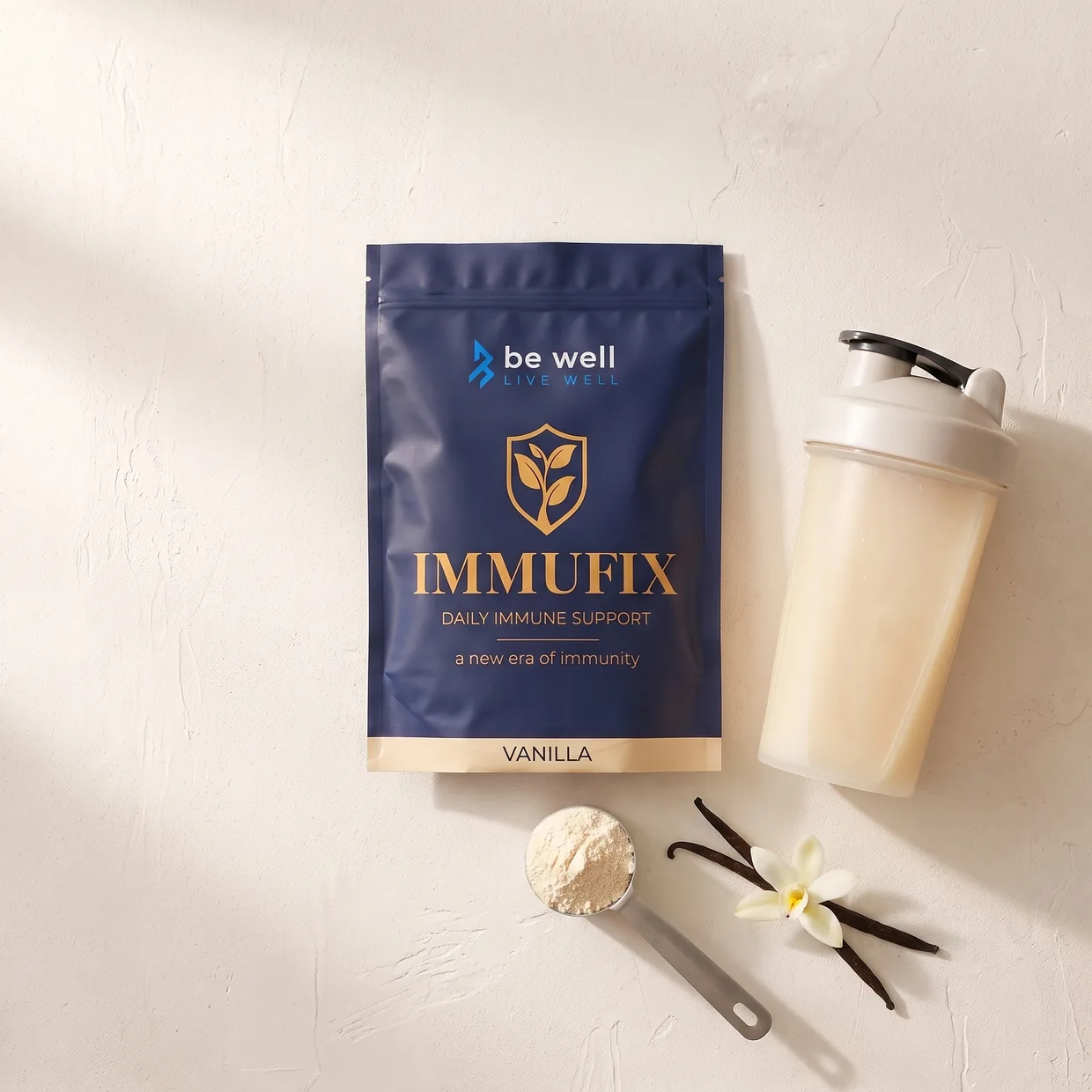
Immufix does not contain caffeine. It is not a stimulant and will not feel like a coffee. It is one scoop (25g) in around 200ml of water, once a day, so it can be taken at any time without adding to your caffeine count. Vitamin C, riboflavin, niacin, pantothenic acid, vitamin B6 and magnesium contribute to the reduction of tiredness and fatigue and to normal energy-yielding metabolism. Every amount is listed on the science page.
The short version.
- UK guidance from the FSA, based on EFSA, says up to 400mg of caffeine a day is unlikely to cause adverse effects for most adults.
- Single doses of up to 200mg are considered safe for healthy adults.
- A mug of coffee has about 100 to 140mg and a mug of tea about 75mg, so three mugs of coffee can reach the limit.
- Caffeine's effects can last up to 7 hours, so keep it to earlier in the day.
- To cut down, reduce gradually, one drink at a time.
Food supplements should not be used as a substitute for a varied, balanced diet and a healthy lifestyle. If you have a medical condition, are pregnant, breastfeeding or taking medication, speak to your GP or pharmacist before taking any food supplement.

Daily Immune Support
Vitamins, minerals and plant nutrients in one daily scoop. The formula Paula Radcliffe has taken every day since 1998.
4.8 out of 5 · 89 reviewsDispatched the same day on weekday orders placed before 2pm.
Free standard UK delivery. Royal Mail 48 tracked, 2 to 3 working days. UK addresses only.
30‑day money-back guarantee. Try your first pouch of IMMUFIX for up to 30 days. If it’s not for you, we’ll refund your first qualifying pouch, less £10 shipping and handling. First purchase only. T&Cs apply.
Checkout completes securely on immufix.com
More from the journal.

Cold weather, short days and feeling tired.
Does cold weather make you tired? What research shows about winter, sleep and daylight, what is still unknown, and the routine changes that help most.
10 October 2026 · 6 min read
How much exercise you need each week.
The NHS and UK Chief Medical Officers say 150 minutes of moderate or 75 of vigorous activity a week, plus strength on 2 days. What counts and how to fit it in.
10 October 2026 · 6 min read
How much sleep adults really need.
The NHS says adults need 7 to 9 hours of sleep on average. How to tell if you get enough, the NHS sleep tips, and why a regular routine matters.
10 October 2026 · 5 min read