
A healthy morning routine, one small step at a time.
The mornings that work are rarely the ambitious ones. They are a handful of small steps done in the same order every day, until they stop needing a decision.
Quick answer. A healthy morning routine is a few small steps you can repeat every day: get up at the same time, drink a glass of water, get some daylight and movement, and eat breakfast. The NHS says getting up at similar times each day "helps your body know when it's time to sleep", and advises "Do not skip breakfast". To make the routine stick, link each step to something you already do, such as "after breakfast", which is how habits formed in a UCL study.
What are some good morning routine ideas?
The best morning routine ideas are the ones that take little time and need no willpower. These six building blocks come from NHS and UK government advice. Pick two or three to start with, not all six.
- The same wake-up time, every day. The NHS's first tip for better sleep is "Keep a regular sleep routine", adding: "Try to keep your routine the same when you can, even on days when you're not working" (NHS Every Mind Matters).
- A glass of water. The government recommends 6 to 8 glasses of fluid a day. All non-alcoholic drinks count, and the NHS names water, lower fat milk, tea and coffee among the healthier choices. The first one can be on the counter before the kettle has boiled.
- Light. Open the curtains, switch on a bright main light and get outside when you can. Light sets the body clock. In a University of Colorado study, people living only by natural light found their internal night ended "just after sunrise".
- A few minutes of movement. A walk, some stretches or the stairs. Short bouts count, as the next section explains.
- Breakfast. The NHS suggests one "high in fibre and low in fat, sugar and salt".
- Five minutes of set-up for tomorrow. Clothes out, breakfast bowl ready, bag by the door. Fewer decisions tomorrow morning.
What does a healthy morning routine look like?
Here is one example, built around a 7am alarm. Change the times, keep the order.
- 07:00. Up at the alarm, curtains open, main light on.
- 07:05. Glass of water while the kettle boils.
- 07:10. Ten minutes of movement: a brisk walk round the block, or stretches if it is still dark.
- 07:25. Breakfast, sitting down. Porridge with fruit, or wholemeal toast with eggs or beans.
- 07:45. Washed, dressed and out, with tomorrow's clothes already chosen last night.
None of these steps takes long. What makes them a routine is that they happen in the same order, at roughly the same time, every day. If you find the dark months make getting up harder, our guide to waking up when it is still dark covers light, alarms and the night before.

How do I make a morning routine stick?
Attach each new step to one you already do. This is often called habit stacking: "after I switch the kettle on, I drink a glass of water", "after I sit down to breakfast, I take my vitamins". The idea has a research base. A team at University College London defines habits as "actions that are triggered automatically in response to contextual cues", and their advice is simple: "repeat an action consistently in the same context" (Gardner, Lally and Wardle, British Journal of General Practice, 2012).
In the original UCL study, volunteers picked one healthy behaviour and did it in response to a daily cue, for example "after breakfast". The behaviour got more automatic with each repetition and levelled off after an average of 66 days, though the range between people was wide. Missing a single day made little difference. The full findings are in our guide to how to build a habit that sticks.
Three practical rules follow from it:
- Start smaller than you think. One glass of water is a better habit target than "drink more".
- Use a cue that happens every day. The kettle, the alarm, sitting down to breakfast. "When I have time" is not a cue.
- Keep going after a missed day. One gap does not reset the clock.
How do I fit exercise into a morning routine?
You do not need a full workout. The UK Chief Medical Officers say adults should aim for at least 150 minutes of moderate activity a week, such as brisk walking or cycling, and that the 150 minutes "can be accumulated in bouts of any length". Their headline message is that "Any activity is better than none" (UK CMO physical activity guidelines).
The NHS puts a number on the smallest useful step: "A brisk 10-minute daily walk has lots of health benefits and counts towards your 150 minutes of weekly exercise" (NHS: walking for health). Ten minutes before work on five days is 50 minutes, a third of the weekly target. Walking part of the commute is the same idea, and the NHS lists it first among its ways to make walking a habit.
What should I eat as part of a healthy morning routine?
Eat something, and make it count. The NHS's eighth tip for healthy eating is "Do not skip breakfast", and its example is "a wholegrain lower sugar cereal with semi-skimmed milk and fruit sliced over the top" (NHS: 8 tips for healthy eating). Its tips to fight tiredness add that eating "regular meals and healthy snacks every 3 to 4 hours" is a good way to keep up your energy through the day.
A breakfast that takes no thought is the one that happens on a busy morning. Overnight oats made the night before, porridge, or wholemeal toast with eggs or beans all work. Our healthy breakfast ideas compare the NHS's own recipes by time, protein and fibre.
Where Immufix fits.
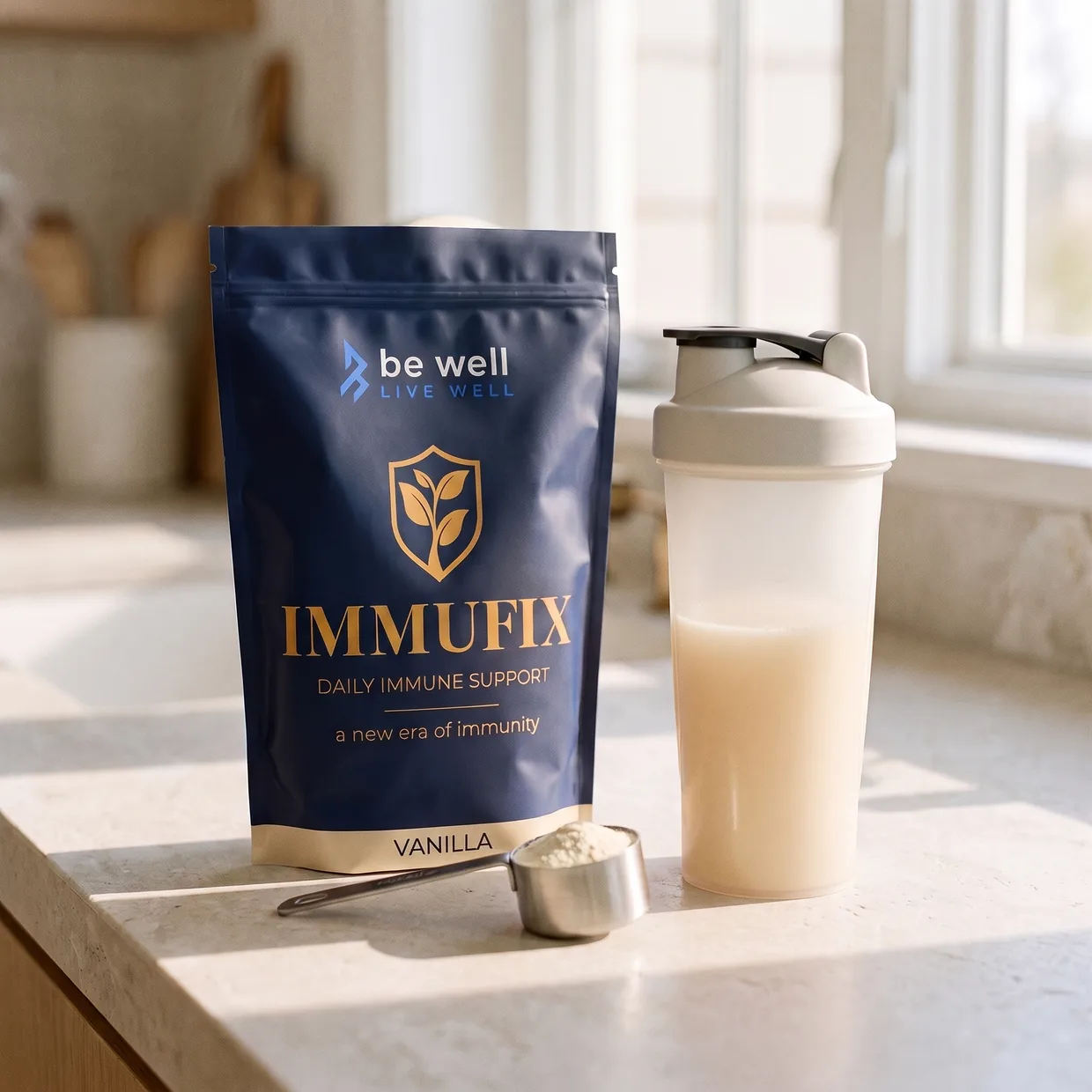
A daily scoop is the kind of step that suits a routine: it is the same every day, and breakfast gives it an obvious cue. It is one 25g scoop in around 200ml of water, once a day, and it adds 75 kcal. Paula Radcliffe has taken it every morning since 1998. Riboflavin, niacin, pantothenic acid, vitamin B6 and magnesium contribute to normal energy-yielding metabolism and to the reduction of tiredness and fatigue, and each is in the scoop at a level that allows the claim. Every amount is on the science page.
The short version.
- A healthy morning routine is a few small steps done in the same order: wake-up time, water, light, movement, breakfast.
- Get up at the same time every day, weekends included, as the NHS advises.
- A brisk 10-minute walk counts towards the 150 minutes a week, and bouts of any length add up.
- Do not skip breakfast. Aim for one high in fibre and low in fat, sugar and salt.
- Link each new step to something you already do, and expect it to take weeks, not days, to feel automatic.
Food supplements should not be used as a substitute for a varied, balanced diet and a healthy lifestyle. If you have a medical condition, are pregnant, breastfeeding or taking medication, speak to your GP or pharmacist before taking any food supplement.

Daily Immune Support
Vitamins, minerals and plant nutrients in one daily scoop. The formula Paula Radcliffe has taken every day since 1998.
4.8 out of 5 · 89 reviewsDispatched the same day on weekday orders placed before 2pm.
Free standard UK delivery. Royal Mail 48 tracked, 2 to 3 working days. UK addresses only.
30‑day money-back guarantee. Try your first pouch of IMMUFIX for up to 30 days. If it’s not for you, we’ll refund your first qualifying pouch, less £10 shipping and handling. First purchase only. T&Cs apply.
Checkout completes securely on immufix.com
More from the journal.
The clocks go back. Here's what changes.
The clocks go back at 2am on Sunday 25 October 2026. What really happens to UK mornings and evenings, when the darkest days are, and a routine that copes.
10 October 2026 · 4 min read
Healthy breakfasts, quick enough for a weekday.
Healthy breakfast ideas from the NHS's own recipes, compared by time, protein, fibre and salt, plus quick breakfasts and how to pick a cereal by its label.
10 October 2026 · 6 min read
How to build a habit that actually sticks.
How to build a habit, from UCL research: pick one action, tie it to a daily cue and repeat it. It took 18 to 254 days in the study, about 66 on average.
10 October 2026 · 6 min read