
How to build a habit that actually sticks.
The research on habits is clearer than the advice. Repeat one simple action in the same place or moment every day, expect it to take weeks rather than days, and do not panic about a missed day.
Quick answer. To build a habit, choose one simple action and do it every day in response to the same cue, such as "after breakfast". In a UCL study published in the European Journal of Social Psychology (Lally and colleagues, 2010), the time it took for a new behaviour to become close to fully automatic "ranged from 18 to 254 days", and the researchers' later summary puts the average at around 66 days. Missing one day "did not materially affect the habit formation process".
How do you build a habit?
Start with what a habit is. Researchers at University College London define habits as "actions that are triggered automatically in response to contextual cues that have been associated with their performance". Their examples are everyday ones: washing your hands after using the toilet, or putting on a seatbelt after getting into the car. The cue does the work, so you no longer have to remember or decide (Gardner, Lally and Wardle, British Journal of General Practice, 2012).
The same paper sums up the method in one line: "repeat an action consistently in the same context". It includes a short plan for patients, which is the clearest how-to we have found. In its words:
- "Decide on a goal that you would like to achieve for your health."
- "Choose a simple action that will get you towards your goal which you can do on a daily basis."
- "Plan when and where you will do your chosen action. Be consistent: choose a time and place that you encounter every day of the week."
- "Every time you encounter that time and place, do the action."
The plan's own example is a goal "to eat more fruit and vegetables" turned into an action: "after I have lunch at home I will have a piece of fruit". It also suggests a daily tick-sheet, rating each week how automatic the action feels.
How long does it take to form a habit?
Longer than most people expect, and it varies a lot from person to person. The best known study on this comes from the same UCL group. Its abstract describes the design: "96 volunteers chose an eating, drinking or activity behaviour to carry out daily in the same context (for example 'after breakfast') for 12 weeks." Each day they rated how automatic the behaviour felt, and 82 of them provided enough data to analyse (Lally, van Jaarsveld, Potts and Wardle, European Journal of Social Psychology, 2010).
Automaticity rose fastest in the early days and then levelled off. The time to reach 95% of each person's plateau "ranged from 18 to 254 days", which the authors say highlights "that it can take a very long time". In their 2012 summary for GPs, the UCL team write that automaticity "plateaued on average around 66 days after the first daily performance", and suggest telling people "to expect habit formation (based on daily repetition) to take around 10 weeks".
Two cautions. The study measured how automatic people said the behaviour felt, not something observed from outside. And the model fitted well for 39 of the 82 people, so the averages describe a pattern rather than a rule for everyone. A post on UCL's behavioural science blog puts it plainly: "The best estimate is 66 days, but it's unwise to attempt to assign a number to this process."
Does it take 21 days to form a habit?
There is no good evidence for 21 days. The UCL team traced the figure to "anecdotal evidence of patients who had received plastic surgery treatment and typically adjusted psychologically to their new appearance within 21 days". That is about getting used to a change, not about forming a new habit. Their advice is to plan for around 10 weeks, and they note that people are reassured to hear the behaviour "gets progressively easier".
What if I miss a day?
Carry on. The study found: "Missing one opportunity to perform the behaviour did not materially affect the habit formation process." In the 2012 paper's words, "automaticity gains soon resumed after one missed performance". The all-or-nothing thinking that makes people give up after a bad weekend is not supported by the data. What matters is the overall pattern of repetition: in the study, doing the behaviour more consistently was linked to a better fit with the habit curve.
Which habits are easiest to build?
Simple ones. The UCL team report that automaticity "peaked more quickly for simple actions (for example, drinking water) than for more elaborate routines (for example, doing 50 sit-ups)". Their advice on choosing a habit follows from that:
- Make it small and specific. "Eat a banana with breakfast" is a habit. "Eat better" is a goal.
- Pick something to start, not stop. They point out that "it is not possible to form a habit for not doing something". Swap in a new action instead.
- Use a cue inside your existing day. They suggest "a cue located within an existing daily routine (for example, 'when I go on my lunch break')" as a stable starting point.
- Choose it yourself. A behaviour picked for its personal value is, in their words, "an easier habit target" than one picked to satisfy someone else.
- Keep it the same. They note that varying the action to stave off boredom "is incompatible with development of automaticity".
If you want to put this into practice, a morning is a good place to start because it already has fixed cues: the alarm, the kettle, breakfast. Our guide to morning routine ideas shows how to link several small steps together. For activity, the UK target is 150 minutes of moderate activity a week, and short daily walks count towards it; see how much exercise you need a week.
Where Immufix fits.
A daily scoop is a textbook habit target: one simple action, done once a day, with an obvious cue. Taking it with breakfast ties it to a meal you already have. It is one 25g scoop in around 200ml of water, once a day. Paula Radcliffe has taken it every morning since 1998. Vitamin C, riboflavin, niacin, pantothenic acid, vitamin B6, folic acid and magnesium contribute to the reduction of tiredness and fatigue. Every amount is on the science page.
The short version.
- A habit is an action triggered automatically by a cue. Build one by repeating a simple action in the same context every day.
- In the UCL study, it took 18 to 254 days for a behaviour to become close to fully automatic, around 66 days on average.
- Plan for about 10 weeks. The 21-day figure has no good evidence behind it.
- Missing one day does not materially affect the process. Consistency over weeks is what counts.
- Start small, start something new rather than stopping something, and attach it to a cue you meet every day.
Food supplements should not be used as a substitute for a varied, balanced diet and a healthy lifestyle. If you have a medical condition, are pregnant, breastfeeding or taking medication, speak to your GP or pharmacist before taking any food supplement.

Daily Immune Support
Vitamins, minerals and plant nutrients in one daily scoop. The formula Paula Radcliffe has taken every day since 1998.
4.8 out of 5 · 89 reviewsDispatched the same day on weekday orders placed before 2pm.
Free standard UK delivery. Royal Mail 48 tracked, 2 to 3 working days. UK addresses only.
30‑day money-back guarantee. Try your first pouch of IMMUFIX for up to 30 days. If it’s not for you, we’ll refund your first qualifying pouch, less £10 shipping and handling. First purchase only. T&Cs apply.
Checkout completes securely on immufix.com
More from the journal.
The clocks go back. Here's what changes.
The clocks go back at 2am on Sunday 25 October 2026. What really happens to UK mornings and evenings, when the darkest days are, and a routine that copes.
10 October 2026 · 4 min read
Healthy breakfasts, quick enough for a weekday.
Healthy breakfast ideas from the NHS's own recipes, compared by time, protein, fibre and salt, plus quick breakfasts and how to pick a cereal by its label.
10 October 2026 · 6 min read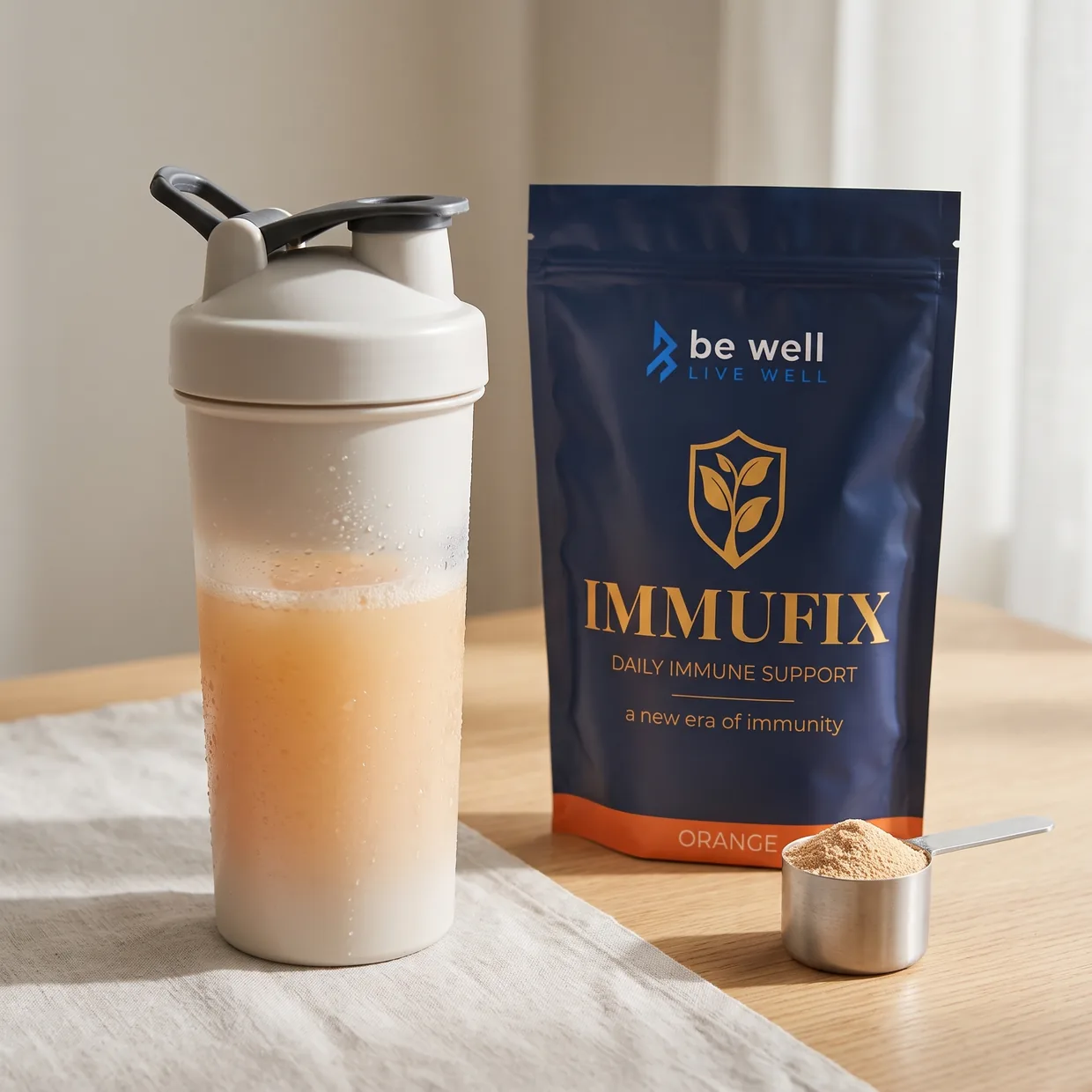
Getting up when it is still dark outside.
Practical ways to wake up on dark UK winter mornings: light, a steady routine, alarms that help and the NHS's sleep advice, with calculated sunrise times.
10 October 2026 · 6 min read