
Paula Radcliffe's running style, in the words of those who watched it.
Race reports from 2002 onwards describe a nodding head, relentless front running and an even tempo. This page sets out what those reports, her physical therapist and Paula herself have said, and nothing more.
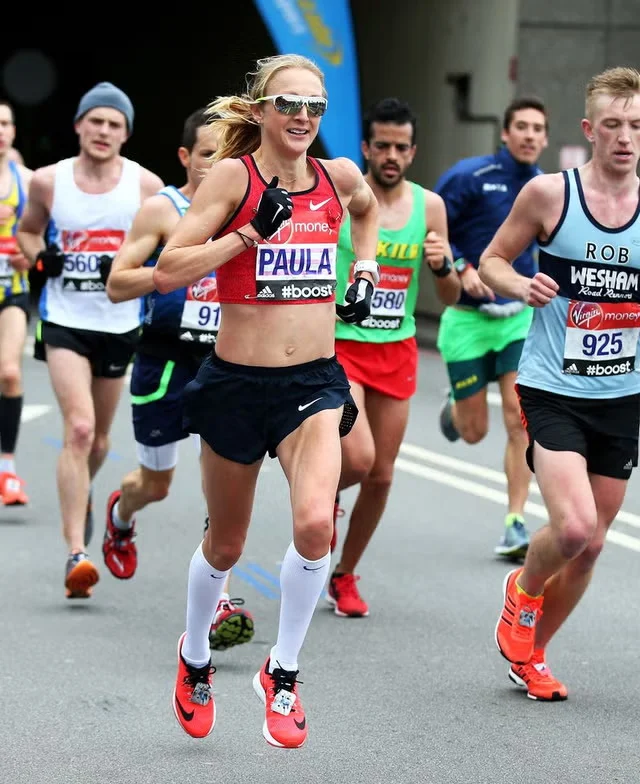
Quick answer. Paula Radcliffe's running style is best known for two things: a bobbing head and front running. World Athletics described "her head bobbing in familiar style" as she won her first London Marathon in 2002, and she usually led from early on, racing on feel rather than to set splits. The Guardian reported that 18 months of work with the physical therapist Gerard Hartmann tidied up her form. No source we found gives a figure for her cadence.
What was Paula Radcliffe's running style?
The reports agree on one thing above all: she ran from the front. On her marathon debut in London in 2002, World Athletics wrote of her "committed front-running", and said that on the downhill opening miles she "at times seemed to be almost skipping along, so comfortable was she with the early pace." By 20 miles her "extraordinary front-running continued".
In New York in 2004, World Athletics reported that "Radcliffe was forcing the pace so strongly that designated pace setter Leah Malot of Kenya was having trouble keeping in front of her." On the day of her farewell London Marathon in 2015, the Guardian looked back: "In the past she has always been a front runner, determined to push on alone."
Writing in 2015, the Guardian's running blog asked how "a woman from Cheshire with a seemingly awkward gait" came to set the world record. Its answer centred on how she trained and how she paced her races, both covered below.
Why did Paula Radcliffe's head bob?
The sources we read describe the head bob in detail, but none of them explains its cause. We do not offer one either. What they do record is when it showed:
- London, 2002. At 20 miles, World Athletics wrote, her "head bobbing in familiar style", already a known trait on her debut.
- London, 2003. In her world record run, World Athletics noted around the 17th mile "her head beginning to bob but the legs were still piling on the pressure", and later, "Into the last mile and with head bobbing more and more".
- New York, 2008. After her third New York win, the Guardian's Kevin Mitchell wrote of her rivals: "They see just one view of her: that bobbing head." He added: "The tempo doesn't change. It remains frustratingly constant".
In these accounts the bob grows as a race goes on, while the pace holds. That is as far as the sources go.
How did Paula Radcliffe change her running form?
The clearest account comes from the Guardian's Sean Ingle, writing before her final London Marathon in 2015. Most of her track career, he wrote, came before she worked full time with "the Irish physical therapist Gerard Hartmann". As Hartmann explained it to Ingle, her form at the time meant she would run the last lap of a track race in 67 seconds, while rivals such as Sonia O'Sullivan were several seconds quicker.
"It took Hartmann 18 months to sort Radcliffe out, reducing that last lap to 61 seconds," Ingle wrote. He added that "the head bobbing wasn't completely eradicated", but that by 2002 she ran a 10,000m best of 30:01.09.
The third figure is from the Guardian's running blog, which wrote that "she improved her running economy by about 15% over the course of her career". Running economy is how much energy it takes to run at a given speed. The details of how her training built that up are in our article on lessons from Paula's training.
What was Paula Radcliffe's cadence?
We could not find one. No race report, interview or publisher page we checked gives a figure for her steps per minute, so we leave it out rather than estimate it from video.
Her pace, by contrast, is well recorded. World Athletics published her mile splits from London in 2003. Her opening mile took 5:10, her third mile 4:57, and her slowest was the sixth, in 5:22. Across the whole race she averaged about 5:10 a mile (calculated from 2:15:25).
How did Paula Radcliffe pace a marathon?
On feel. Before her 2003 world record, World Athletics reported, she "went into the race with no set pace or race plan". She realised the 4:57 third mile was too fast and eased off. "Then I eased off a bit too much," she said.
She explained the approach to the Guardian's running blog. Her broad aim was a negative split, getting faster in the second half, but no fixed schedule. "I ran how I felt," she said. "I had a mantra of 'no limits' throughout my career". She said she "never really ran to try and hit certain times at halfway". The blog's writer, Ed Caesar, said most Kenyan and Ethiopian runners want to run as she did: "on feel, not splits".
She said much the same in a 2013 Guardian interview: "I never plan to run at a certain pace."
What running form advice does Paula Radcliffe give?
Asked in that 2013 interview what training tip she gives, she started with shoes, then form and variety:
"Make sure you get the right running shoes for you. Get some gait analysis done in a running shop. And don't just run at one pace all the time, but put some fartlek [alternating between fast and slow pace], or hillwork into your schedule. And do some core training as well."
She also wrote a full guide, How to Run, published in 2011. What the publisher says it covers is in our article on Paula's books.
Where Immufix fits.
Paula is a co-owner of the company that makes Immufix, and she has taken it every morning since 1998, through the years described above. Her own account is on her journey page. It is not a claim about her results. Immufix is one 25g scoop in around 200ml of water, once a day, alongside a varied diet. Magnesium and vitamin D contribute to normal muscle function, and vitamin C, riboflavin, niacin and vitamin B6 contribute to the reduction of tiredness and fatigue. Every amount is on the science page.
The short version.
- Her style was front running: she usually led from early on and pushed on alone.
- Race reports from 2002 to 2008 describe a bobbing head that grew as races went on. None explains why.
- The Guardian reported that 18 months with Gerard Hartmann cut her last track lap from 67 to 61 seconds.
- She raced on feel, aiming for a negative split, with a "no limits" motto.
- No source we found gives her cadence.
Food supplements should not be used as a substitute for a varied, balanced diet and a healthy lifestyle. If you have a medical condition, are pregnant, breastfeeding or taking medication, speak to your GP or pharmacist before taking any food supplement.


Daily Immune Support
Vitamins, minerals and plant nutrients in one daily scoop. The formula Paula Radcliffe has taken every day since 1998.
4.8 out of 5 · 89 reviewsMonthly subscription. £52.00 is charged every month until you cancel. Minimum three payments, then cancel any time. Subscription terms
New here? 20% off your first order with code TRYIMMUFIX. Apply it
Dispatched the same day on weekday orders placed before 2pm.
Free standard UK delivery. Royal Mail 48 tracked, 2 to 3 working days. UK addresses only.
30‑day money-back guarantee. Try your first pouch of IMMUFIX for up to 30 days. If it’s not for you, we’ll refund your first qualifying pouch, less £10 shipping and handling. First purchase only. T&Cs apply.
Checkout completes securely on immufix.com
More from the journal.

Paula Radcliffe's books, from autobiography to running guide.
Paula Radcliffe's two books: her autobiography Paula: My Story So Far and her guide How to Run, with editions, ISBNs and what the publisher says each covers.
17 November 2026 · 6 min read
Paula Radcliffe at the Chicago Marathon, 2:17:18 and a world best.
Paula Radcliffe won the 2002 Chicago Marathon in 2:17:18, taking 1:29 off the women's world best in only her second marathon. How the race went.
17 November 2026 · 5 min readPaula Radcliffe at the World Championships, from Seville to Helsinki.
Paula Radcliffe won the world marathon title in Helsinki in 2005, 10,000m silver in Seville in 1999 and three world half marathon titles.
17 November 2026 · 6 min read