
Paula Radcliffe's training, scaled down.
Paula Radcliffe's marathon training was built around four key sessions and very high mileage. The mileage is for professionals. The structure, and the habits around it, work for anyone.
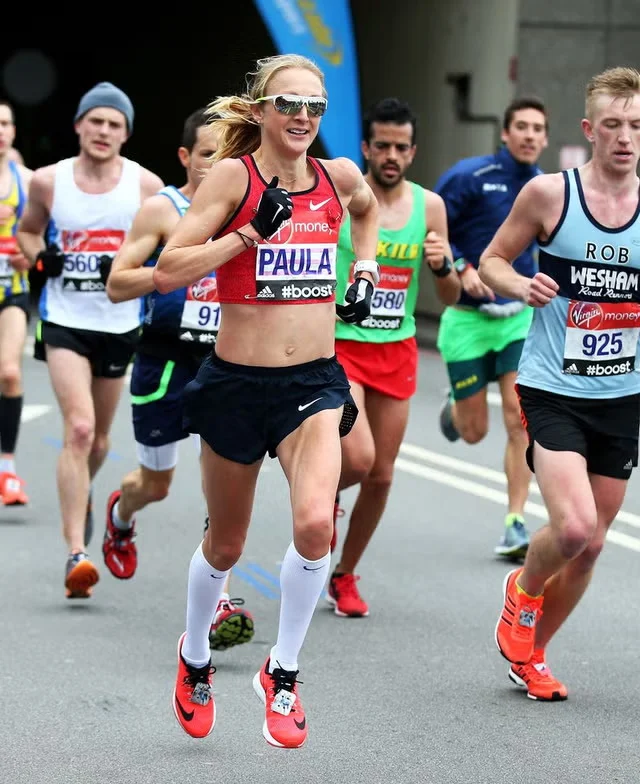
Quick answer. Before her 2003 world record, World Athletics reported that Paula Radcliffe's marathon training plan was about 140 miles a week built around four main sessions: a track session, grass repetitions of 2km or a mile, a tempo run of 5 to 12 miles and a long run of 20 to 24 miles. She has not published a full day-by-day training log that we could find. Lab data published by her physiologist shows her running economy improved by about 15% over many years, and her own tips for ordinary runners are to vary your paces, build volume gradually and take regular rest days.
Every fact and quote below comes from World Athletics, peer-reviewed research or published interviews. Paula is a co-owner of the company that makes Immufix.
What was Paula Radcliffe's marathon training plan?
A simple weekly shape repeated at very high volume. The 2003 World Athletics report says she "kept her training pattern similar to last year", the year of her marathon debut. Here are those four sessions next to a scaled-down version for a runner doing three or four runs a week. The right-hand column is our suggestion, not Paula's prescription.
| Paula's session, spring 2003 | What it trains | Everyday version (our suggestion) |
|---|---|---|
| Track session | Speed and economy | Short faster repeats with easy recoveries, once a week at most |
| Grass reps of 2km or one mile | Sustained speed on a soft surface | 3 or 4 repeats of about 1km on grass or a park path |
| Tempo run of 5 to 12 miles | Holding a strong, steady effort | 15 to 30 minutes at a "sustained cruise pace that requires concentration" |
| Long run of 20 to 24 miles | Endurance | One longer run a week, built up gradually |
The tempo description is from the London Marathon beginner plan, which puts it at 70 to 80% of maximum effort. For most runners, the session that matters is the long run. Do the track and grass work only once the weekly running feels routine. Her meals and altitude training are covered in how Paula Radcliffe ate and trained.
Is Paula Radcliffe's training log public?
Not as a full diary. What is public is a record built from three sources: race-week reports by World Athletics, her own interviews, and laboratory data. The physiologist Andrew Jones is known, in the University of Exeter's words, for "his close scientific association" with marathon world record holders including Paula Radcliffe.
In a 2015 paper in the Journal of Applied Physiology, Jones, Sandra Hunter and Michael Joyner summarised her numbers. She had a maximal oxygen uptake of about 70 ml/kg/min and a lactate threshold at 18.5km/h. Her running economy, about 175 ml/kg/km against a "typical" value of about 200, "improved ∼15% over many years of training." That last line is the useful one for the rest of us.
Seven lessons from Paula Radcliffe's training.
1. Improvement takes years, so build slowly.
A 15% gain in economy did not come from one good block. Her own first tip on training, listed in a 2018 Women's Running piece, says the same thing: "For training it's important to vary the paces of your runs, build volume up gradually and include regular rest days."
2. Vary the pace.
Her four sessions were four different speeds. Most ordinary runners run every run at the same middling pace. One quicker session, one steady run and one long, easy run is a fair copy of her week at a fraction of the volume.
3. Rest is part of the plan.
Rest days are in that 2018 tip, and recovery got more attention as she got older. In 2009, aged 35, she told World Athletics: "Your endurance gets stronger as you get older, maybe you need an extra day's recovery in between hard sessions." In the same interview she gave the best single line on copying anyone's training: "everybody needs to do what's right for them".
4. Do the strength work.
In a 2025 PA interview published by The Irish News, she advised runners to "build a little bit of core exercises, basic planks, foot strength exercises, calf raises." A simple routine is in our guide to strength training for runners.
5. Race less while you build.
Before London 2003, she was "happy going into the marathon with just the Puerto Rico race under my belt." "When marathon training I don't feel the need to race much," she told World Athletics. "I don't want to back off from training nor spend too much time travelling." For club runners, that means choosing a few tune-up races, such as a half marathon, rather than racing every weekend.
6. Train your head as well as your legs.
Her best-known technique is counting. "I count to 100 in my head, it stops my mind wandering or worrying as you only think about which number is next," she told Women's Running. She also rehearsed races in training. In 2004 she told World Athletics: "I often visualise parts of the Olympic Marathon during my training sessions. Sometimes it's the hills or the finish or even the start."
7. Plan the second half.
Her third New York win, in 2008, was run to a plan. "It was always my plan to keep comfortable through the halfway and then push the last six miles," she said afterwards. The full story is in Paula Radcliffe's New York Marathon wins. For a first marathon the lesson is gentler: start at a pace that feels too easy, and keep something for the last 10km.
Where Immufix fits.
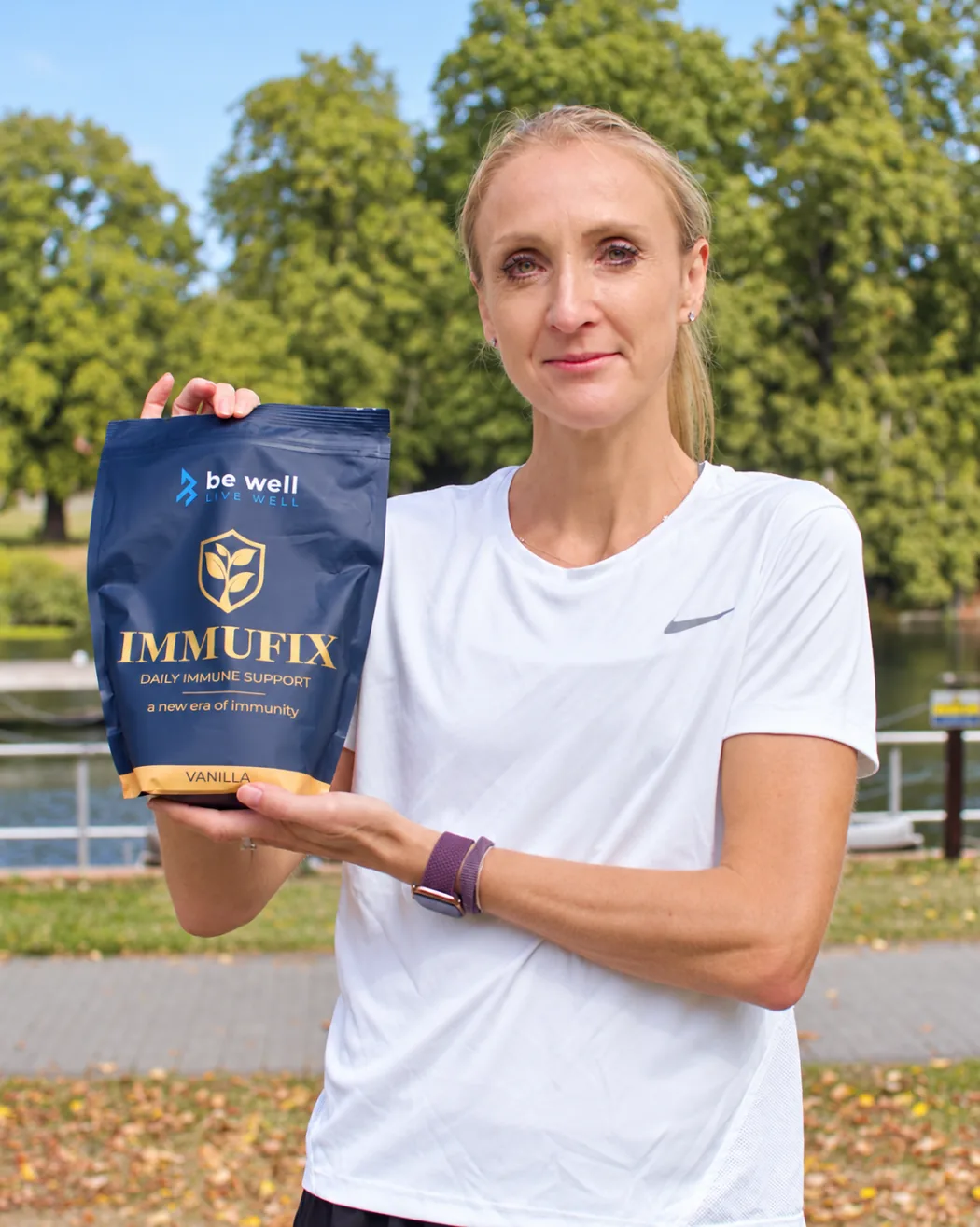
Paula has taken Immufix every morning since 1998, through the training described above. It is not a claim about her results, and none of the lessons here depend on it. Immufix is one 25g scoop in around 200ml of water, once a day, alongside a varied diet. Magnesium and vitamin D contribute to normal muscle function, and magnesium, vitamin C, riboflavin, niacin and vitamin B6 contribute to the reduction of tiredness and fatigue. Every amount is on the science page.
The short version.
- In 2003 Paula ran about 140 miles a week around a track session, grass reps, a tempo run and a 20 to 24 mile long run.
- No full training log is public. Lab data shows her running economy improved about 15% over many years.
- Her tips: vary your paces, build volume gradually, take regular rest days and add core and calf strength.
- Race sparingly in a marathon build, and practise mental techniques such as counting to 100.
- Copy the structure, not the mileage: "everybody needs to do what's right for them".
Food supplements should not be used as a substitute for a varied, balanced diet and a healthy lifestyle. If you have a medical condition, are pregnant, breastfeeding or taking medication, speak to your GP or pharmacist before taking any food supplement.

Daily Immune Support
Vitamins, minerals and plant nutrients in one daily scoop. The formula Paula Radcliffe has taken every day since 1998.
4.8 out of 5 · 89 reviewsDispatched the same day on weekday orders placed before 2pm.
Free standard UK delivery. Royal Mail 48 tracked, 2 to 3 working days. UK addresses only.
30‑day money-back guarantee. Try your first pouch of IMMUFIX for up to 30 days. If it’s not for you, we’ll refund your first qualifying pouch, less £10 shipping and handling. First purchase only. T&Cs apply.
Checkout completes securely on immufix.com
More from the journal.
Paula Radcliffe's career, year by year.
A sourced timeline of Paula Radcliffe's titles, medals, records and honours, from the 1992 world junior cross country title to her 2026 OBE.
10 October 2026 · 6 min read
How Paula Radcliffe ate and trained.
What Paula Radcliffe has said she eats, how she trained for the marathon, and the daily scoop she has taken every morning since 1998.
10 October 2026 · 5 min readPaula Radcliffe's three London wins.
Paula Radcliffe won the London Marathon three times, in 2002, 2003 and 2005. Each date and winning time, what each win meant, and her course record.
10 October 2026 · 5 min read