
Keeping a routine over Christmas.
Christmas breaks every routine at once: different meals, later nights, more sitting and more drinks. You do not need to hold on to all of it. Three or four anchors are enough to make January easier.
Quick answer. A healthy Christmas routine keeps a few anchors rather than every habit: a wake-up time within an hour of normal, some movement every day, vegetables with the main meal and a plan for alcohol. The UK Chief Medical Officers say adults should aim to be active every day and that "any activity is better than none". A daylight walk on Christmas Day or Boxing Day, a festive parkrun, or ten minutes of bodyweight exercise all count.
What does a healthy Christmas routine look like?
In 2026 the break is a long one for many people. Christmas Day is Friday 25 December, the Boxing Day bank holiday moves to Monday 28 December, and New Year's Day is Friday 1 January 2027, according to GOV.UK's bank holiday list. Scotland adds Monday 4 January as the substitute for 2 January.
That is ten days or more where nothing is fixed. The aim is not to keep everything the same. It is to keep a short list of habits that make the rest easy to pick up again.
- Wake-up time. Within an hour of your normal one, most days.
- Daily movement. Something every day, even short.
- Regular meals. Breakfast still happens, and vegetables come with the main meal.
- A drinks plan. Decide your drink-free days before the week starts.
How to stay active over Christmas.
The adult guidelines are the same in December as in June. The NHS's physical activity guidelines ask for at least 150 minutes of moderate activity a week, or 75 minutes of vigorous activity, plus strengthening activities on at least 2 days. They also ask adults to "reduce time spent sitting or lying down and break up long periods of not moving with some activity", which is the part Christmas tests most.
The Chief Medical Officers' guidelines say the 150 minutes "can be accumulated in bouts of any length". A few short walks over a long weekend add up.
Walk while it is light.
The light is short. On 21 December the sun rises in London at about 08:04 and sets at about 15:53, and in Edinburgh it is up for under 7 hours, calculated for each city. A walk after lunch has to start by about 2:30pm to finish in daylight. A brisk walk, about 3 miles an hour on the NHS's walking for health page, counts as moderate activity.
Use the festive parkruns.
Christmas Day and New Year's Day both fall on a Friday this year, so any parkrun that runs on them is an extra event on top of the usual Saturday. Not every event takes part. Our guide to parkrun in winter explains how to check yours.
Keep strength going at home.
The NHS lists everyday examples of muscle-strengthening activity, including "carrying heavy shopping bags" and "exercises that use your own body weight, such as push-ups and sit-ups". Ten minutes of squats, lunges and press-ups on two mornings covers the twice-a-week target with no gym.
Break up the sitting.
Stand up between films, do the washing up, walk to the shop rather than drive. None of it feels like exercise, and all of it counts.

How to keep sleep on track over the holidays.
Late nights are part of Christmas. The problem is the drift, where bedtime and wake-up time slide later each day until the first working Monday hurts. The NHS's tips for sleeping better are useful here.
- Keep the wake-up time. The NHS says "going to bed and getting up at similar times each day helps your body know when it's time to sleep", and suggests keeping the routine "even on days when you're not working."
- Watch the late meal. "Eating large meals close to bedtime may make it harder to fall asleep."
- Watch the last drink. The NHS suggests avoiding alcohol and nicotine "1 to 2 hours before bed."
If the last week has slipped, bring the wake-up time back by 30 minutes a day from about 30 December. Our guide to how much sleep adults need has the numbers.
How to eat well over Christmas without a rulebook.
The Eatwell Guide is built for weeks, not single meals. The NHS's Eatwell Guide page says: "You do not need to achieve this balance with every meal, but try to get the balance right over a day or even a week." Christmas dinner is one meal. The days around it are where the balance comes back.
- Count the vegetables on the plate. On the NHS's portion guide, 2 broccoli spears or 3 heaped tablespoons of cooked carrots are each one of your 5 A Day. Parsnips count too. Roast potatoes do not, because the NHS classes potatoes as a starchy food.
- Keep breakfast normal. Porridge or eggs on Boxing Day morning keeps the day's eating regular.
- Make the leftovers do the work. Turkey and vegetable soup, or bubble and squeak with extra sprouts, puts the leftover vegetables to use.
- Chocolate and cake are part of it. The Eatwell Guide places foods high in fat, salt and sugar outside the main groups, to be eaten "less often and in small amounts". Over one week of the year, that is a judgement call, not a rule to break.
How many units are in Christmas drinks?
The NHS advises men and women "not to drink more than 14 units a week on a regular basis", spread over 3 or more days, with several drink-free days. These are the NHS's unit counts for common drinks.
| Drink | Size and strength | Units |
|---|---|---|
| Single spirit | 25ml, 40% ABV | 1 |
| Small glass of wine | 125ml, 12% ABV | 1.5 |
| Standard glass of wine | 175ml, 12% ABV | 2.1 |
| Large glass of wine | 250ml, 12% ABV | 3 |
| Pint of lower-strength beer or cider | 3.6% ABV | 2 |
| Pint of higher-strength beer or cider | 5.2% ABV | 3 |
| Bottle of wine | 750ml, 13.5% ABV | 10 |
For a single occasion, the NHS page on the risks of drinking too much suggests you "drink more slowly", "drink with food" and "alternate your drinks with water or non-alcoholic drinks". Alcohol also makes the next morning harder: the NHS's sleep advice notes that it can have "disruptive effects on sleep".
Where Immufix fits.
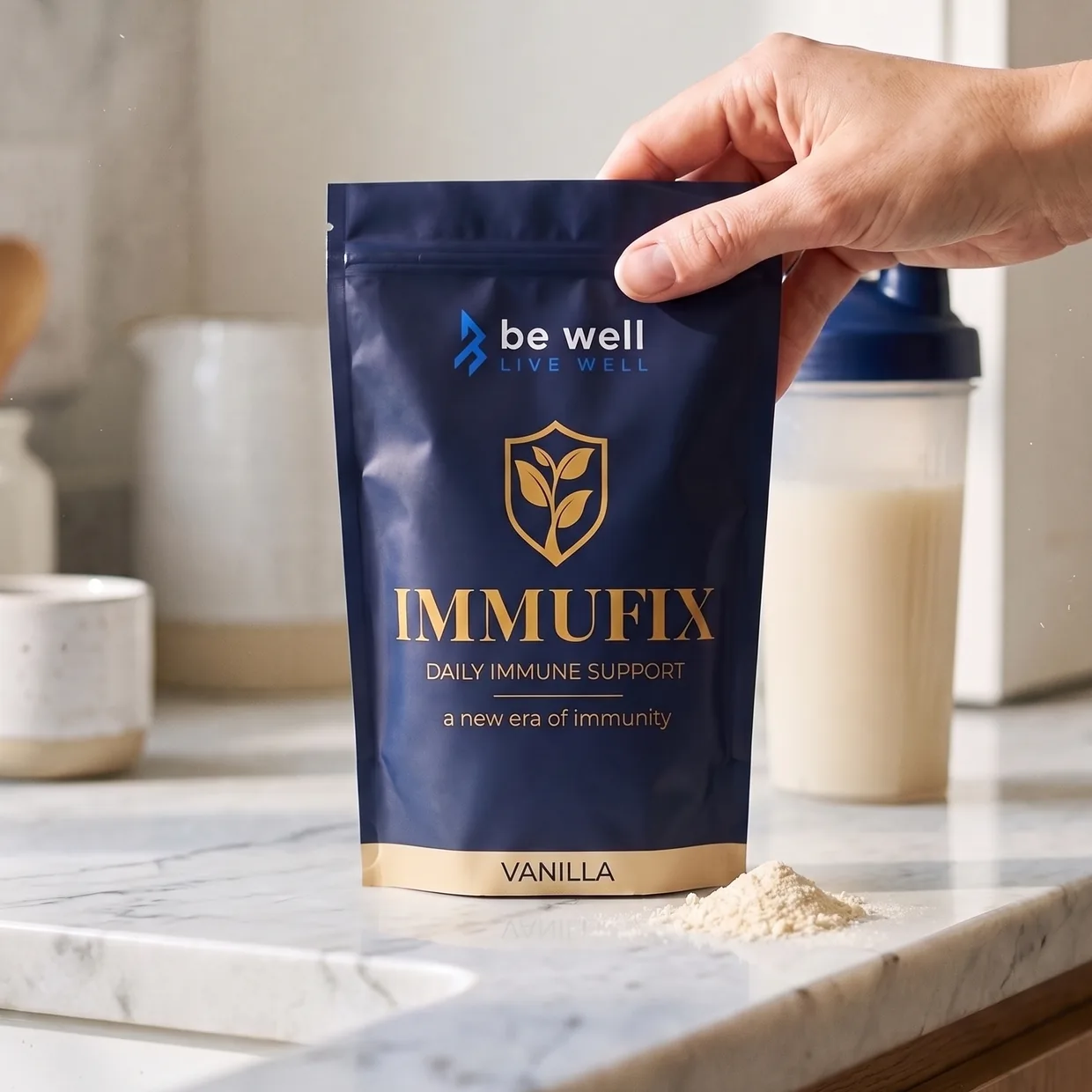
Immufix is one 25g scoop in around 200ml of water, once a day. A pouch travels, so the morning scoop can come with you to family and keep one part of the day the same wherever you wake up. It sits alongside the food on the table, not in place of it. B vitamins and magnesium contribute to normal energy-yielding metabolism and to the reduction of tiredness and fatigue. Magnesium also contributes to normal muscle function. Every ingredient and amount is on the science page.
The short version.
- Keep a few anchors, not every habit: wake-up time, daily movement, regular meals and a drinks plan.
- Activity can come in bouts of any length. A daylight walk, a festive parkrun or ten minutes of bodyweight exercise all count.
- On 21 December London has about 7 hours 50 minutes of daylight, so walk early in the afternoon.
- Balance food over the week, as the Eatwell Guide suggests, and count the vegetables at Christmas dinner.
- The NHS low-risk guideline is no more than 14 units a week, spread over 3 or more days. A bottle of wine is 10.
Food supplements should not be used as a substitute for a varied, balanced diet and a healthy lifestyle. If you have a medical condition, are pregnant, breastfeeding or taking medication, speak to your GP or pharmacist before taking any food supplement.

Daily Immune Support
Vitamins, minerals and plant nutrients in one daily scoop. The formula Paula Radcliffe has taken every day since 1998.
4.8 out of 5 · 89 reviewsDispatched the same day on weekday orders placed before 2pm.
Free standard UK delivery. Royal Mail 48 tracked, 2 to 3 working days. UK addresses only.
30‑day money-back guarantee. Try your first pouch of IMMUFIX for up to 30 days. If it’s not for you, we’ll refund your first qualifying pouch, less £10 shipping and handling. First purchase only. T&Cs apply.
Checkout completes securely on immufix.com
More from the journal.
The clocks go forward on Sunday 28 March 2027.
The UK clocks go forward at 1am on Sunday 28 March 2027. What changes, how much lighter the evenings get city by city, and how to handle the lost hour.
10 October 2026 · 6 min read
Your 5 A Day in the winter months.
NHS 5 A Day portion sizes explained: 80g of fruit or veg, 30g dried, 150ml juice. What counts in winter, including frozen, tinned and soup, and a sample day.
10 October 2026 · 6 min read
A new year routine that lasts past January.
How to build a new year routine that lasts past January: small goals tied to a daily cue, what UK guidelines suggest, and how long a habit really takes.
10 October 2026 · 7 min read